

A good dive light is essential for night diving. It illuminates the reef, helps you communicate with your buddy and reveals all the weird and wonderful marine life that emerges after dark.
Once you’ve got the hang of your dive torch, you’ll often find yourself reaching for it on daytime dives too — peering into dark cracks and crevices in search of hidden critters, exploring wrecks or bringing color back on deeper dives.
However (!)… choosing the best dive light (AKA dive torch) isn’t simply a case of finding the brightest one. Torches vary enormously in lumens (brightness), beam width, battery life, controls and weight — from tiny backup lights to hefty primary torches that look like they could double up as a melee weapon.
Hi! I’m Alex, founder of Diving Squad and a scuba instructor based in the Philippines. I’ve been diving with torches for years and have guided countless night dives — including taking plenty of nervous first-timers into the darkness and watching them emerge 45 minutes later completely obsessed with night diving.
For this guide, I’ve narrowed things down to 10 of the best dive lights, ranging from dirt-cheap backup torches to powerful primary lights and specialist models costing several hundred dollars. There are also some more unusual options, including UV lights for fluoro diving and even dive lights with laser pointers for highlighting marine life.
Enough pre-dive briefing — here are my Quick Picks! 🔦🤿 Or dive down deeper for my detailed reviews of all 10 dive lights.
⚡ 🤿 🔦 Quick Picks
🏆 1) Best Dive Light Overall — OrcaTorch D710 ($$)
My favorite all-rounder, combining 3,000 lumens, four useful brightness levels, a focused 6° beam and excellent build quality in a compact package. For around $160, it’s the dive light I’d recommend to most recreational divers.
👉 Read Review ↓ | 🛒 Check Price
🤑 2) Cheapest — HECLOUD 3000LM ($)
At under $30, this is ridiculously cheap for a 3,000-lumen rechargeable dive light. Its 100 ft (30 m) depth rating is limiting, but it’s a surprisingly capable option for shallow recreational and night diving.
👉 Read Review ↓ | 🛒 Check Price
💰 3) Best Value — PFSN DF30PRO ($)
Spend only around $10 more than the HECLOUD and you get 3,000 lumens, excellent battery life, a 492 ft (150 m) depth rating, battery indicator and lock function. A lot of dive light for around $40.
👉 Read Review ↓ | 🛒 Check Price
😎 4) Most Stylish Budget Option — WINDFIRE TS08 / DM06 ($)
Available in several colors and two slightly different designs, these look considerably more interesting than your average black torch. Better still, they deliver an impressive 5,000 lumens for around $40.
👉 Read Review ↓ | 🛒 Check Price
🛟 5) Best Backup — Sofirn SD08 ($)
Tiny enough to carry as a backup without getting in your way, but still packing 3,200 lumens and a 328 ft (100 m) depth rating. Its clever 360° RGB positioning light also makes you easier for buddies to spot in the dark.
👉 Read Review ↓ | 🛒 Check Price
🪸 6) Best for Fluoro Diving — OrcaTorch D530-UV ($$)
A specialist 395nm UV dive light that reveals spectacular fluorescent colors in certain corals and marine life that you simply won’t see with a normal white torch. A seriously cool addition once you’ve experienced regular night diving.
👉 Read Review ↓ | 🛒 Check Price
☀️ 7) Brightest — Wurkkos DL70 — $$
An absolute monster pumping out 13,000 lumens, making it easily the brightest light here. Four brightness levels mean you can thankfully turn it down when you don’t need the underwater equivalent of a car headlight.
👉 Read Review ↓ | 🛒 Check Price
🤿 8) Best for Diving Instructors & Dive Masters — OrcaTorch D570-GL — $$
Combines a capable 1,500-lumen dive light with a built-in green laser pointer. As a dive guide, I’ve found this kind of setup incredibly useful for showing an entire group exactly where that tiny nudibranch or camouflaged critter is hiding.
👉 Read Review ↓ | 🛒 Check Price
🌊 9) Widest Beam — AKISONG 6000 — $$$
Combines a huge 75° flood with a focused 15° central spot and 6,000 lumens, illuminating an enormous area without completely sacrificing distance. Big and heavy, but seriously impressive for reefs, wrecks and large underwater spaces.
👉 Read Review ↓ | 🛒 Check Price
👑 10) Premium Pick — OrcaTorch D630 V2.0 — $$$
A completely different beast: a technical canister light with a gear-mounted battery, Goodman handle and adjustable cable setup. Huge battery capacity, a focused beam and hands-free operation make it ideal for serious cave, wreck and technical diving.
👉 Read Review ↓ | 🛒 Check Price
🤓 Not sure what all the dive light specs mean?
Dive down to the Dive Light Buying Guide & Terminology ↓ for simple explanations of lumens, beam angles, runtime, batteries, depth ratings, primary vs backup lights and more.

Ahoy! I’m Alex — a PADI Scuba Diving Instructor and the creator of Diving Squad. I started this blog back in early 2019, during a five-year odyssey spent drifting through Southeast Asia, Central America and beyond. In 2023, I landed in Panglao, Philippines — and liked it so much I never really left. I’ve been based here ever since, diving, teaching and continuing to build Diving Squad. When I’m not underwater, I’m usually editing dive footage, plotting the next questionable adventure or cruising around on my bike — but never for long before the reefs pull me back.
🐙 👀🔦🌙 My Reviews of the Best Dive Lights
🏆 🔦 1) Best Dive Light Overall: OrcaTorch D710 ($$)
⭐ Quick Verdict
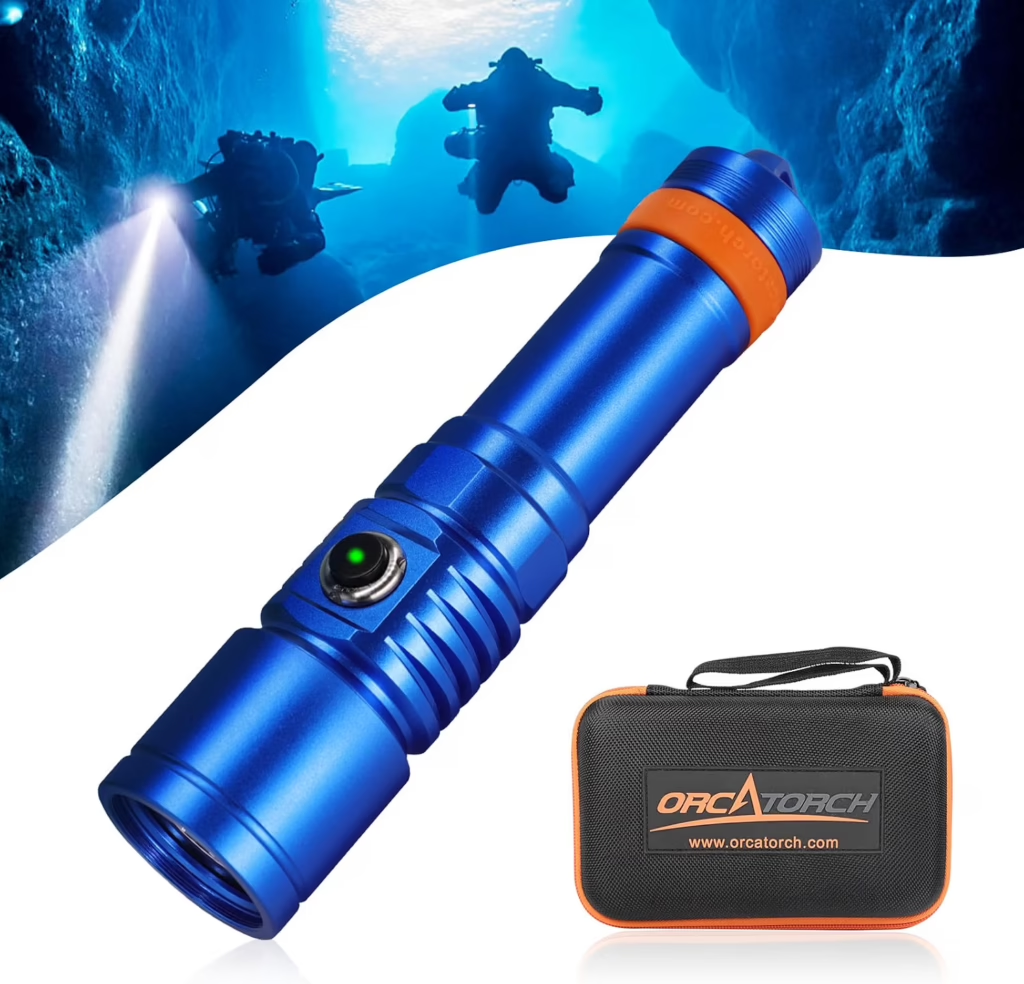
I’ve been using OrcaTorch dive lights for years, and the D710 is one of my favorites. For around $160, this model hits an awesome sweet spot between power, size, runtime, quality and usability — making it the dive light I’d recommend to most recreational divers.
The D710 packs serious power into a surprisingly compact package, with four brightness levels: 3,000-lumen Turbo, 1,700 High, 800 Medium and 400 Low. A simple side button cycles through the regular settings, while holding it activates Turbo for short bursts of maximum power.
That range is a big part of why I like it as an all-rounder. You’ve got serious power when you need it, but on a normal night dive you can drop the brightness when viewing marine life up close or communicating with other divers — and there are no unnecessary strobe modes to cycle through.
Its tight 6° beam is great for cutting through darkness, searching cracks and crevices and showing cool marine life to other divers. It’s rated to 492 ft (150 m) — vastly deeper than recreational divers need.
Power comes from a rechargeable 21700 battery with USB-C charging, delivering up to 7 hours 40 minutes on Low. There’s also a battery indicator and lock function to prevent accidental activation.
The Amazon package includes a storage case, lanyard and spare O-rings, which is handy for travel. And it looks pretty damn good! Choose from black, green, red, pink or blue — considerably more personality than your standard black dive torch.
What ultimately makes the D710 my Top Pick is balance. Some lights further down this guide are cheaper, brighter or more specialized, but the D710 does pretty much everything I want from a primary recreational dive light without becoming enormous or ridiculously expensive.
👍 Best For
- 🏅🔦 Divers wanting the best all-round dive light
- 🌙🚤 Night diving, wreck diving & deeper dives
- 🐙🔍 Searching cracks and crevices for hidden marine life
- 👋🔦 Communicating and pointing things out to other divers
- ✈️🤏 Traveling divers wanting serious power without a bulky torch
📌 Key Specs
- ☀️ Maximum output: 3,000 lumens
- 🎛️ Brightness levels: 4 — 3,000 / 1,700 / 800 / 400 lumens
- 🔦 Beam angle: 6°
- 🌊 Depth rating: 492 ft (150 m)
- 🔋 Battery: Rechargeable 21700
- 🔌 Charging: USB-C
- ⏱️ Max runtime: Approx. 7 hrs 40 mins
- 🎨 Colors: Black, green, red, pink or blue
- 🚫 Strobe: None
- ⚖️ Weight: 7.9 oz (225 g) with battery
- 📏 Length: 6.1 inches (15.5 cm)
⭐ Bottom Line
The OrcaTorch D710 isn’t my Top Pick because of any single crazy specification — it’s because it gets almost everything right.
You get serious power, useful lower settings, good runtime and a compact, stylish design at a reasonable mid-range price. For someone who wants one excellent dive light that can handle almost everything, this is my pick.
🤑 💡 2) Cheapest Dive Light: HECLOUD ($)
⭐ Quick Verdict
The HECLOUD is the cheapest dive light on this list and exceptionally cheap at under $30 — yet it still offers surprisingly good value. You get a claimed 3,000-lumen maximum output, three lighting modes, rechargeable battery and a tough aluminum-alloy body rated to 100 ft (30 m).
I’ll be honest with you: this ain’t going to feel like a $160 OrcaTorch for under $30. But what still impresses me is simply how much usable dive light you’re getting for so little money; one that does the job and offers the sort of headline power you’d normally expect from considerably more expensive models.
There are three modes — High, Low and Strobe. High delivers the full claimed 3,000 lumens, Low conserves battery for longer dives, while Strobe doubles as an emergency signalling light if you need to attract attention.
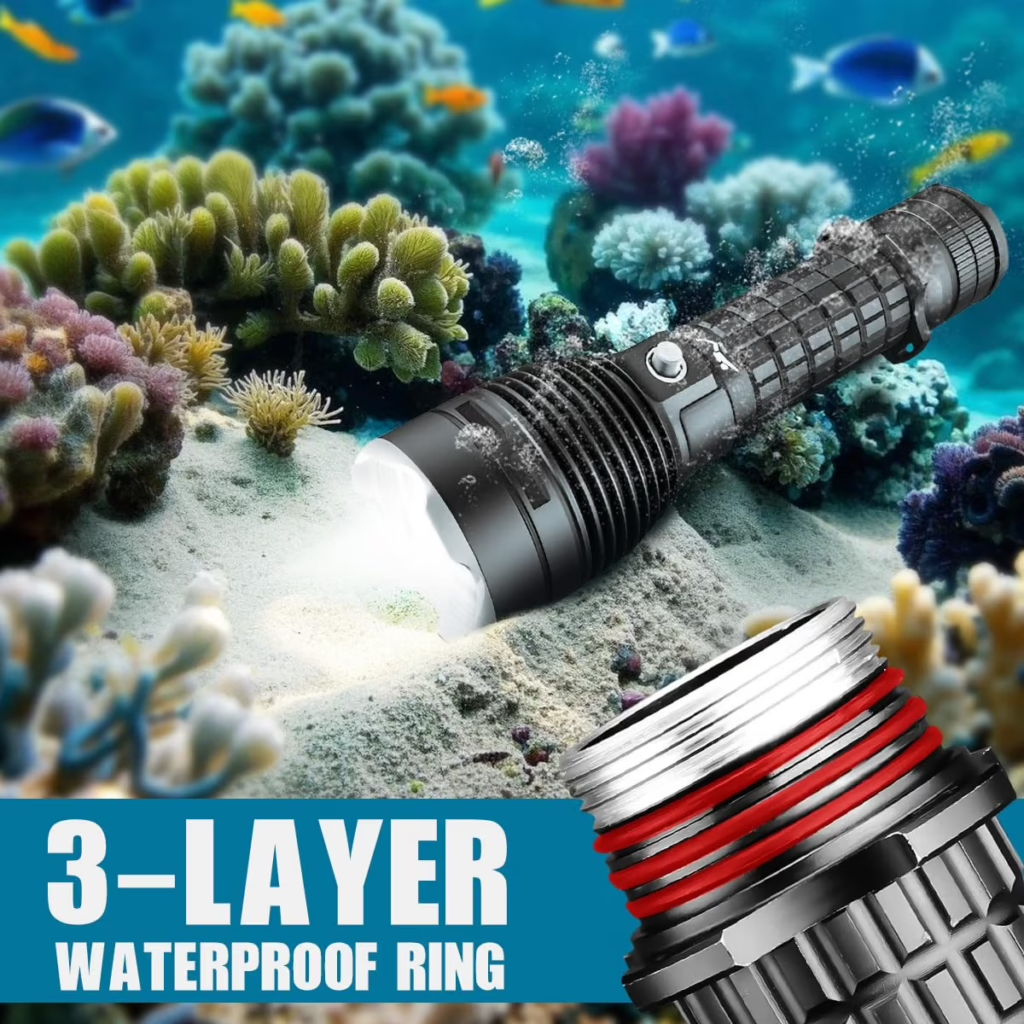
It’s also surprisingly substantial for such a cheap torch. The Hecloud 3000lm has a rugged hard-anodized aluminum-alloy body designed to resist wear, corrosion and scratching rather than feeling like a flimsy emergency light.
I will say that, at around 7.1 inches long and 1 lb (450 g), it’s also fairly substantial — roughly twice the weight of some options in this guide. It’s still perfectly manageable overall, but definitely not the lightest or most travel-friendly dive torch.
The main compromise is its 100 ft (30 m) depth rating. Advanced divers sometimes exceed 100 ft, so I wouldn’t choose this for deeper diving. However, night dives are often relatively shallow — commonly around 60 ft (18 m) or less — so that limit should be perfectly adequate for many recreational night dives.
Ultimately, the HECLOUD 3000lm gets the essentials right for remarkably little money. For occasional divers, anyone on a tight budget or someone wanting an inexpensive extra torch in their dive bag, it’s a great option.
👍 Best For
- 🤑💡 Divers wanting the cheapest dive light on this list
- 🌙🚤 Recreational night dives within its 100 ft depth limit
- 🐠🔍 Searching cracks and crevices
- 🎒💡 Keeping an inexpensive extra light in your dive bag
- 🚨👋 Emergency signaling with the Strobe mode
📌 Key Specs
- ☀️ Maximum output: Claimed 3,000 lumens
- 🎛️ Modes: 3 — High / Low / Strobe
- 🚨 Strobe: Emergency signaling
- 🌊 Depth rating: 100 ft (30 m)
- 🔋 Battery: Rechargeable
- 🧲 Controls: Magnetic switch
- ⚖️ Weight: Approx. 1 lb (450 g)
- 📏 Length: Approx. 7.1 inches (18 cm)
⭐ Bottom Line
For under $30, the HECLOUD gives you an impressive amount of dive light for your money.
The 100 ft depth rating is its biggest limitation, so deeper or more demanding divers should look elsewhere. But for typical recreational night dives, occasional use or a cheap extra torch, it covers the essentials at an exceptionally low price.
💵 🔦 3) Best Value for Money: PFSN DF30PRO ($)
⭐ Quick Verdict
Make no mistake — the PFSN is still a cheap dive light. But for only around $10 more than the HECLOUD above, it feels like a sensible step up: you get the same claimed 3,000-lumen output alongside a much deeper 492 ft (150 m) rating, smaller and lighter design, excellent battery life and a few useful extra features.
Like the HECLOUD, the PFSN puts out a claimed 3,000 lumens, so you’re not spending the extra money for more brightness. You’re getting a better overall package while remaining firmly in budget territory.
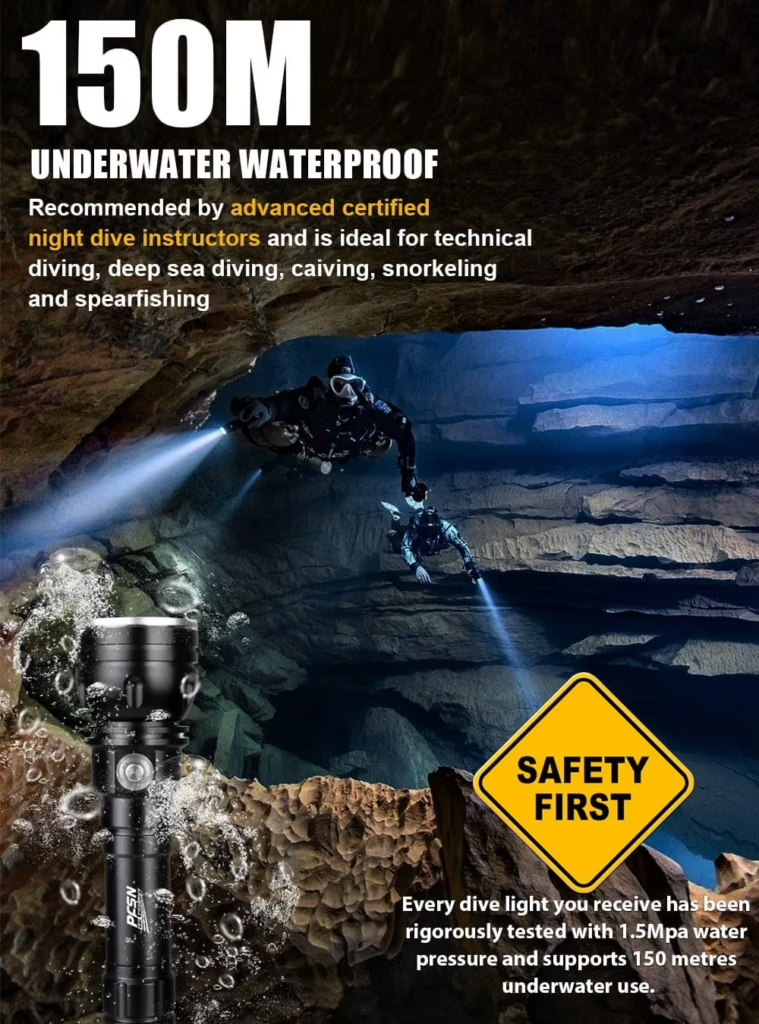
The biggest upgrade is depth. It’s rated to 492 ft (150 m) versus just 100 ft (30 m) for the HECLOUD. That’s far beyond recreational diving depths, so there’s considerably more headroom.
It’s also smaller and lighter, measuring around 6.6 inches long and weighing 10.7 oz (303 g). That’s a nice improvement if you’re traveling or simply don’t want a chunky torch hanging from your BCD.
Its 4800mAh rechargeable battery is rated for around 4 hours on High and 20+ hours on Low, while a battery-level indicator lets you see how much power you’ve got left.
You still get three modes — High, Low and SOS — plus a lockable switch, which helps prevent the torch accidentally switching on inside your dive bag.
So yes, this is still a cheap dive light — just a noticeable step up from buying the absolute cheapest option. For only a little extra money, I think the improvements easily justify the difference.
👍 Best For
- 💵⬆️ Budget divers willing to spend a little extra for a better overall torch
- 🪫👀 Divers who like being able to check remaining battery at a glance
- 🔒🎒 Anyone worried about their torch accidentally switching on in their dive bag
- 🔋⏱️ Long dives and multiple dives between charges
📌 Key Specs
- ☀️ Maximum output: 3,000 lumens
- 🎛️ Modes: High / Low / SOS
- 🌊 Depth rating: 492 ft (150 m)
- 🔋 Battery: 4800mAh rechargeable
- ⏱️ Runtime: Approx. 4 hrs High / 20+ hrs Low
- 🪫 Battery indicator: Yes
- 📏 Length: 6.6 inches
- ⚖️ Weight: 10.7 oz (303 g)
- 🔒 Switch lock: Yes
⭐ Bottom Line
The PFSN is still very much a budget dive light — but it’s what I’d buy if I could stretch slightly beyond the absolute cheapest option.
For around $10 extra, you’re getting a much deeper rating, smaller and lighter design, known battery performance and some useful quality-of-life features. That’s enough to make the PFSN my Best Value for Money pick.
😎 🔦 4) Most Stylish Budget Option: WINDFIRE TS08 / DM06 ($)
⭐ Quick Verdict
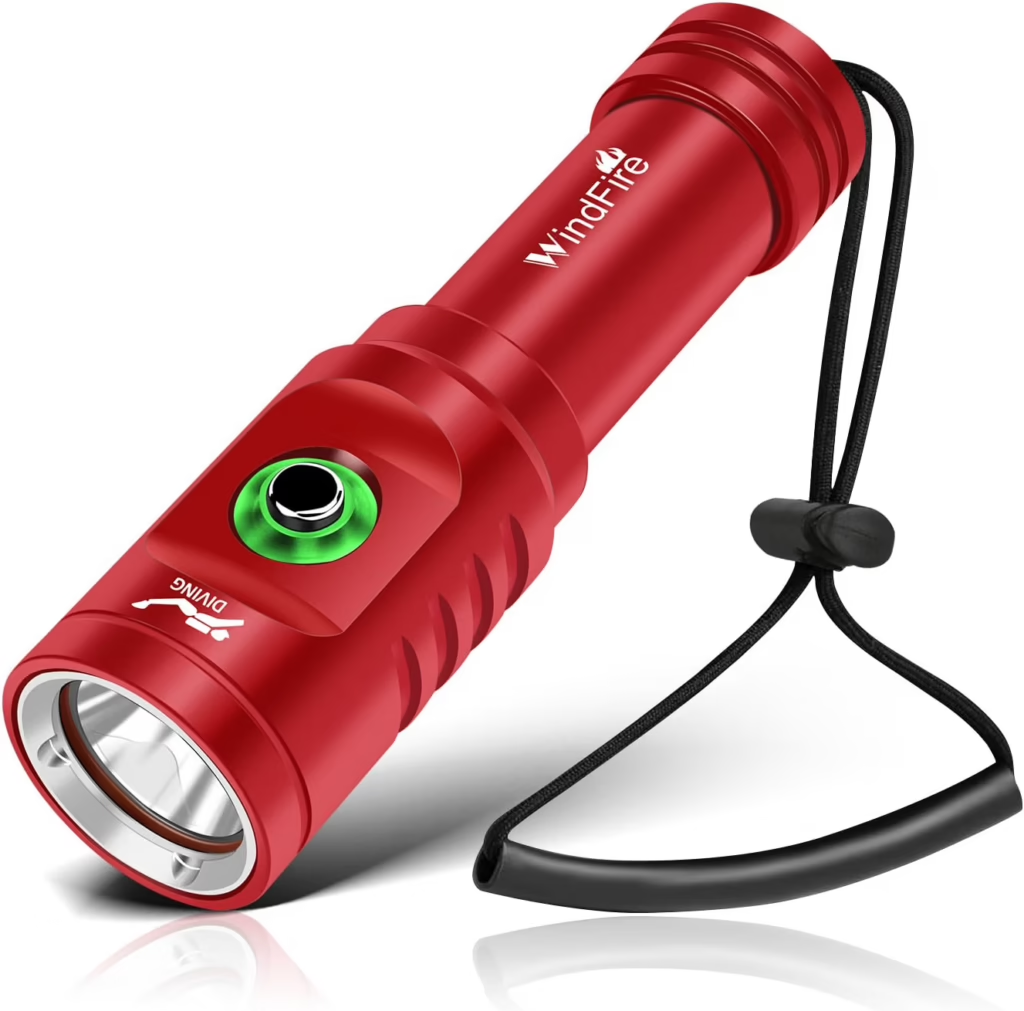
Most cheap dive lights are big, black and purely functional. WINDFIRE gives you something considerably more stylish, with red, light blue, black, black & green and purple options across two very similar designs — the TS08 and DM06. They also feel surprisingly good quality for the price and pump out an impressive 5,000 lumens, all for around $40.
There are actually two very similar versions on the same Amazon listing: the TS08 and DM06. Their core diving specs are extremely similar, so I’ve grouped them together here — just choose whichever design and color you prefer.
And these aren’t just pretty torches. 5,000 lumens is seriously impressive at this price, giving them considerably more headline power than the two cheaper lights above. You also get three modes — High, Low and SOS — so you can tone things down when full power isn’t necessary or use SOS for emergency signaling.
Both have a particularly useful battery indicator around the power button. It changes from green to orange to red as the battery runs down, so you can check your remaining power before jumping in rather than guessing whether you’ve got enough juice for another night dive.
They’re powered by a removable rechargeable battery. Unscrew the tail cap, remove the battery and charge it using the supplied USB charger; a full charge takes around 5.5 hours. You also get a lanyard, spare O-rings and a storage box.
The two designs are slightly different. The TS08 is longer and slimmer at around 5.6 inches (14.2 cm) and 6 oz (168 g), while the DM06 is shorter and lighter at around 5 inches (12.8 cm) and 4.2 oz (120 g). Both are compact dive lights with tough aluminum bodies that feel surprisingly substantial and good quality considering the price.
Finally, both are rated to 197 ft (60 m), comfortably covering recreational scuba depths. So you’re not sacrificing diving capability for style — if anything, with 5,000 lumens, these are actually more powerful than the two cheaper lights above.
👍 Best For
- 😎🎨 Divers wanting a cheap dive light that actually looks good
- 🌈🔦 Anyone wanting a choice of colors and body styles
- 💰☀️ Getting an impressive 5,000 lumens without spending much
- 🔋👀 Anyone who likes being able to check battery level at a glance
- 🤏🎒 Divers who prefer a relatively lightweight torch
📌 Key Specs
- ☀️ Maximum output: 5,000 lumens
- 🎛️ Modes: High / Low / SOS
- 🌊 Depth rating: 197 ft (60 m)
- 🔋 Battery: Removable rechargeable battery
- 🔌 Charging: Supplied USB battery charger
- ⏱️ Charging time: Approx. 5.5 hours
- 🪫 Battery indicator: Green / Orange / Red
- 📏 Length: TS08 — 5.6 in (14.2 cm) / DM06 — 5.0 in (12.8 cm)
- ⚖️ Weight: TS08 — 6 oz (168 g) / DM06 — 4.2 oz (120 g)
- 🔩 Body: Aluminum
⭐ Bottom Line
The WINDFIRE TS08 and DM06 prove that a cheap dive light doesn’t have to look cheap.
They’re very similar in actual diving performance, so I wouldn’t overthink which one to buy. Pick the design and color you prefer and you’re getting a good-quality, compact aluminum dive light with an impressive 5,000 lumens, three useful modes and a proper battery indicator for around $40.
If you want an affordable dive torch with a little more personality than the usual black tube, this is my pick.
🛟 🔦 5) Best Backup: Sofirn SD08 ($)
⭐ Quick Verdict
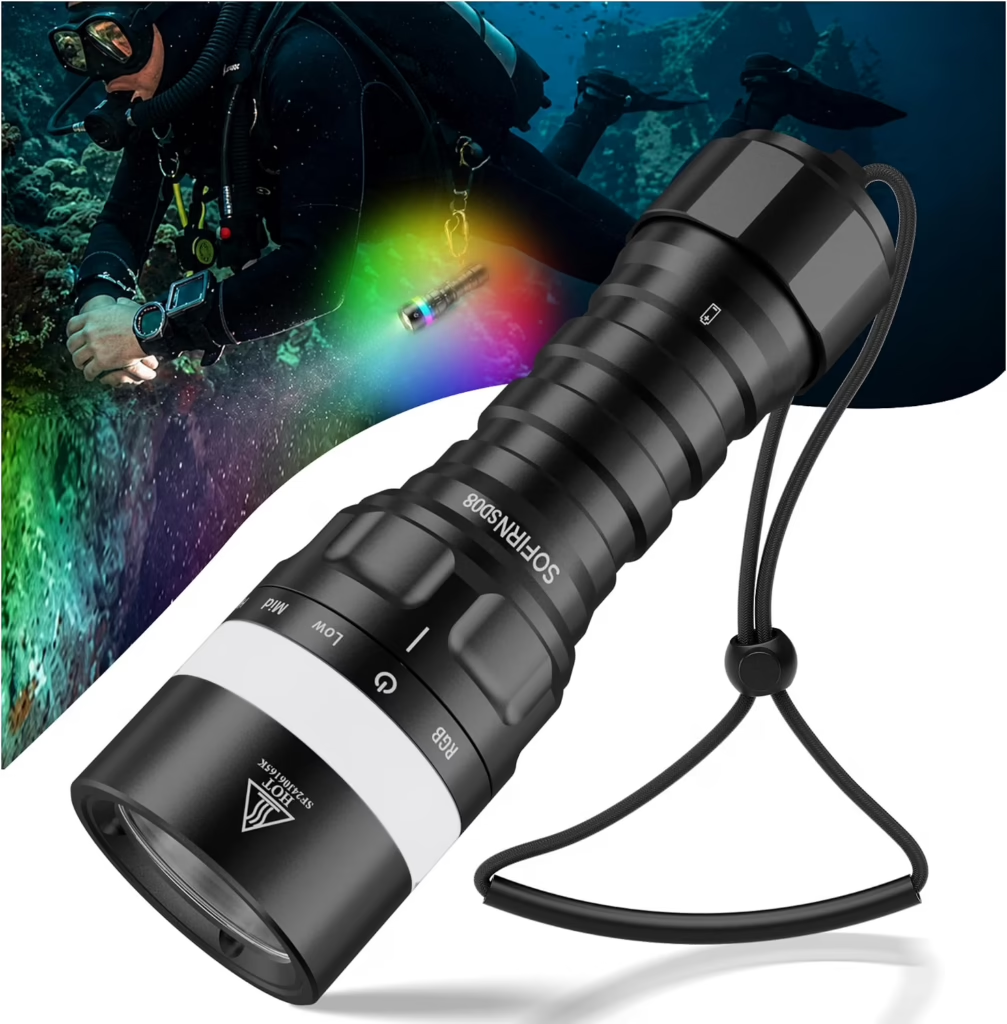
A good backup light should be small enough that you barely notice you’re carrying it, but powerful enough that you’d actually trust it if your primary torch failed. The Sofirn SD08 nails that balance, packing 3,200 lumens, three brightness levels and a 328 ft (100 m) depth rating into a tiny 4.9-inch body. It also has a brilliant 360° RGB positioning light that makes you easier for your buddies to spot in the dark. Awesomeness!
This is a really nice little dive light. At just 4.9 inches (12.4 cm) long and 4.5 oz (127 g) without the battery, it’s compact enough to clip onto your BCD and forget about until you need it. Yet there’s still some serious power inside.
You get three brightness levels — 3,200, 1,000 and 300 lumens — controlled using a simple magnetic rotary switch. Low runs for around 7.25 hours, Medium for 2.75 hours, while High gives you a burst of maximum power before stepping down to prevent overheating.
But my favorite feature is the 360° RGB positioning ring. Thirty small colored LEDs surround the head and remain illuminated while you’re using the torch, making your position much easier for buddies to identify underwater. The RGB light itself can run for up to 30 hours. That’s genuinely useful on night dives and a clever feature for a backup light.
It’s also rated to an impressive 328 ft (100 m) and built from tough aluminum alloy. Power comes from a removable 5000mAh 21700 rechargeable battery, with a USB-C charging cable included.
For around $40, there’s an awful lot packed into this little torch. You could comfortably use the SD08 as a primary recreational dive light, but its compact dimensions, long Low-mode runtime and RGB positioning system make it particularly well suited to backup duty.
👍 Best For
- 🛟🔦 Divers wanting a capable backup light they can carry on every dive
- 🤏🎒 Keeping a powerful spare without adding much bulk to your gear
- 🌈👥 Making yourself easier for your buddy to locate during night dives
- 🔋⏱️ Having plenty of emergency runtime on a lower brightness setting
- 🌊⬇️ Divers wanting a backup with a serious 328 ft depth rating
📌 Key Specs
- ☀️ Maximum output: 3,200 lumens
- 🎛️ Brightness levels: 3,200 / 1,000 / 300 lumens
- 🌈 Positioning light: 360° RGB / 30 LEDs
- 🌊 Depth rating: 328 ft (100 m)
- 🔦 Maximum beam distance: 385 m
- 🔋 Battery: Removable 5000mAh 21700
- 🔌 Charging: USB-C cable included
- ⏱️ Runtime: 7.25 hrs Low / 2.75 hrs Medium
- 📏 Length: 4.9 in (12.4 cm)
- ⚖️ Weight: 4.5 oz (127 g) without battery
⭐ Bottom Line
The Sofirn SD08 is exactly what I want from a backup dive light: small, powerful, simple and capable enough that I’d actually be happy relying on it if my primary torch died.
The 360° RGB positioning ring is the icing on the cake, giving your buddy another easy way to keep track of you in darkness. And at around $40, this is a seriously impressive little dive light for the money.
🪸 🟣 6) Best for Fluoro Diving: OrcaTorch D530-UV ($$)
⭐ Quick Verdict
I’ve used OrcaTorch dive lights a lot over the years and have always found them to be great-quality, reliable torches. The D530 is one of their more unusual models, available in UV, Red, Cold White and Neutral White versions.
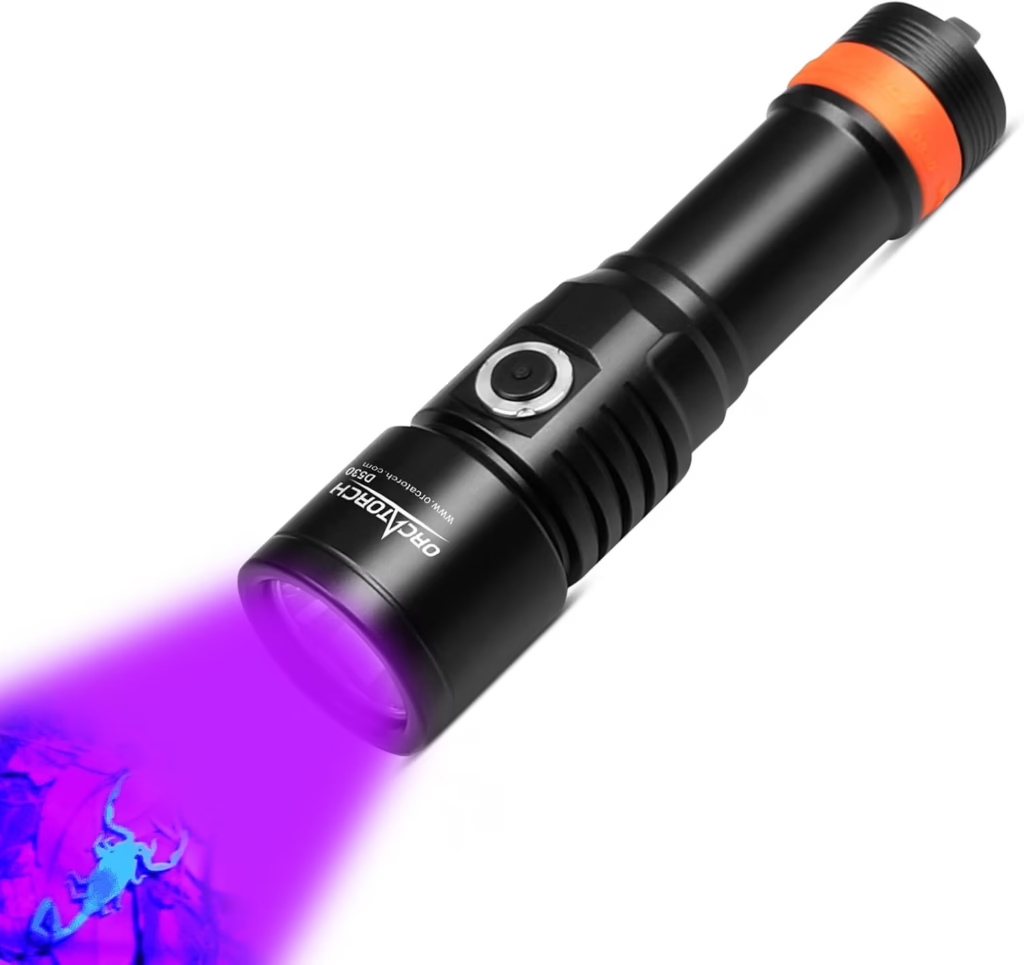
My pick here is the D530-UV, which uses 395 nm ultraviolet light to reveal fluorescent colors in corals and marine life that are normally invisible to us.
Fluoro diving is night diving with UV light that causes certain corals and marine organisms to fluoresce — absorbing the light and re-emitting it as vivid greens, oranges, reds and other colors that appear to glow against the darkness.
The D530-UV is purpose-built for this, using a 395 nm UV LED with a tight 6° beam. It has two brightness levels — literally 5 and 2 lumens — with runtimes of around 3.5 and 7.5 hours. Don’t compare those tiny numbers with a normal white dive light though: UV is doing a completely different job, exciting fluorescence rather than illuminating the reef with visible white light.
There are also Red, Cold White and Neutral White versions. These are separate torches with different purposes and aren’t for fluoro diving. Red can be useful for observing some nocturnal marine life, while Cold and Neutral White work as conventional dive lights.
Whichever version you choose, you get proper OrcaTorch construction: hard-anodized aluminum, titanium-alloy switch, battery indicator, lock function and a huge 492 ft (150 m) depth rating. It’s also compact at 5.6 inches (14.2 cm) and powered by a rechargeable 18650 battery.
Just remember: the UV version complements your normal white dive light rather than replacing it. Use your regular torch for navigating, then switch to UV when you want to watch the reef transform.
👍 Best For
- 🪸🟣 Divers wanting to experience fluorescent night diving
- 🌈🐠 Revealing colors invisible under normal white light
- 📸✨ Underwater photographers experimenting with fluorescence
- 🔴🦐 Divers considering the Red version for nocturnal marine life
- 🎨🔦 Any diver seeking a specialist dive light
📌 Key Specs
- 🟣 UV wavelength: 395 nm
- ☀️ Brightness: 5 / 2 lumens (UV Purple)
- 🔦 Beam angle: 6°
- 🌊 Depth rating: 492 ft (150 m)
- 🔋 Battery: Rechargeable 18650
- ⏱️ Runtime: Approx. 3.5 hrs High / 7.5 hrs Low
- 📏 Length: 5.6 in (14.2 cm)
- ⚖️ Weight: Approx. 5.3 oz (150 g) without battery
- 🪫 Battery indicator: Yes
- 🔒 Lock function: Yes
- 🎨 Available versions: UV / Red / Cold White / Neutral White
⭐ Bottom Line
The D530-UV is a specialist tool for seeing something your everyday dive light simply can’t show you.
If you’ve already done normal night dives and want to experience the reef in an entirely different way, fluoro diving is seriously cool. Just make sure you choose the UV version — the Red and White versions are great specialist alternatives, but they’re designed for different purposes.
☀️ 🔦 7) Brightest: Wurkkos DL70 ($$)
⭐ Quick Verdict
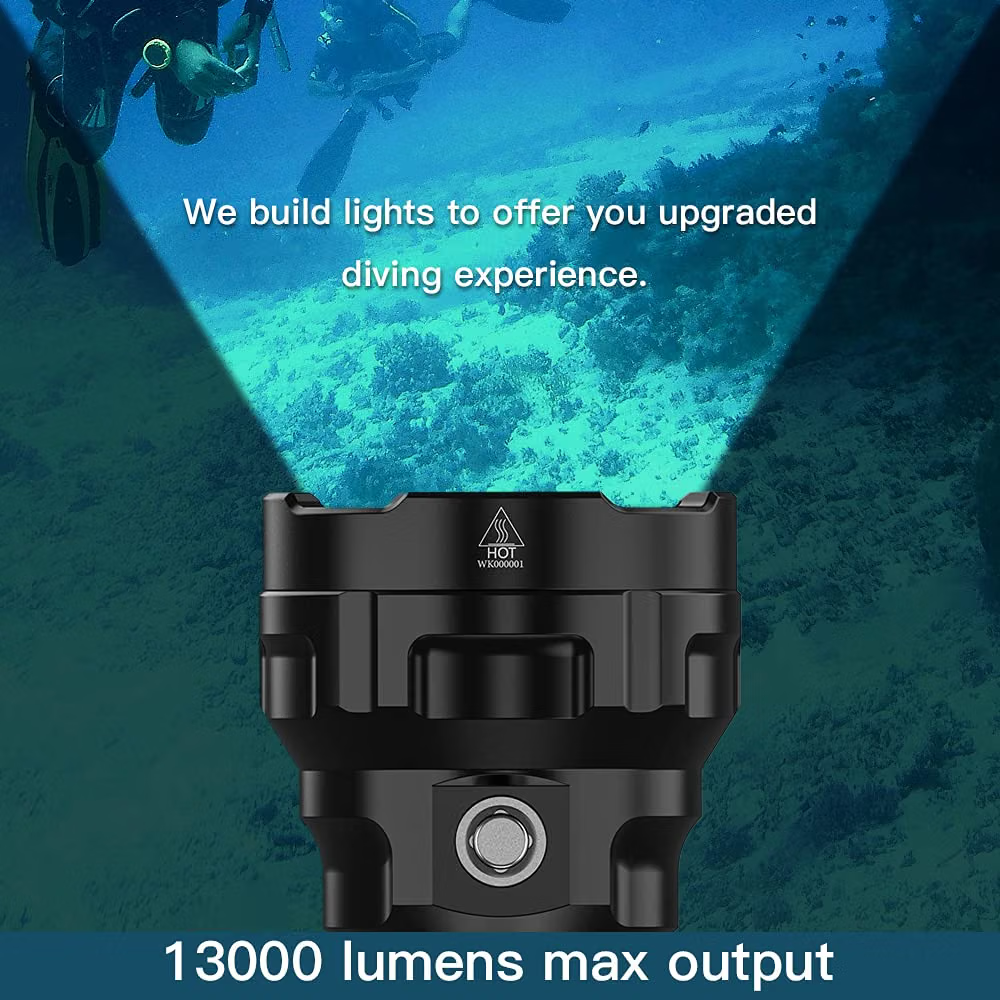
If maximum brightness is what you’re after, the Wurkkos DL70 is an absolute monster. Its 13,000-lumen Turbo mode makes it by far the brightest dive light on this list, backed up by three genuinely useful lower settings and a combined spot-and-flood beam. For around $100, that’s a serious amount of underwater firepower.
The headline feature is obviously those 13,000 lumens, produced by four powerful LEDs. That’s serious illumination for night dives, large wrecks and lighting up big areas of open water.
Now, let’s be clear: no recreational diver actually needs 13,000 lumens for a normal night dive. In fact, that much light can be complete overkill when you’re looking at marine life up close.
But there are times when huge output is useful — lighting up large wrecks, illuminating big areas of open water or simply seeing as much of your surroundings as possible. Because the DL70 drops down to 4,000, 1,300 and 450 lumens, you’re not stuck blasting the reef with the underwater equivalent of a car headlight. And when you do want ridiculous amounts of light at your disposal, this is absolutely the dive light for it.
The beam is interesting too. Rather than being purely narrow or wide, it combines a 15° central spot with a much wider 49° flood, giving you both distance and plenty of peripheral illumination.
All that power requires a fairly substantial torch. The DL70 is 8.2 inches (20.9 cm) long and weighs 13.9 oz (395 g) without batteries, making it noticeably bigger and heavier than most lights we’ve looked at so far.
It’s powered by two rechargeable 5000mAh 26650 batteries, with runtimes ranging from around 2 hours on Turbo to more than 18 hours on Low. There’s also a magnetic side switch, mode memory and low-battery warning. Finally, its tough aluminum body is rated to 328 ft (100 m) — more than enough for recreational scuba and plenty of technical diving too.
👍 Best For
- ☀️🤿 Divers who want enormous maximum brightness
- 🚢🔦 Lighting up large wrecks and underwater spaces
- 🌊👀 Illuminating large areas rather than just a narrow spot
- 🔆⬇️ Huge power with useful lower settings when you don’t need it
- 🔋🌙 Long runtimes when using the lower brightness levels
📌 Key Specs
- ☀️ Maximum brightness: 13,000 lumens
- 🔆 Brightness levels: 13,000 / 4,000 / 1,300 / 450 lumens
- 🔦 Beam: 15° spot + 49° flood
- 🌊 Depth rating: 328 ft (100 m)
- 🔋 Battery: 2 × rechargeable 5000mAh 26650 batteries
- ⏱️ Runtime: Approx. 2 hrs Turbo / 18+ hrs Low
- 🪫 Low-battery warning: Yes
- 📏 Length: 8.2 in (20.9 cm)
- ⚖️ Weight: 13.9 oz (395 g) without batteries
⭐ Bottom Line
The Wurkkos DL70 wins Brightest by a ridiculous margin — but that doesn’t mean you actually need 13,000 lumens all the time.
What makes it work is the combination of massive maximum output, four useful brightness levels and a spot-and-flood beam. It’s bigger and heavier than a normal recreational torch, but if you want serious power available when you need it without spending several hundred dollars, the DL70 offers an awful lot for the money.
🤿 🟢 8) Best for Diving Instructors and Divemasters: OrcaTorch D570-GL ($$)
⭐ Quick Verdict
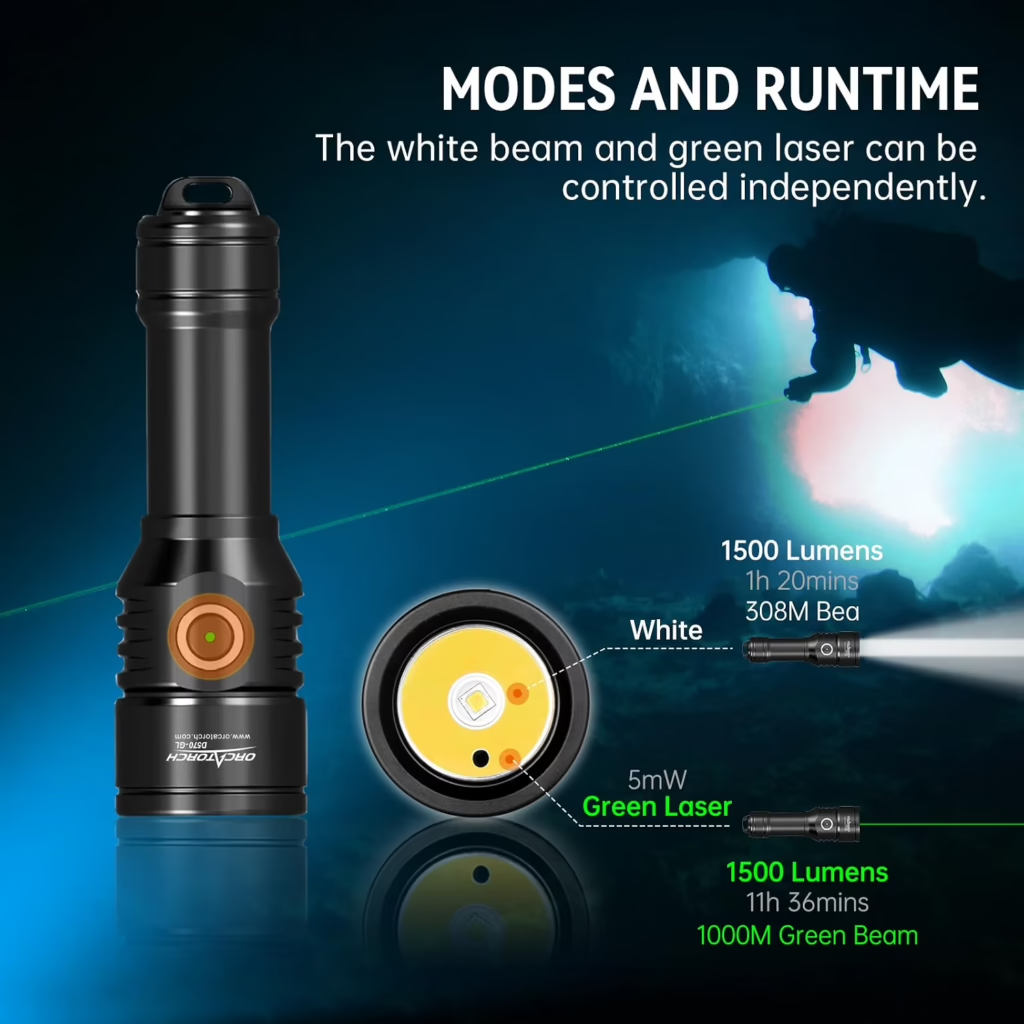
As a scuba diving instructor, I’ve found having a laser pointer underwater extremely useful — it’s honestly a bit of a game changer. OrcaTorch lets you have exactly that built straight into your dive light: the D570-GL combines a powerful 1,500-lumen white beam with a green laser pointer, letting you illuminate the dive and then instantly point out exactly what you want your divers to see.
When you’re guiding, you’re constantly showing people things underwater. With a normal torch you can circle a nudibranch, shrimp, frogfish or other tiny critter to draw everyone’s attention towards it. With a laser, you can point right beside it and show everyone exactly where to look.
I’ve found this extremely useful when guiding dives. It’s faster and more precise, particularly when you’re trying to show several divers something small or well camouflaged.
The D570-GL combines this with a proper 1,500-lumen white light and focused 8° beam. The white light and green laser can be controlled independently, so you can use either separately or both together.
It’s also surprisingly compact and light for a torch doing two jobs. At just 5.3 inches (13.4 cm) long and 6.3 oz (179 g) without the battery, it’s easy to carry without adding another bulky piece of equipment to your setup.
You also get OrcaTorch’s usual tough construction, with a hard-anodized aluminum body, battery indicator and enormous 492 ft (150 m) depth rating. Power comes from a rechargeable 3400mAh 18650 battery with USB-C charging.
Naturally, use the laser responsibly — point beside marine life, never directly at animals or other divers.
👍 Best For
- 🤿🟢 Scuba Diving Instructors and Divemasters
🐙👉 Precisely pointing out tiny or camouflaged marine life
- 🌙🔦 Combining your primary dive light and pointer in one
- 🤏🎒 Guides wanting a compact, lightweight two-in-one setup
📌 Key Specs
- ☀️ Maximum brightness: 1,500 lumens
- 🔦 White beam: 8°
- 🟢 Pointer: Green laser
- 🎛️ Controls: White light and laser independently controlled
- 🌊 Depth rating: 492 ft (150 m)
- 🔋 Battery: Rechargeable 3400mAh 18650
- 🔌 Charging: USB-C
- ⏱️ White-light runtime: Approx. 1 hr 20 mins
- 🪫 Battery indicator: Yes
- 📏 Length: 5.3 in (13.4 cm)
- ⚖️ Weight: 6.3 oz (179 g) without battery
⭐ Bottom Line
As someone who actually guides dives, I don’t see the laser as a gimmick — it’s genuinely a total game changer.
The D570-GL gives you a capable 1,500-lumen primary dive light and a precise underwater pointer in one compact package. If you regularly guide or teach divers and spend half your dives pointing out marine life, this is an incredibly useful piece of kit.
🌊 🔦 9) Widest Beam: AKISONG 6000 ($$$)
⭐ Quick Verdict
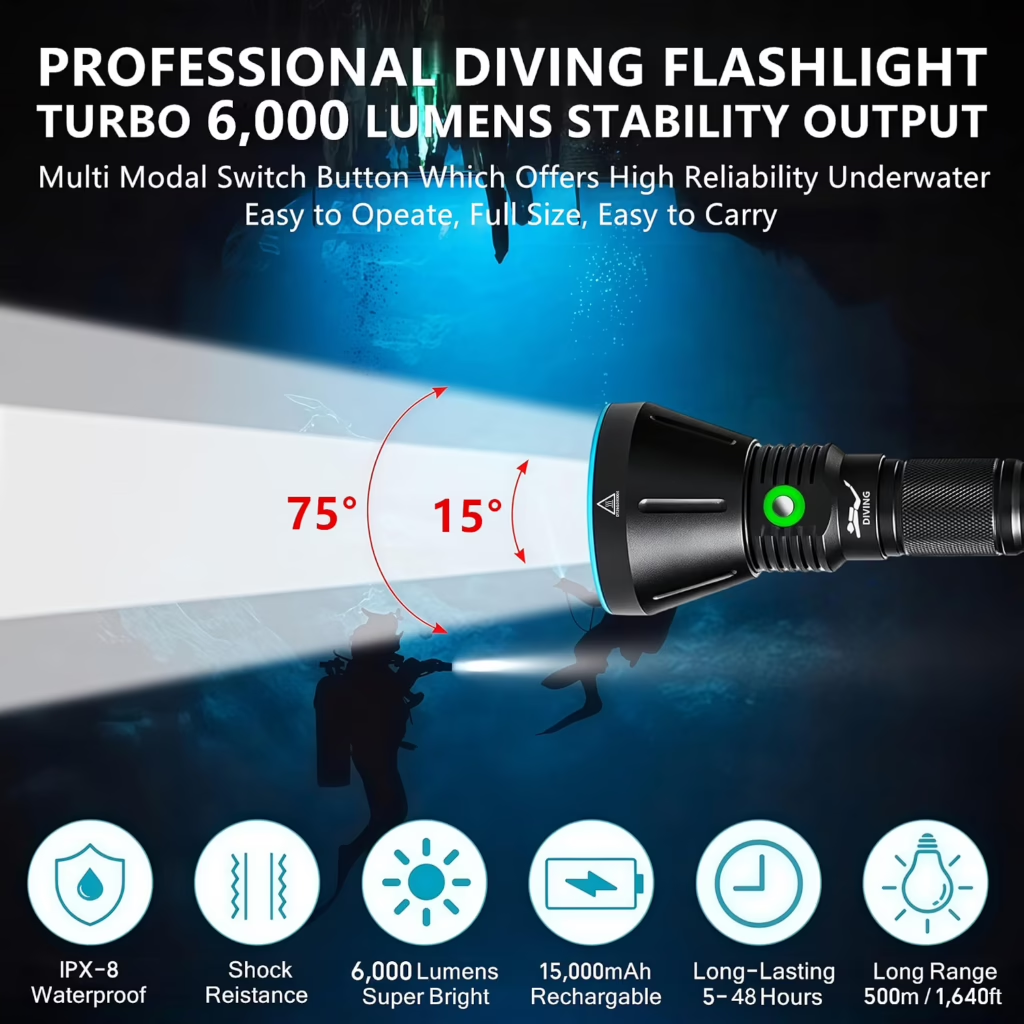
The AKISONG 6000 combines a huge 75° flood with a focused 15° central spot, illuminating far more of your surroundings than a typical dive torch. Add 6,000 lumens — making it the second-brightest light in this guide — six modes and a massive 15,000mAh battery, and this is one seriously powerful dive light.
Narrow beams are great for looking into cracks, signaling your buddy and cutting through murk, but sometimes you simply want to see more of what’s around you. That’s where the AKISONG stands out.
Its 15° central spot + 75° flood gives you a powerful hotspot surrounded by a huge field of illumination, with a maximum throw of 1,640 ft (500 m). And with 6,000 lumens, it’s the second-brightest light in this entire guide.
Thankfully, you don’t need all that power constantly. There are six modes — 100%, 50%, 25%, 5%, SOS and Strobe — so you can dramatically reduce the output for ordinary night diving or viewing marine life up close.
Three built-in 5,000mAh rechargeable batteries provide 15,000mAh total capacity, with around 5 hours on High, 8 hours on Medium and up to 48 hours on Low. There’s also a power indicator and a serious 328 ft (100 m) depth rating.
The trade-off is size. At 11.81 inches (30 cm) and 1.78 lb (807 g) including batteries, this thing is a beast. But in return you get tremendous power, battery life and one of the broadest views of your surroundings of any light here.
👍 Best For
- 🌊👀 Divers who want to illuminate as much of their surroundings as possible
- 🪸🔦 Seeing large sections of reef rather than one narrow spot
- 🚢💡 Exploring big wrecks and open underwater spaces
- ☀️🌊 Divers wanting huge brightness combined with a wide beam
- 🔋⏱️ Long runtimes and enormous battery capacity
📌 Key Specs
- 🔦 Beam: 15° spot + 75° flood
- ☀️ Maximum brightness: 6,000 lumens (second brightest in this list)
- 🎛️ Modes: 100% / 50% / 25% / 5% / SOS / Strobe
- 📡 Maximum throw: 1,640 ft (500 m)
- 🌊 Depth rating: 328 ft (100 m)
- 🔋 Battery: 3 × 5,000mAh rechargeable (15,000mAh total)
- ⏱️ Runtime: Approx. 5 hrs High / 8 hrs Medium / 48 hrs Low
- 🪫 Power indicator: Yes
- 📏 Length: 11.81 in (30 cm)
- ⚖️ Weight: 1.78 lb (807 g) including batteries
⭐ Bottom Line
The AKISONG 6000 is all about seeing the bigger picture. Its 75° flood, focused 15° central beam and 6,000-lumen output let you illuminate a huge section of the underwater world at once.
It’s big, but if maximum coverage, serious power and huge battery capacity are what you want, this is the light I’d choose.
👑 🔦 10) Premium Pick: OrcaTorch D630 V2.0 ($$$)
⭐ Quick Verdict
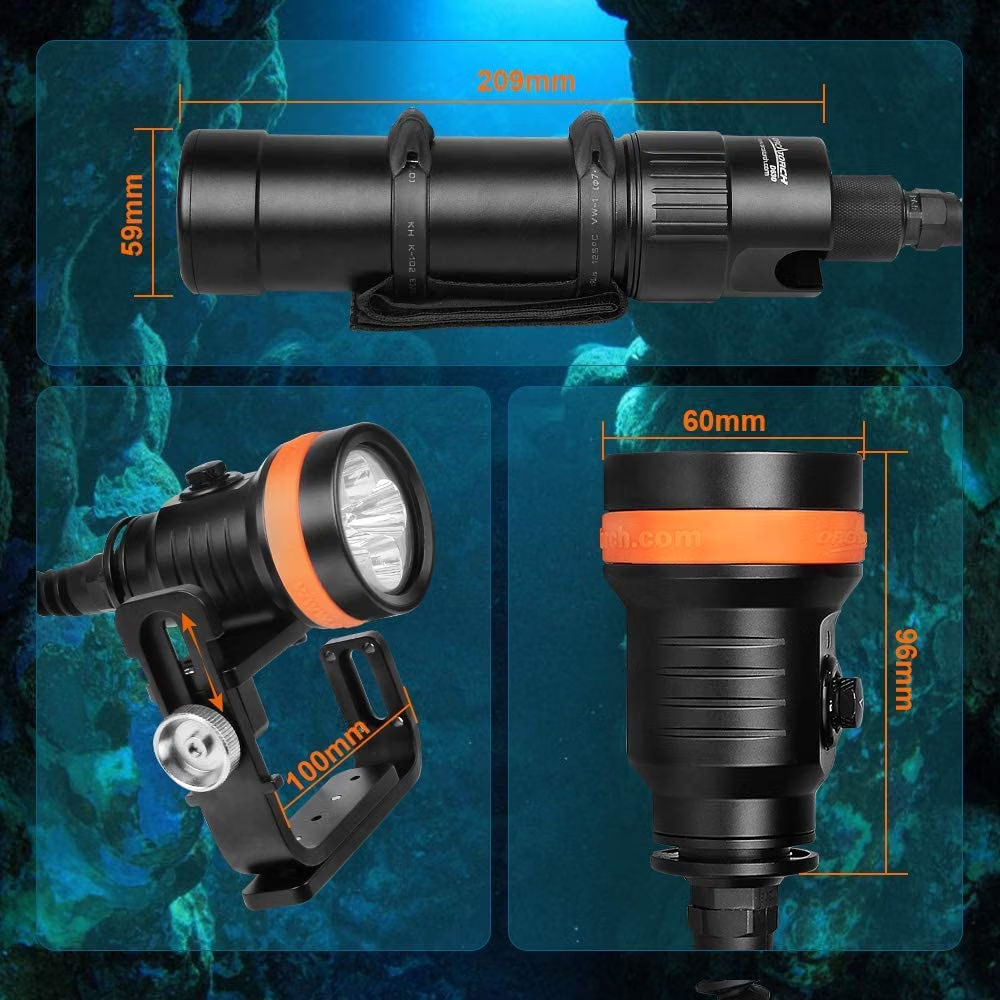
The OrcaTorch D630 is in a completely different class from your typical handheld dive torch. It’s a serious canister light designed to mount to your dive gear, with the light head sitting on a Goodman handle over your hand and a unique rotating cable connection that lets you adjust the cable angle for backmount or sidemount configurations.
Add 4,600 lumens, a razor-focused 7° beam and more than four hours of runtime at full power, and you’ve got a seriously capable premium light for cave, wreck and technical diving.
Instead of carrying the entire light in your hand, the large battery canister mounts to your dive gear, while the much smaller light head sits over your hand on the supplied Goodman handle. This keeps your hand largely free while giving you immediate control of the beam.
The D630’s rotating cable connection is particularly clever, allowing the cable angle to be adjusted to suit different setups rather than forcing it into one fixed position. This makes the D630 suitable for both backmount and sidemount configurations.
You get three brightness levels — 4,600 / 1,700 / 460 lumens — through a very tight 7° beam. That concentrated beam is ideal for caves, wreck penetration and communicating with other divers over distance, rather than simply flooding everything around you with light.
The enormous 89Wh rechargeable battery pack provides around 4 hours 20 minutes on High, 7 hours 10 minutes on Medium and 24 hours on Low. It can even double as a power bank, while a battery indicator lets you keep track of the remaining charge.
It’s seriously tough too, with hard-anodized aluminum construction, a titanium-alloy switch, lock function and 492 ft (150 m) depth rating. The complete setup weighs around 3.1 lb (1.42 kg) including the battery, although much of that weight is mounted to your gear rather than carried in your hand.
For ordinary recreational night diving, this is obviously overkill. But that’s not who it’s for. The D630 is built for divers who need long runtime, hands-free operation, a focused signaling beam and a mounting system designed around demanding technical dives.
👍 Best For
- 🪨🤿 Cave and technical divers
- 🚢🔦 Wreck diving and penetration
- 👐💡 Hands-free Goodman-handle operation
- 🎒🔄 Backmount and sidemount configurations
- ⏱️🔋 Long dives requiring serious battery capacity
📌 Key Specs
- ☀️ Maximum brightness: 4,600 lumens
- 🔆 Brightness levels: 4,600 / 1,700 / 460 lumens
- 🔦 Beam angle: 7°
- 🌊 Depth rating: 492 ft (150 m)
- 🔋 Battery: Rechargeable 89Wh battery pack
- ⏱️ Runtime: 4h 20m High / 7h 10m Medium / 24h Low
- 🔋 Power bank: Yes
- 🪫 Battery indicator: Yes
- 🔒 Lock function: Yes
- 🔄 Cable: Adjustable rotating connection
- 👐 Goodman handle: Included
- 🎒 Mounting: Backmount or sidemount
- ⚖️ Total weight: Approx. 3.1 lb (1.42 kg) including battery
- 🔩 Body: Hard-anodized aluminum
⭐ Bottom Line
The OrcaTorch D630 is massive overkill for the average recreational diver — but that’s precisely the point. This is a premium light built for serious cave, wreck and technical diving.
You get huge battery capacity, excellent runtime, a powerful focused beam and an extremely versatile hands-free mounting system from a brand I’ve personally used and trusted for years. If you’re ready to step up from a conventional handheld torch to a serious technical-diving light, this is my Premium Pick.
🤓📊📖 🔦 Dive Light Buying Guide & Terminology

Already picked your favorite dive light? Great. If you’re still wondering what lumens, beam angles, burn times and all the other dive-light jargon actually mean, this section is for you!
I’ll keep things simple and focus on the specifications that actually make a difference underwater.
⚡ Jump to What You Need
☀️ How Many Lumens Do You Need for a Dive Light?
Lumens measure how much visible light a torch produces. Generally speaking, the higher the number, the brighter the dive light — but that doesn’t necessarily mean it’s better.
For most recreational night diving, you simply need enough light to comfortably see the reef, communicate with your buddy and spot marine life. You don’t need to turn the entire ocean into daylight.
Extremely powerful lights become more useful when you’re trying to illuminate large wrecks, caves or big areas of open water. At the other end of the scale, lower outputs are useful for looking at marine life up close, conserving battery or serving as a backup light.
This is also why I really like dive lights with multiple brightness levels. A 3,000-lumen torch that can drop down to 500 lumens is much more versatile than one that’s permanently stuck on full blast.
And don’t judge a dive light by lumens alone. Beam angle makes an enormous difference to how bright a light actually appears underwater. A narrow beam concentrates its output into a small area, while a wide beam spreads the same amount of light much further.
🔦 Beam Angle: Narrow vs Wide
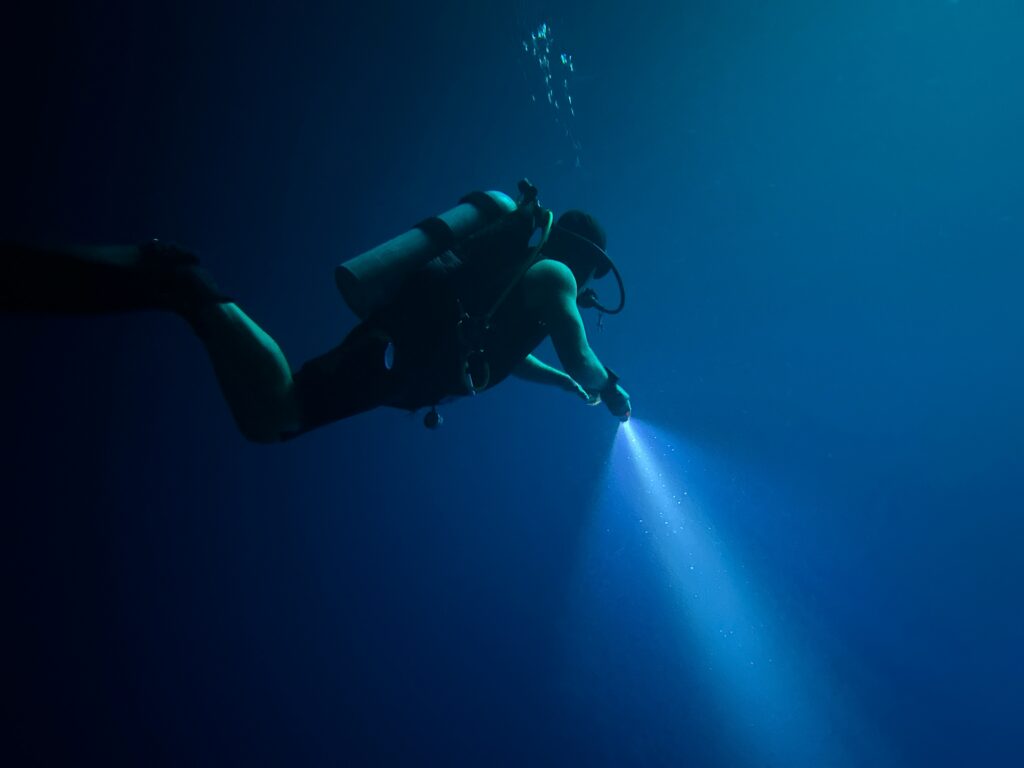
Beam angle tells you how wide the cone of light coming from your dive torch is. And it’s one of the most important specs to look at alongside lumens.
A narrow beam — roughly 6° to 15° — concentrates the light into a tight, powerful spot. This is great for peering into cracks and crevices, cutting through murky water and pointing things out to your buddy. It’s also much easier to use for underwater communication.
A wide or flood beam spreads the light across a much larger area, giving you a better view of the reef and your overall surroundings. The downside is that the same amount of light is spread more thinly, so it won’t appear as intense or penetrate as far as a narrow beam.
Some dive lights combine the two, with a bright central spot surrounded by a wider flood — giving you some of the advantages of both.
This is why lumens don’t tell the whole story. A 3,000-lumen light with a tight 8° beam can look dramatically different underwater from a 3,000-lumen light spreading that output across 70°.
Neither is automatically better. For general recreational diving, I personally like a relatively focused beam, while a wider beam makes more sense if your priority is illuminating as much of the underwater environment as possible.
🔋 Runtime, Batteries & Charging
Runtime — sometimes called burn time — is simply how long your dive light will run before the battery dies. Just remember that the headline number can be misleading.
A torch advertised with a 20-hour runtime might only achieve that on its lowest setting, while full power lasts a couple of hours. Always check the runtime for the brightness level you’ll actually use.
Dive lights generally use either removable rechargeable batteries or built-in battery packs. Removable batteries are handy because you can carry charged spares, while built-in systems can be simpler and reduce the number of compartments you need to open and reseal.
For travel, I’m also a big fan of USB-C charging. It means one less dedicated charger to lose somewhere between your hotel room and the dive boat.
Finally, don’t obsess over enormous battery capacity. For normal recreational diving, you mainly want a light that can comfortably outlast your planned dive with plenty of charge to spare. For technical, cave or particularly long dives, runtime becomes a much bigger consideration.
🌊 Depth Ratings & Build Quality
A dive light’s depth rating tells you the maximum depth it’s designed to withstand without leaking or failing under pressure.
For most recreational divers, even a 328 ft (100 m) rating is already far beyond the depths you’ll actually be diving. A 492 ft (150 m) rating sounds impressive, but it doesn’t automatically make that torch better for someone whose deepest dives are 100 ft (30 m).
What matters more is having a well-built, properly sealed light with plenty of depth-rating headroom for the diving you actually do.
Most decent dive lights use aluminum-alloy bodies, O-ring seals and controls designed to operate under pressure. You’ll also see tougher models using things like hard-anodized finishes and titanium-alloy switches.
And remember: even the toughest dive light can flood if its seals aren’t looked after. Keep O-rings clean, check them for damage and make sure any battery compartments are properly closed before jumping in.
You really don’t want to discover your waterproof flashlight isn’t waterproof after you’ve descended. 😬🔦
🔦 Primary vs Backup vs Canister Dive Lights
Not every dive light is designed to do the same job. Broadly speaking, you’ll encounter primary lights, backup lights and canister lights.
A primary dive light is exactly what it sounds like — your main torch. For recreational night diving, this will usually be a handheld rechargeable light powerful enough to comfortably illuminate the reef for the entire dive.
A backup light is smaller and carried in case your primary fails. It doesn’t need ridiculous power, but it should be reliable and bright enough to safely finish the dive if your main light dies.
Then there are canister lights, like the OrcaTorch D630 above. These separate the large battery pack from the light head, with the battery mounted to your dive gear and connected by a cable. They’re particularly popular for technical, cave and wreck diving, where long runtimes and hands-free operation become much more important.
For a straightforward recreational night dive, a good primary plus a small, dependable backup is the setup I’d recommend. 🔦🔦
🌙 How to Use a Dive Light Underwater

Using a dive light is pretty straightforward, but there are a few bits of underwater torch etiquette worth knowing — especially on night dives.
First: don’t shine it directly into another diver’s eyes. It absolutely destroys their night vision and is a great way to annoy your buddy. When communicating, illuminate your own hand signals with the torch rather than pointing the beam at their face.
Your light itself can also be used for communication. Slow, deliberate movements are best — waving your torch around frantically can look like you’re signaling a problem. Before a night dive, make sure you and your buddy understand the light signals you’ll be using.
A torch is also brilliant for pointing out marine life. Circle a nudibranch, shrimp or other critter with your beam to help your buddy spot it rather than repeatedly jabbing the light directly at the animal.
And be considerate around marine life. Don’t deliberately chase, blind or harass animals with your torch, particularly nocturnal creatures that rely on darkness.
Of course, sometimes the marine life completely ignores the briefing and decides your dive light belongs to them instead. 🐙🔦
🔦 Dive Light vs Dive Torch — What’s the Difference?
Absolutely nothing! Dive light and dive torch are simply two names for the same piece of equipment.
“Dive light” is more commonly used in the USA, while “dive torch” is more common in the UK and various other parts of the world.
You’ll see me use both terms throughout this guide — partly because I’m British, and partly because after years of working around divers from all over the world, I tend to use them interchangeably.
So whether you’re shopping for the best dive light or best dive torch, you’re looking for exactly the same thing. 🔦🤿
🤿 🔦 Final Thoughts
A good dive light is one of those pieces of gear that quickly becomes far more useful than you originally expected. You might buy one for your first night dive, then find yourself bringing it along during the day to investigate cracks, explore wrecks and hunt for hidden critters.
And as you’ve hopefully gathered by now, the best dive light isn’t necessarily the brightest one. Beam angle, brightness levels, battery life, size and how you actually plan to use it matter just as much as the headline lumen figure.
For most recreational divers, the OrcaTorch D710 remains my Top Pick because it gets that balance right without becoming ridiculously expensive. But there are plenty of excellent alternatives here — from $30 backup torches to UV lights, laser-equipped models and full-blown technical canister systems.
Ultimately, pick the light that suits the kind of diving you actually do rather than chasing the biggest numbers on the box.
Now get out there, wait for the sun to go down and see what comes out after dark. Night diving is awesome. 🌙🐙🔦
Support the Squad!
We are part of the Amazon Services LLC Associate Program. If you make a purchase on amazon after clicking an amazon link on Diving Squad, we earn a small commission fee, at no extra cost to yourself.
We are also part of several other affiliate programs so if you click on a Diving Squad affiliate link that results in you booking a liveaboard, booking accommodation, purchasing insurance or buying a product somewhere else, once more we make a small commission, without it costing you a cent extra. Cheers!

