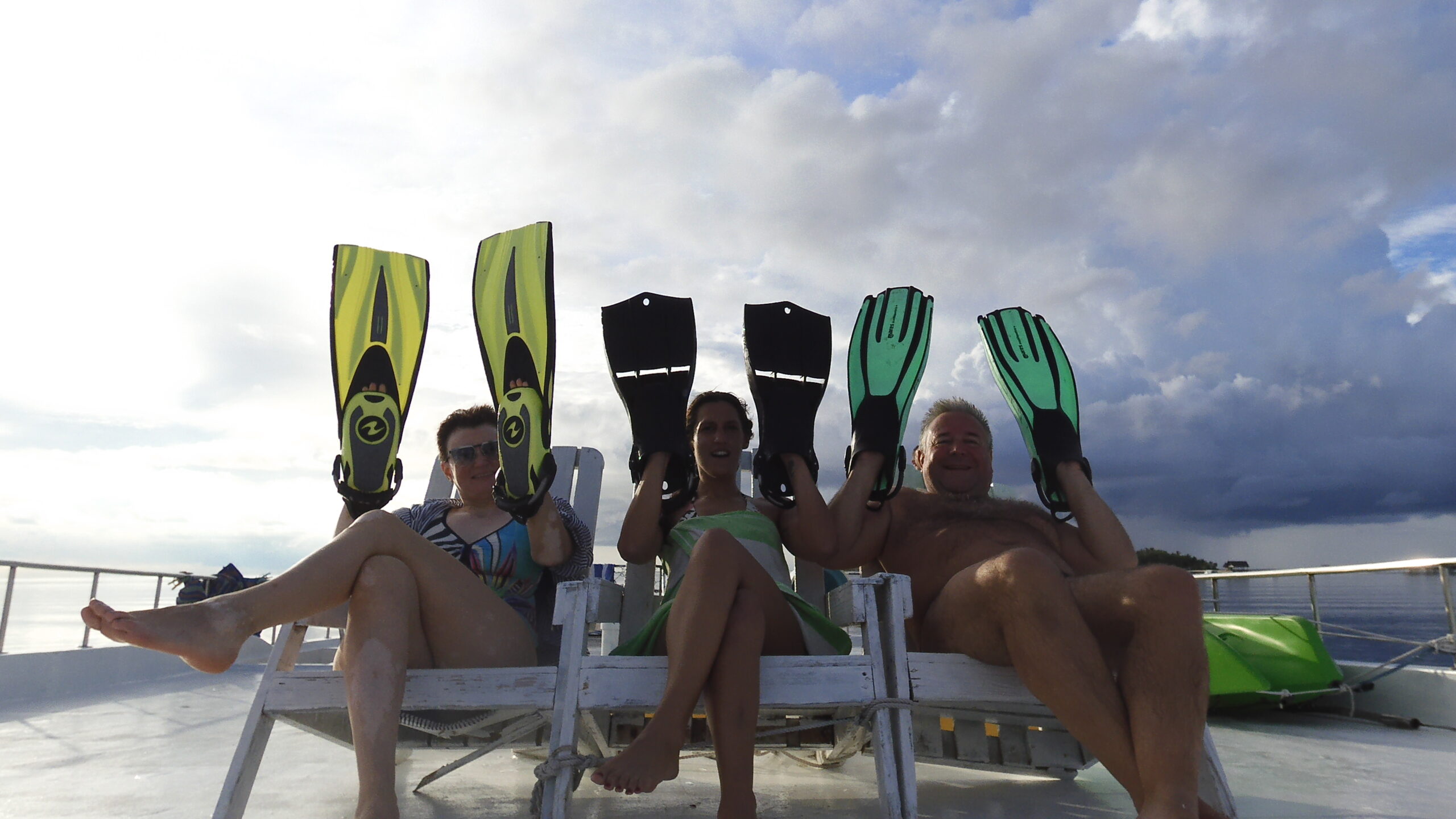
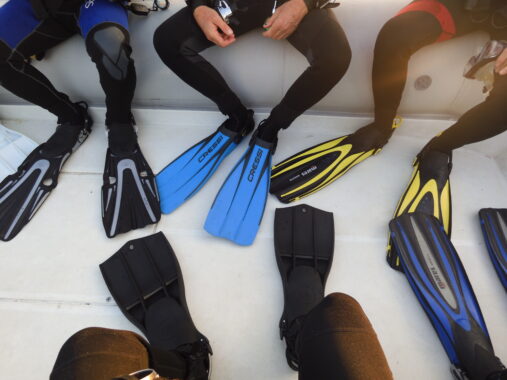
I used to think scuba fins were basically just… fins. Turns out I was quite wrong.
I bought my first proper pair after becoming a divemaster in 2020 and the difference was ridiculous. Suddenly I could move around with less effort, had way more control and wasn’t burning through as much air just getting from A to B.
Six years later, I’m a scuba instructor, I’ve tried a shitload more fins and I’ve watched hundreds of divers wrestle with rental fins, buy their own and slowly figure out what actually works for them.
And if there’s one thing I’ve learned, it’s that scuba fins are annoyingly personal. One diver’s dream fin is another diver’s overpriced fucking ankle-cramp machine.
Big feet, small feet, strong legs, dodgy knees, kicking style and where you actually dive all make a difference. This is made considerably easier by the fact that there are approximately eight billion fin designs to choose from, each promising to revolutionise the ancient art of kicking one’s legs.
So for this guide, I’ve narrowed the chaos down to 12 of the best scuba fins of 2026, covering different feet, budgets and styles of diving.
Personally, I bloody love my Apeks RK3s — but there are cheaper, lighter and more specialised options that may suit you better. Right. Enough waffling about fins — let’s get into the Quick Picks. 🤿
⚡ 🤿 Quick Picks
🏆 1) My Top Pick — Apeks RK3
My personal favourites and the fins I’ve used for years. They’re tough as hell, powerful and give me excellent control for frog kicking and precise manoeuvring, although they’re heavier and bulkier than most recreational fins.
👉 Read Review ↓ | 🛒 Check Price
⚙️ 2) Best Hybrid Scuba Fins — Scubapro Seawing Nova
A seriously unusual articulated design that combines the power and control of a paddle fin with surprisingly easy kicking. They’re expensive, but lightweight, responsive and one of the most distinctive fins I’ve dived with.
👉 Read Review ↓ | 🛒 Check Price
✈️ 3) Best Scuba Fins for Travel — Scubapro Go Travel
Extremely lightweight, compact and even designed to stack together inside your luggage. They’re primarily intended for barefoot diving, making them an excellent choice for warm-water divers trying to keep their baggage weight down.
👉 Read Review ↓ | 🛒 Check Price
👶 4) Best Scuba Fins for Beginners — TUSA SF-22 Solla
Comfortable, forgiving paddle fins that provide plenty of propulsion without requiring ridiculously strong legs. I’ve dived with these myself and think they offer a great balance of power, control and ease of use for newer recreational divers.
👉 Read Review ↓ | 🛒 Check Price
🏅 🤑 5) Cheapest Scuba Fins — LUXPARD
One of the cheapest pairs of proper open-heel scuba fins I’ve found, complete with adjustable straps and a channelled paddle blade. They’re nowhere near as refined as premium fins, but make a lot of sense if you simply want your own fins for as little money as possible.
👉 Read Review ↓ | 🛒 Check Price
👣 6) Best Scuba Fins for Small Feet — Scubapro GO Sport
Compact, boot-friendly fins available in smaller sizes, with a tough Monprene construction and replaceable bungee straps. They’re also lightweight enough for travel while still providing considerably more control than your average flimsy travel fin.
👉 Read Review ↓ | 🛒 Check Price
💰 7) Best Budget All-Rounder — Cressi Pro Light
A simple, proven paddle-fin design from one of scuba’s biggest manufacturers without the premium price tag. They’re comfortable, versatile and powerful enough for everyday recreational diving — basically a lot of fin for not a lot of money.
👉 Read Review ↓ | 🛒 Check Price
🌊 8) Best Scuba Fins for Strong Currents — Mares Avanti Quattro+
Powerful four-channel paddle fins designed to shift a serious amount of water with each kick. I’ve encountered these repeatedly as rental fins around the world, and they’re an excellent choice for divers wanting strong propulsion without moving into short, heavy technical fins.
👉 Read Review ↓ | 🛒 Check Price
🐸 9) Best Scuba Fins for Frog Kick — Scubapro Jet Fin
A legendary short, stiff and negatively buoyant rubber fin that’s particularly well suited to frog kicks, back kicks and precise manoeuvring. They’re heavy, bulky and decidedly old-school — but there’s a reason this basic design has survived for decades.
👉 Read Review ↓ | 🛒 Check Price
🦵 10) Best Split Fins — TUSA SF-011 HyFlex Zoom
A modern split-fin design built around low-resistance, easy flutter kicking rather than maximum stiffness and control. They’re particularly interesting if powerful paddle fins tire your legs, although split fins remain very much a love-them-or-hate-them choice.
👉 Read Review ↓ | 🛒 Check Price
🚀 11) Most Innovative Design — Mares X-Stream
Lightweight, futuristic fins using channels, cut-outs and Mares’ pivoting blade technology to produce propulsion while reducing resistance. They’re one of the strangest-looking fins here, packed with genuinely interesting engineering and — importantly — they look fucking cool.
👉 Read Review ↓ | 🛒 Check Price
☀️ 12) Best Full-Foot Scuba Fins — Mares Volo Race
The only full-foot fins in this guide, designed to be worn barefoot rather than with normal dive boots. They’re light, flexible and well suited to warm-water diving, although I’d still recommend open-heel fins to most scuba divers.
👉 Read Review ↓ | 🛒 Check Price
🤓 ⚙️ 📊 Not sure what all these Scuba Fin Specs mean!?
Dive down to the Scuba Fin Info, Terminology & Buying Guide ↓ for nerdy explanations of fin sizing, kicking styles, blades, foot pockets, straps, vents, fin types, scuba vs snorkelling fins and more.

Ahoy! I’m Alex — a PADI Scuba Diving Instructor and the creator of Diving Squad. I started this blog back in early 2019, during a five-year odyssey spent drifting through Southeast Asia, Central America and beyond. In 2023, I landed in Panglao, Philippines — and liked it so much I never really left. I’ve been based here ever since, diving, teaching and continuing to build Diving Squad. When I’m not underwater, I’m usually editing dive footage, plotting the next questionable adventure or cruising around on my bike — but never for long before the reefs pull me back.
🌊🤘📚 Reviews of the Best Scuba Diving Fins
🏆 🤿 1) My Top Pick: Apeks RK3 ($$$)
⭐ Quick Verdict
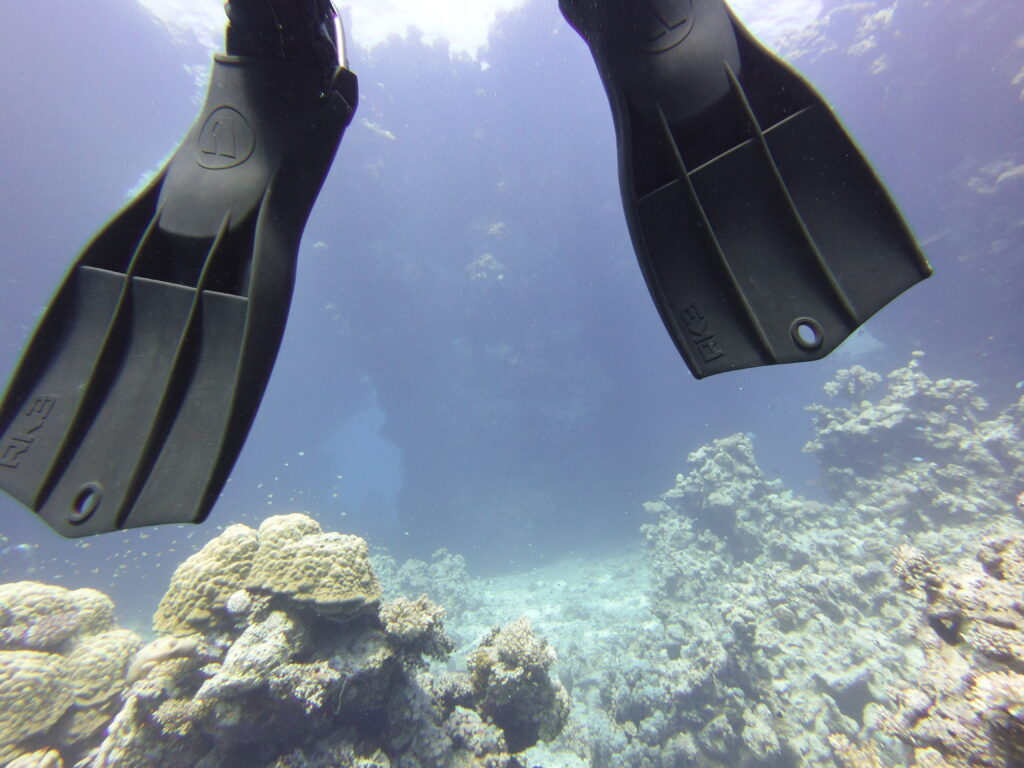
The Apeks RK3s have been my go-to fins for years and remain my favourite scuba fins overall. They’re short, ridiculously tough and give me superb power and control — particularly for frog kicking and precise manoeuvres.
They’re chunky, fairly heavy and look like they were designed to survive a small war. But that’s also kind of why I love them.
The RK3s use short, wide vented blades that produce plenty of thrust without having enormous fins dangling off each foot. The vents reduce resistance on the upstroke, and overall they feel powerful without sacrificing manoeuvrability.
But what I really love is the control. Frog kicks feel fantastic, as do little corrective kicks, turns and adjustments when I’m hovering around students or trying not to boot a piece of coral into next Tuesday.
They’re also built like absolute tanks. Tough thermoplastic rubber, stainless-steel spring straps and chunky foot pockets make these fins feel practically indestructible. Half a decade later, I’m still using the same pair.
The downside is pretty obvious once you pick them up: RK3s are not dainty little travel fins. They’re relatively heavy and bulky, and I wouldn’t choose them if shaving every possible ounce off my luggage was the priority.
The foot pockets are also deliberately roomy for dive boots, so sizing matters – but this extra space also makes the Apeks RK3’s some of the best scuba fins for wide feet. Just don’t just order your normal shoe size and pray to Poseidon — check your boot-and-fin combination properly. They’re available in several different sizes and colours, so there’s a decent amount of choice.
👍 Best For
- 🐸 Frog kicking and precise finning
- 💨 Powerful, controlled propulsion
- 🚢 Wrecks and confined spaces
- 💪 Anyone wanting fins that can take a serious beating
📌 Key Specs
- 🤿 Type: Open heel
- 📐 Blade: Short, wide & vented
- 🧱 Material: Thermoplastic rubber
- 🦶 Foot pocket: Oversized to accomodate dive boots
- 🔩 Strap: Stainless-steel spring
- 📏 Sizes: Several sizes available
- 🎨 Colours: Several colour options
- 🪝 Extras: Twin grommet holes for carabiner clipping
⭐ Bottom Line
There are lighter, cheaper and more travel-friendly fins in this guide. But if I could only keep one pair, I’d keep my RK3s.
They’re powerful, precise, absurdly tough and brilliant for frog kicking. After half a decade of diving mine, they’re still the fins I judge everything else against. They’ve taken years of abuse, travelled around the world with me and still show absolutely no signs of giving up.
They won’t be the perfect fins for everyone — especially if weight and portability are your priorities — but for the kind of diving I do, I genuinely haven’t found anything I’d rather have strapped to my beloved feet.
🤓 Want the nerdily detailed version? Read my full Apeks RK3 review →
⚙️ 🤿 2) Best Hybrid Scuba Fins: Scubapro Seawing Nova ($$$)
⭐ Quick Verdict
The Scubapro Seawing Novas are some of the weirdest-looking fins in this guide — and some of the cleverest.
They’re hybrid fins, designed to give you the power and control of traditional paddle fins while being easier to kick like split fins. That means plenty of thrust without needing super-stiff blades — great if you want strong fins without every dive feeling like leg day.
I’ve dived the Seawing Novas myself, and they feel noticeably different from conventional paddle fins.
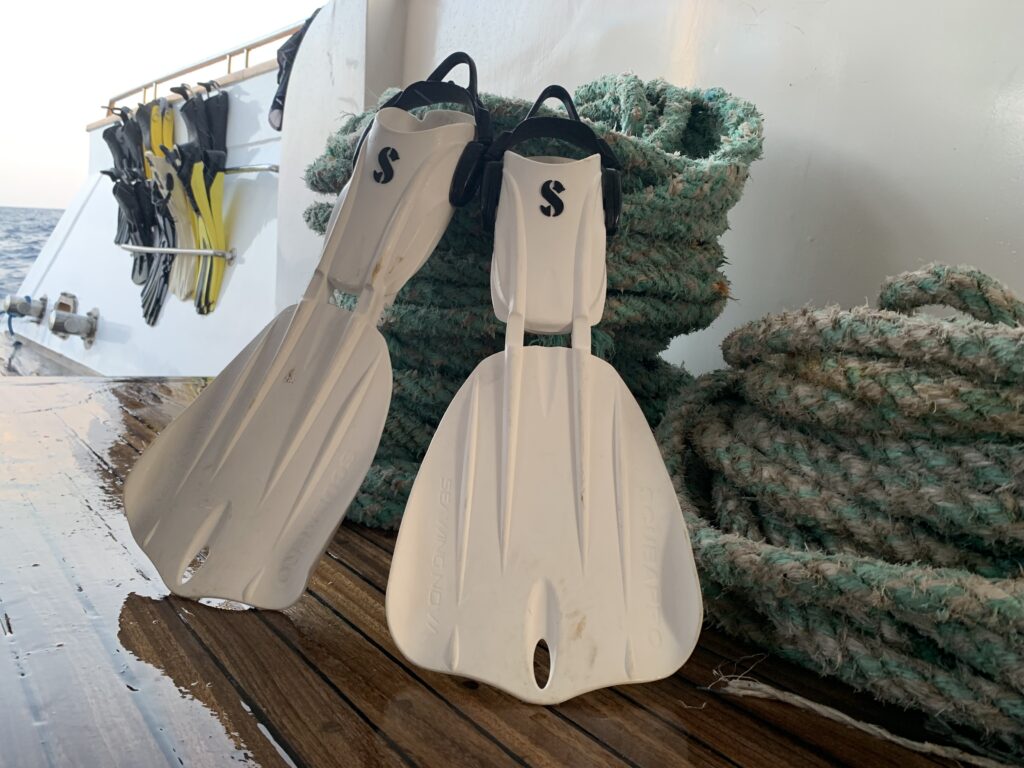
The reason is that enormous articulated joint across each fin. Rather than the whole blade simply flexing, it pivots independently from the foot pocket, helping maintain an efficient angle throughout your kick.
It looks slightly bonkers, but there’s some clever engineering going on here. Scubapro’s Pivot Control system limits how far the blade rotates, while the wide, wing-shaped blade helps turn your kicks into forward thrust.
Despite looking like something a manta ray might wear to a rave, they’re surprisingly versatile. They can produce plenty of power but also work well for frog kicks, turns and smaller underwater adjustments.
Marine-grade bungee straps make them easy to get on and off, and the relatively flexible action makes them a great choice if you find stiffer paddle fins tiring.
The trade-off? They’re expensive, feel a little unusual at first and their strange shape isn’t exactly a gift from the scuba-packing gods.
👍 Best For
- ⚙️ Divers wanting a paddle/split-fin hybrid
- 💨 Strong thrust without extremely stiff blades
- 🐸 Frog kicks & manoeuvring
- 🦵 Easier, more comfortable kicking
- 🛸 Anyone bored of normal-looking fins
📌 Key Specs
- 🤿 Type: Open heel / hybrid
- ⚙️ Design: Articulated G4 joint
- 📐 Blade: Wing-shaped
- 🧱 Material: Monprene
- 🦶 Strap: Marine-grade bungee
- 🎈 Buoyancy: Positive
- 📏 Sizes: Several available
- 🎨 Colours: Several options
⭐ Bottom Line
The Seawing Novas aren’t ordinary fins with a few fancy grooves slapped onto them. That articulated blade genuinely changes how they feel underwater.
They’re powerful, manoeuvrable and surprisingly easy to kick. I still prefer the more planted feeling of my RK3s, but if you want something between a traditional paddle and split fin — and don’t mind your feet looking vaguely extraterrestrial — these are my favourite hybrid option.
🤓 Want the absurdly detailed version? Read my full Scubapro Seawing Nova review →
✈️ 🤿 3) Best Scuba Fins for Travel: Scubapro GO Travel ($$)
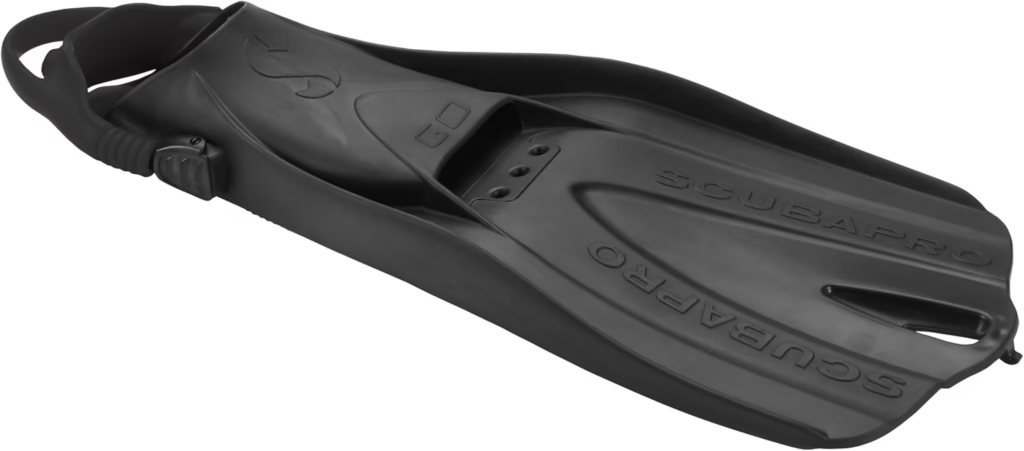
⭐ Quick Verdict
If you’re sick of your fins taking up half your bloody suitcase, the Scubapro GO Travels are the obvious answer.
They’re compact, lightweight and specifically designed for travelling divers, yet still provide enough power and control for proper scuba diving. Better still, the two fins actually lock together for packing — a simple little feature I wish more travel fins had.
Travel is where these fins really make sense. A pair of M/L GO Travels weighs just 2.6 lb / 1.2 kg including the straps, and they’re designed to fit inside IATA carry-on-compliant luggage.
They also have SCUBAPRO’s Piggy Back Stack system. One blade interlocks with the other fin, holding the pair neatly together instead of having two awkward lumps of plastic fighting everything else in your bag.
Thankfully, SCUBAPRO hasn’t made them useless underwater just to save weight. The 25° pre-angled blades, central power panels and reinforcing bars help produce a good combination of speed, stability and manoeuvrability without requiring huge amounts of effort.
They’re also made entirely from tough Monprene, so despite being lightweight, they’re designed to withstand plenty of abuse. The replaceable bungee straps make them quick to get on and off too.
One important difference from most open-heel scuba fins: these are primarily designed to be worn barefoot. You can also use neoprene socks, but if you want to wear proper dive boots, look at the GO Sport instead.
👍 Best For
- ✈️ Frequent dive travellers
- 🎒 Packing light or travelling carry-on
- ☀️ Warm-water diving
- 🦶 Barefoot diving or neoprene socks
- 🤿 Divers wanting compact fins without sacrificing decent performance
📌 Key Specs
- 🤿 Type: Open heel / barefoot travel fin
- ⚖️ Weight: 2.6 lb / 1.2 kg per pair in M/L
- 📐 Blade: 25° pre-angled
- 🧱 Material: 100% Monprene
- 🦶 Strap: Replaceable marine-grade bungee
- 🎈 Buoyancy: Positive
- 🧳 Packing: Piggy Back Stack system
- 📏 Sizes: Multiple sizes available
- 🎨 Colours: Multiple colour options
⭐ Bottom Line
The GO Travels are basically what happens when someone looks at normal scuba fins and asks: “Do these really need to occupy 40% of my luggage?”
They’re light, compact, tough and genuinely designed around travelling — right down to the clever interlocking blades. You sacrifice the boot compatibility and heavy-duty feel of something like my RK3s, but that’s rather the point.
If warm-water dive trips make up most of your diving and luggage space is precious, these are my top travel fins.
👶 🤿 4) Best Scuba Fins for Beginners: TUSA Solla SF-22 ($$)
⭐ Quick Verdict
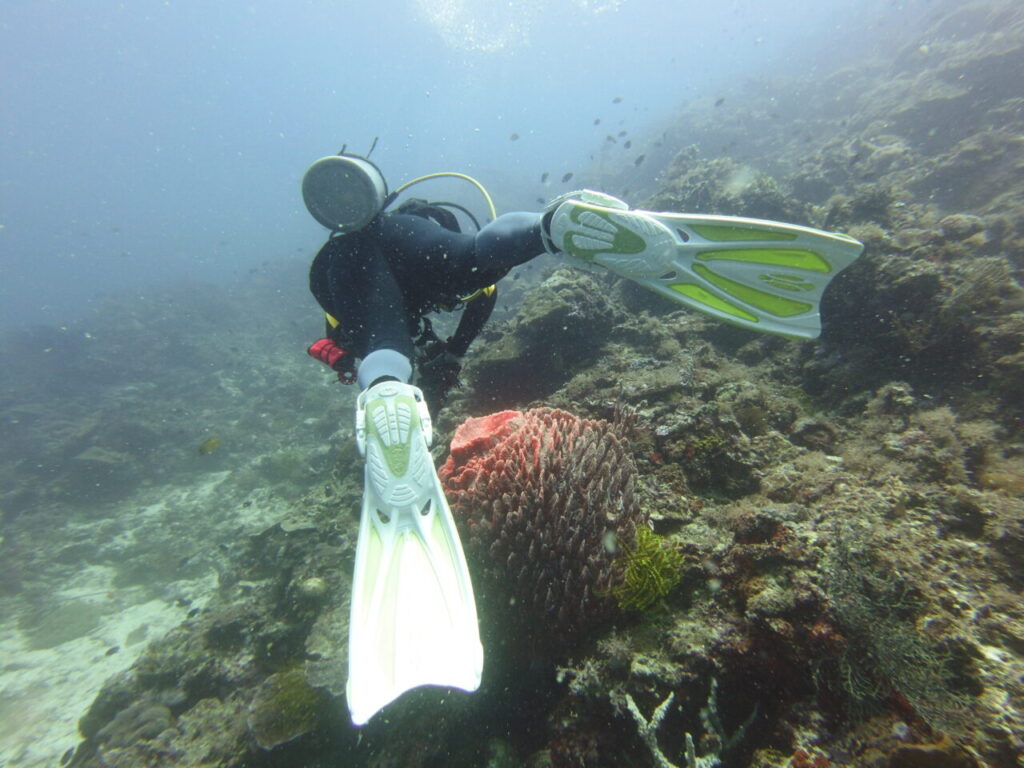
The TUSA Sollas are comfortable, easy to kick and nicely versatile — pretty much exactly what I’d want from a beginner fin.
I’ve dived these fins a bunch of times (they’re a common rental fin at dive shops!) and found them very easy to get along with. There’s plenty of power without the blades feeling brutally stiff, and they work nicely for both flutter and frog kicking. Nothing complicated, nothing exhausting — just a really solid pair of fins.
The Sollas are essentially classic paddle fins with a few clever modern tweaks. TUSA uses a 20° angled blade with three channels, vents and reinforced side rails to generate plenty of thrust without making every dive leg day.
I found them comfortable and nicely balanced underwater. They feel most at home with a regular flutter kick, where the longer, flexible paddle blades give you good propulsion without demanding loads of effort. You can frog kick in them — I have — but if frog kicking is your main style, there are much better options in this guide.
They’re also not especially heavy or brutally stiff, which is another reason I like them for beginners. You don’t need monster leg strength or particularly refined kicking technique to get them moving, making them a good choice for less experienced or less powerful kickers.
The TUSA Solla fins are mid-priced rather than super cheap, but still considerably less expensive than some of the premium fins in this guide. For something you could buy as a beginner and happily continue using years later, I think that’s pretty reasonable.
You also get a borderline ridiculous choice of bright neon colours. Besides making your fins easier for your buddy to recognise underwater, this allows you to spend far too long deciding whether your fins properly complement your mask.
👍 Best For
- 👶 Beginner scuba divers
- 🤿 Easy, versatile kicking
- 🦵 Flutter kicking (easy & natural)
- 🦶 Comfort without overly stiff blades
- 🌈 Divers who like plenty of colour choice
📌 Key Specs
- 🤿 Type: Open heel / paddle
- 📐 Blade: 20° angled, three-channel design
- ⚙️ Technology: TUSA ForcElast
- 🦶 Foot pocket: Anatomically shaped
- 🔧 Strap: Adjustable strap; bungee version also available
- 📏 Sizes: Multiple available
- 🎨 Colours: Loads of options
⭐ Bottom Line
The TUSA Sollas are comfortable, forgiving and refreshingly uncomplicated. They’re particularly good for regular flutter kicking and don’t require especially strong legs or perfect technique to get decent propulsion.
They aren’t the fins I’d choose for technical diving, serious currents or fancy frog-kicking shenanigans. But for a newer recreational diver who wants a dependable first pair, there’s really not much to dislike here.
Easy to kick, easy to control and unlikely to make your calves hate you — friggin’ good beginner fins. 👶
🤓 Want the geeky hyper-detailed version? Read my full TUSA SF-22 Solla review →
🏅 🤑 5) Cheapest Scuba Fins: LUXPARD Diving Fins ($)
⭐ Quick Verdict
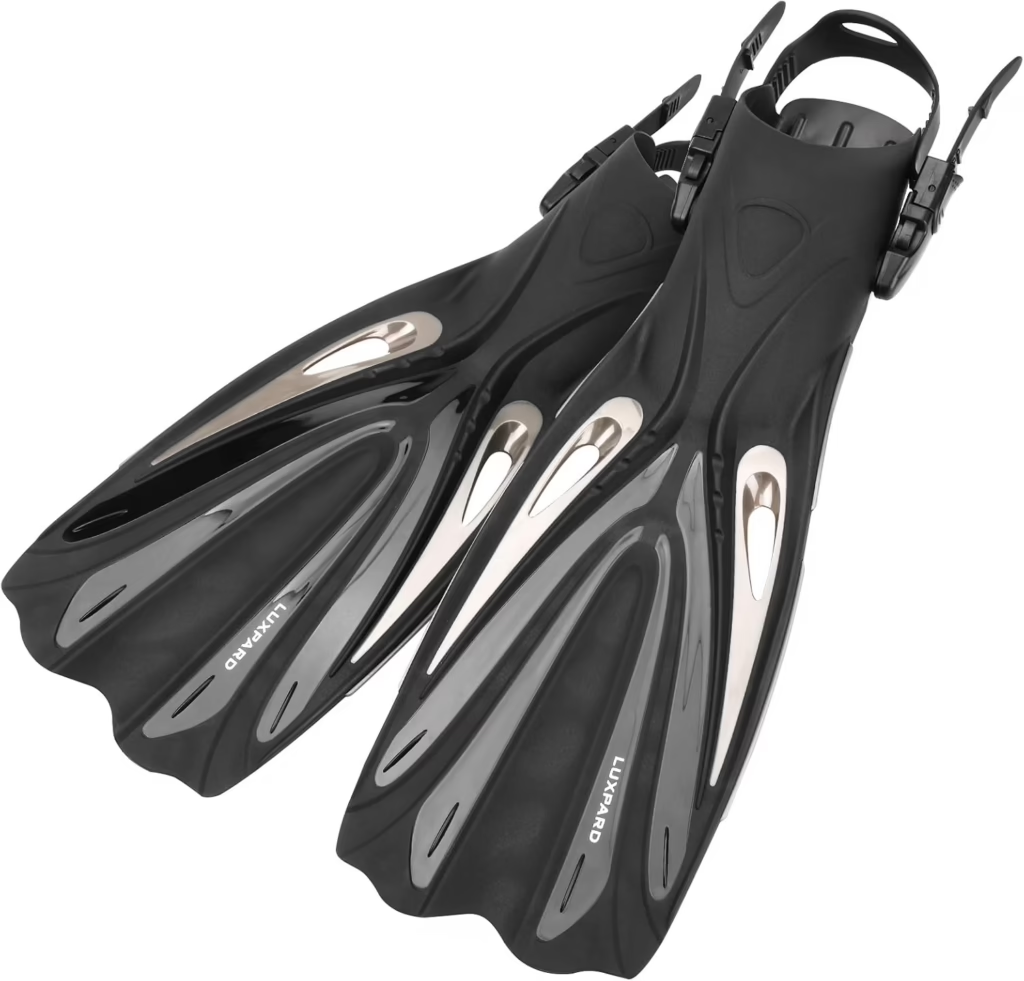
At around the $50 mark, the LUXPARDs are easily some of the cheapest open-heel scuba fins I’ve found that still look like a genuinely usable piece of dive gear.
You get a proper channelled paddle blade, adjustable straps, a reasonably flexible construction and even a carry bag. They’re obviously not going to have the refinement or track record of Apeks, Scubapro or TUSA — but for roughly the price of a mildly irresponsible night at the pub, there’s quite a lot here.
The basic design is actually pretty sensible. The blades combine polypropylene with softer thermoplastic rubber, giving them some flex while still providing enough structure to push water effectively.
They also use a channelled paddle design, which helps direct water backwards through each kick rather than having the entire blade simply flap around uselessly.
The open-heel foot pockets are designed to be worn with dive boots, while adjustable quick-release buckles let you tighten the fit and get the fins on and off relatively easily.
Sizing is kept nice and simple too. There are just two options: S/M and L/XL. S/M covers roughly US men’s 4.5–8, while L/XL covers US men’s 9–13 — so check the size chart rather than performing your usual Amazon sizing roulette.
You even get a fin bag included, which at this price feels almost suspiciously generous.
Of course, there’s a catch. LUXPARD isn’t an established scuba brand in the same league as Scubapro, Apeks, Mares or TUSA. I wouldn’t expect the same long-term track record, refinement or availability of replacement parts.
But that’s not really what these fins are trying to be. They’re here for someone who wants a functional pair of open-heel scuba fins while spending as little money as humanly possible.
👍 Best For
- 🤑 Divers on a tight budget
- 🤿 Recreational scuba diving
- 👶 Beginners who don’t want to spend loads
- 🥾 Diving with boots
- 💰 Anyone thinking “$200 for fins? Fuck off.”
📌 Key Specs
- 🤿 Type: Open heel / paddle
- 🧱 Materials: Polypropylene & TPR
- 🌊 Blade: Channelled paddle design
- 🔧 Strap: Adjustable quick-release buckle
- 📏 Sizes: Multiple sizes available
- 🎒 Extras: Fin bag included
⭐ Bottom Line
Let’s be realistic: $50 fins aren’t going to make my RK3s nervous about being replaced.
What the LUXPARDs offer is something much simpler — a proper open-heel scuba fin with a sensible paddle design for very little money.
If you’re diving constantly, I’d spend more on something from one of the established scuba brands. But for occasional divers, beginners on a tight budget or anyone who simply wants the cheapest decent option in this guide, there’s a surprising amount here for your money.
Not fancy. Not legendary. But fifty-bloody-dollar scuba fins that appear to get the fundamentals right.
🐭 👣 6) Best Scuba Fins for Small Feet: Scubapro GO Sport ($$$)
⭐ Quick Verdict
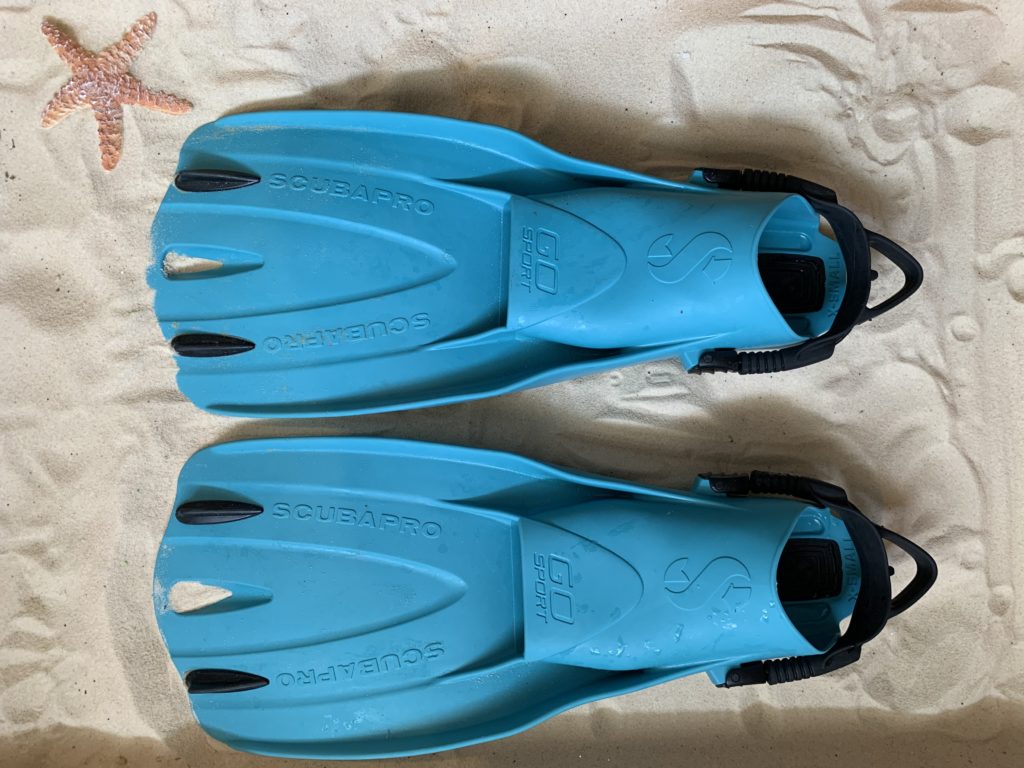
The Scubapro GO Sports are light, compact and surprisingly tough travel fins — but there’s one particular reason they’re in this guide: they come in an extra-small adult size, which can be surprisingly difficult to find.
I first came across these through my friend Aishling, who I met while diving in Ireland and ended up spending quite a bit of time with. Her feet are absolutely bloody tiny. Mine are enormous. So for once, I had to accept that not all scuba diving gear revolves around me.
The GO Sports are basically the boot-friendly cousins of the GO Travels from earlier in this guide. Instead of the barefoot foot pocket, these have Scubapro’s Ergo3 open-heel pocket designed specifically to accommodate dive boots.
And the sizing is genuinely useful. They go all the way down to XS, making them one of the better options I’ve found for adults who struggle to get a secure fit from normal scuba fins.
They’re not just here because Aishling has satirically tiny feet, though. The 25° pre-angled blades use a central power panel and reinforcing bars to generate decent propulsion without making the fins particularly heavy or brutally stiff. Small skegs at the ends of the blades also help with stability.
They’re made from 100% Monprene, so they’re impressively tough considering how light and compact they are. They’re also designed to fit inside IATA carry-on-compliant luggage, making them a solid choice for travel.
Finally, the replaceable bungee straps are comfortable and really easy to pull over your heels — especially useful when you’re balancing on one leg on a rocking dive boat struggling not to launch yourself dramatically into the ocean.
👍 Best For
- 👣 Adults with teeny-tiny feet
- ✈️ Dive travel
- 🦵 Easy, relatively low-effort kicking
- 🤿 General recreational diving
📌 Key Specs
- 🤿 Type: Open heel / paddle
- 📐 Blade: 25° pre-angled
- 🧱 Material: 100% Monprene
- 🦶 Foot pocket: Ergo3 boot-fit
- 🔧 Strap: Replaceable marine-grade bungee
- 📏 Sizes: XS–XL
- 🎈 Buoyancy: Positive
- ✈️ Travel: IATA carry-on compliant
- 🎨 Colours: Several available
⭐ Bottom Line
The GO Sports aren’t just fins for tiny-footed humans. They’re genuinely good all-round scuba fins: light, tough, comfortable and compact enough to travel with easily.
But that XS option is what earns them this particular spot. If you’ve spent your diving career tightening fin straps to within an inch of their lives because apparently scuba manufacturers assume every adult has the feet of a medieval peasant, these are well worth a look.
Aishling’s tiny feet approve. Mine remain far too enormous to have a vote.
🤓 Want the nerdily detailed version? Read my full Scubapro GO Sport review →
💰 🤿 7) Best Budget All-Rounder: Cressi Pro Light ($)
⭐ Quick Verdict
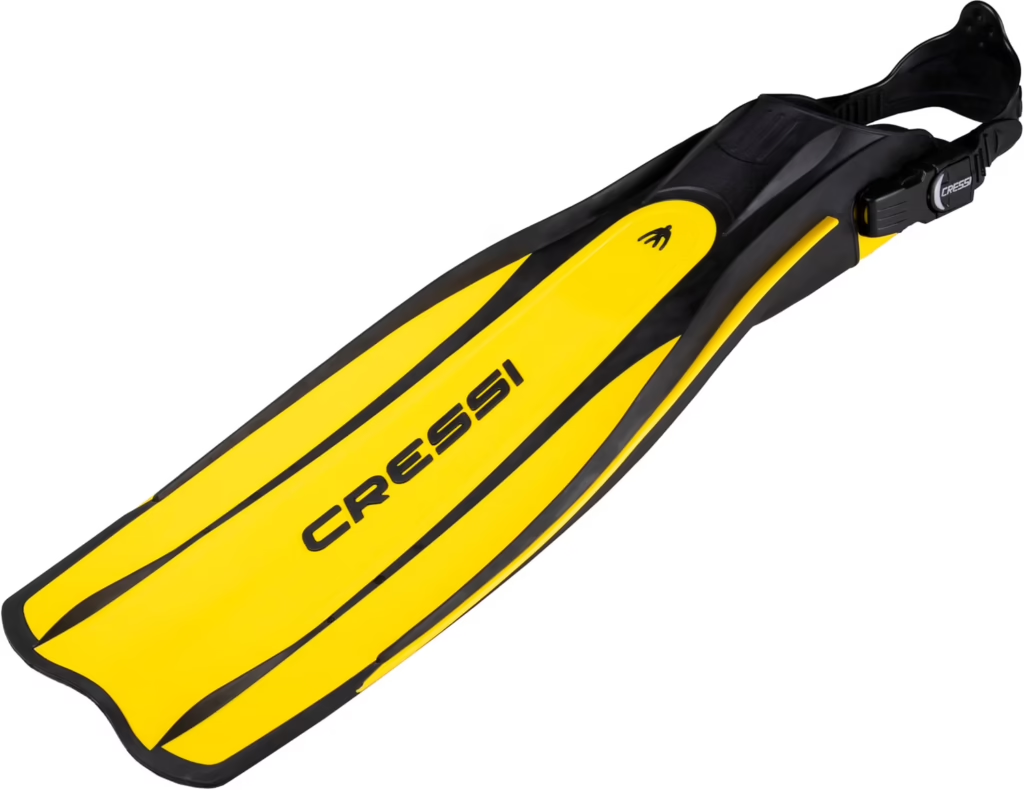
The Cressi Pro Lights are for divers who want to keep things affordable while still buying from a highly reputable scuba brand.
They’re lightweight, comfortable and built around a straightforward paddle design that’ll work for most recreational diving. Nothing particularly exotic is happening here — they’re just good, sensible scuba fins from a company that’s been making dive gear since approximately the dawn of scuba-time.
The Pro Lights use a dual-material construction, combining a strong polypropylene blade with softer elastomer around the foot pocket and other areas. This keeps them relatively light while still giving the blade enough structure to generate decent thrust.
Full-length side rails help channel water backwards and keep the fins tracking properly through a regular flutter kick. Cressi also starts the blade above the foot pocket, giving it around 20% more usable surface area than a conventional blade of the same length.
They’re not especially heavy or brutally stiff either. That’s part of what makes them such a decent all-rounder: you don’t need thighs like Thor just to get yourself across a dive site.
The open-heel design is intended for use with dive boots, while quick-release adjustable buckles keep things simple when you’re getting in and out of the water. Cressi also offers an optional elastic bungee strap if you want to upgrade them later.
Sizing is pretty extensive too, running from XS through XXL depending on the version, with several colour combinations available.
👍 Best For
- 💰 Divers wanting super affordable fins from an established brand
- 👶 Beginners & occasional divers
- ✈️ Travellers wanting something relatively light
- 🦵 Straightforward flutter kicking
📌 Key Specs
- 🤿 Type: Open heel / paddle
- 🧱 Materials: Polypropylene & elastomer
- 🌊 Blade: Full-length side rails
- 🥾 Designed for: Neoprene dive boots
- 🔧 Strap: Adjustable quick-release buckle
- 🪢 Upgrade: Optional Cressi EBS bungee strap
- 📏 Sizes: XS–XXL depending on version
- 🎨 Colours: Several options
⭐ Bottom Line
The Pro Lights sit in a very sensible middle ground. They’re considerably more affordable than premium fins, but you’re still getting a proven design from one of the biggest and longest-established names in scuba.
You don’t get fancy-pants articulated joints, spring straps or some revolutionary new interpretation of what a fin should be. You get a lightweight, comfortable paddle fin that’ll handle ordinary recreational diving perfectly well.
If you want to keep the budget sensible without going for the absolute cheapest option, these are my budget all-rounders.
🌊 8) Best Scuba Fins for Strong Currents: Mares Avanti Quattro+ ($$$)
⭐ Quick Verdict
There’s a reason you’ll see Mares Avanti Quattros absolutely bloody everywhere — dive centres, liveaboards, rental racks and strapped to the feet of divers who’ve been using the same pair for years.
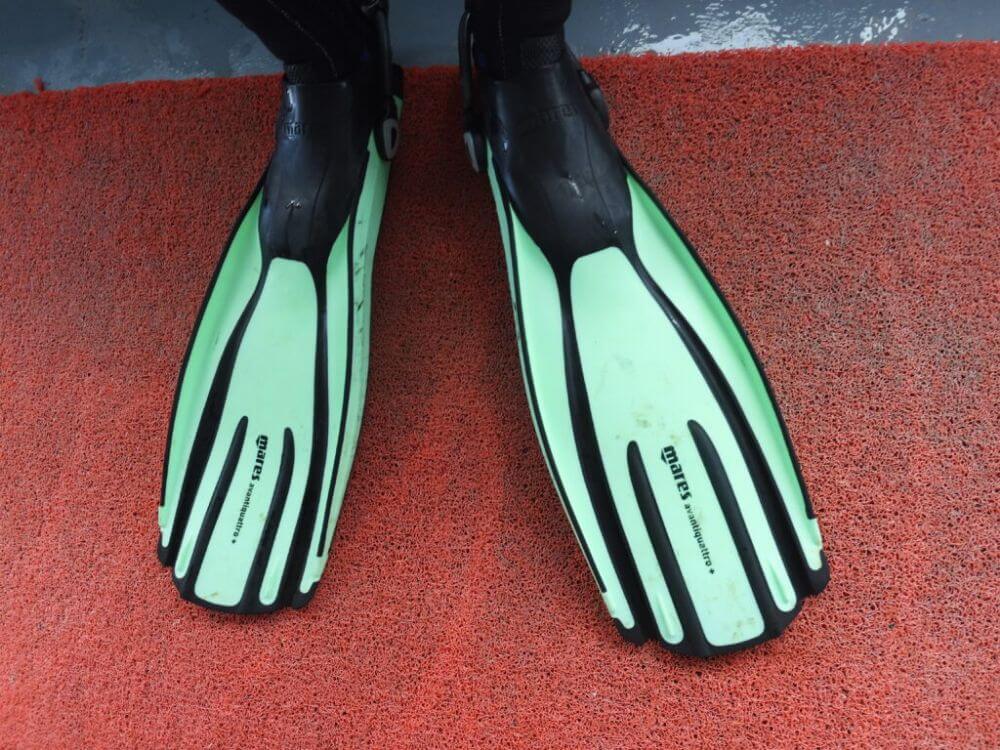
They’re powerful, comfortable and incredibly dependable, but it’s the four-channel paddle blade and strong thrust that earns them this spot. If you regularly dive in current and want fins that’ll actually get you where you’re trying to go, the Quattro+ is a bit of a classic. Mares itself describes the four-channel design as maximising water flow and thrust efficiency.
I first encountered these on a liveaboard in the Maldives, a destination renowned for its strong currents and drift diving — and the Quattro+ was the rental fin of choice on the boat.
It was actually one of the fins I remember being handed again and again as rental gear when I was first getting into diving. Years later, that makes a lot more sense — they’re tough, versatile and work for a huge range of divers.
The distinctive feature is those four channels running along the blade. Rather than simply pushing water around with a flat piece of plastic, Mares’ Channel Thrust design helps direct more of it backwards, producing plenty of propulsion from each kick.
And when the current picks up, that’s exactly what you want. They’re not magic — the ocean will still win that argument eventually — but the Quattro+ gives you considerably more authority than a really soft, lightweight travel fin.
They’re also surprisingly versatile for such a powerful fin. A regular flutter kick is where that forward thrust really shines, but the blade works well for frog kicking too. I wouldn’t choose these over the RK3 or Jet Fin specifically for technical-style manoeuvring, but they’re very capable all-rounders.
The current Quattro+ also comes with an elastic bungee heel strap with a large heel pad, making them ridiculously easy to pull on and off. The anatomical open-heel foot pocket is designed to transfer power efficiently into the blade, while stabilisers help reduce unwanted twisting through the kick.
They’re not the smallest fins in this guide, though. If you’re obsessively weighing every gram before a flight, the GO Travels make far more sense. These are fins I’d choose because I want performance underwater rather than because I want my suitcase to be delighted with me.
👍 Best For
- 🌊 Diving in strong currents
- 💪 Divers wanting plenty of thrust
- 🐸 Flutter & frog kicking
- 🏝️ Divers wanting one dependable all-round fin
📌 Key Specs
- 🤿 Type: Open heel / paddle
- 🌊 Blade: 4-channel Channel Thrust design
- ⚡ Strength: Powerful, efficient propulsion
- 🦶 Foot pocket: Anatomical open heel
- 🪢 Strap: Elastic bungee with heel pad
- 📏 Sizes: XS, S, R & XL
- 🧭 Stability: Stabilising features
- 🎨 Colours: Loads available
⭐ Bottom Line
The Mares Avanti Quattro+ has been around in various forms for years because it’s a bloody good scuba fin. It’s powerful enough for demanding conditions, comfortable enough for everyday recreational diving and versatile enough for different kicking styles.
There are lighter fins for travel and better specialised options for technical manoeuvring. But if your priority is strong, dependable propulsion — particularly when there’s current involved — the Quattro+ is very hard to argue with.
And considering how many of these I’ve seen being relentlessly abused on dive boats and rental racks over the years, they certainly don’t appear to be delicate little flowers either.
🤓 Want the ridiculously detailed version? Read my full Mares Avanti Quattro+ review →
🐸 9) Best Scuba Fins for Frog Kick: Scubapro Jet Fin ($$$)
⭐ Quick Verdict
The Scubapro Jet Fins are the all the best scuba fins for frog kicking, thanks to their short, stiff blades, excellent control and powerful thrust.
They’re also one of the most iconic scuba fins ever made — a brutally simple lump of rubber that’s been kicking divers around the ocean for more than 50 years. If that sounds suspiciously similar to why I love my RK3s, you’d be correct.
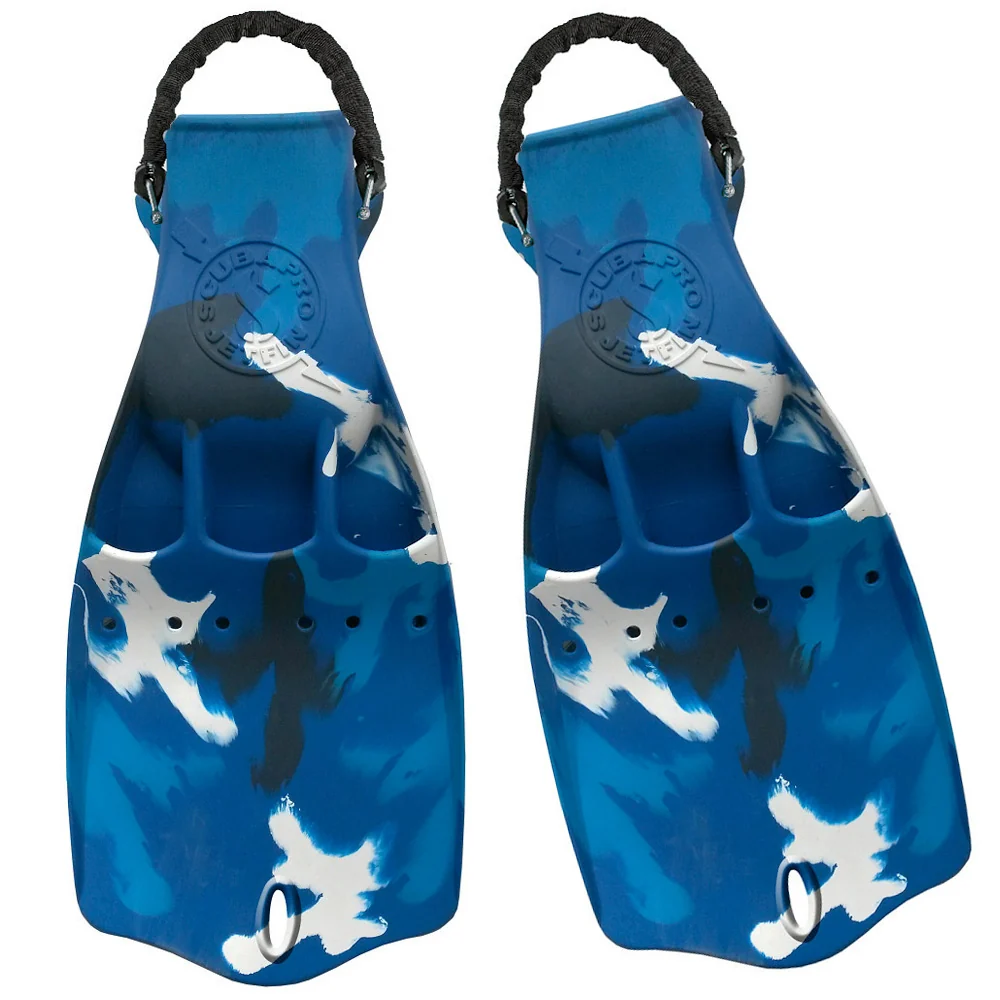
The design looks almost comically old-school compared with some of the fins in this guide. Solid rubber. Big vents. No hinges. No fancy channels. No attempt whatsoever to look aerodynamic on Instagram.
And yet the basic design has survived for decades because it works. The vents reduce drag during the upstroke while the broad rubber blade provides plenty of thrust on the downstroke.
Where Jet Fins really shine is control. That short, stiff blade lends itself beautifully to frog kicks, modified frog kicks and the small corrective movements used when you want to manoeuvre without flapping halfway across the reef.
They’re also negatively buoyant, which can be useful for divers whose legs naturally float upwards — particularly when diving drysuits. The flip side is obvious: these things are heavy, so they’re about as far from an ultralight travel fin as you can get.
Weirdly for such an old-school, brutally functional fin, they’re also some of the most stylish fins in this guide. Jet Fins have genuinely been used by military divers around the world, and you can get them in several military-style camouflage designs and colour combinations. So for once, the army camo isn’t entirely cosplay. 🪖
Admittedly, Jet Fins aren’t cheap — you’re paying premium-fin money for a design that looks like it was invented before colour television. But they’re incredibly tough, proven and built to last for years, so I think they’re totally worth the money.
You also get stainless-steel spring heel straps, which are tough, simple and very easy to pull over a dive boot. And the whole fin is made from thick rubber with the general demeanour of something that might survive the apocalypse.
👍 Best For
- 🐸 Frog kicking (like seriously – the best)
- 🎯 Precise underwater manoeuvring
- ⚙️ Technical & advanced diving
- 🪖 Anyone who reckons army camo makes everything better
📌 Key Specs
- 🤿 Type: Open heel / vented paddle
- 🧱 Material: Solid rubber
- 🌊 Blade: Short, wide & vented
- 🐸 Kicking: Excellent for frog kicks & precise movements
- 🪢 Strap: Stainless-steel spring
- ⚓ Buoyancy: Negative
- 📏 Sizes: M–2XL
- 🎨 Colours: Black + several seriously cool camo designs
⭐ Bottom Line
The Scubapro Jet Fin is old-school scuba gear in the best possible way. It’s stiff, powerful and gives you superb control — particularly for frog kicking.
They’re admittedly heavier, bulkier and more expensive than most modern fins. But they’re incredibly tough, proven and built to last for years, so I think they’re totally worth the money.
Throw in those seriously cool military-style camo colours, and you’ve got a fin that’s somehow both ridiculously old-school and unusually stylish.
There’s a reason this basic design has refused to die for more than half a century.
🦵 10) Best Split Fins: TUSA HyFlex Zoom ($$$)
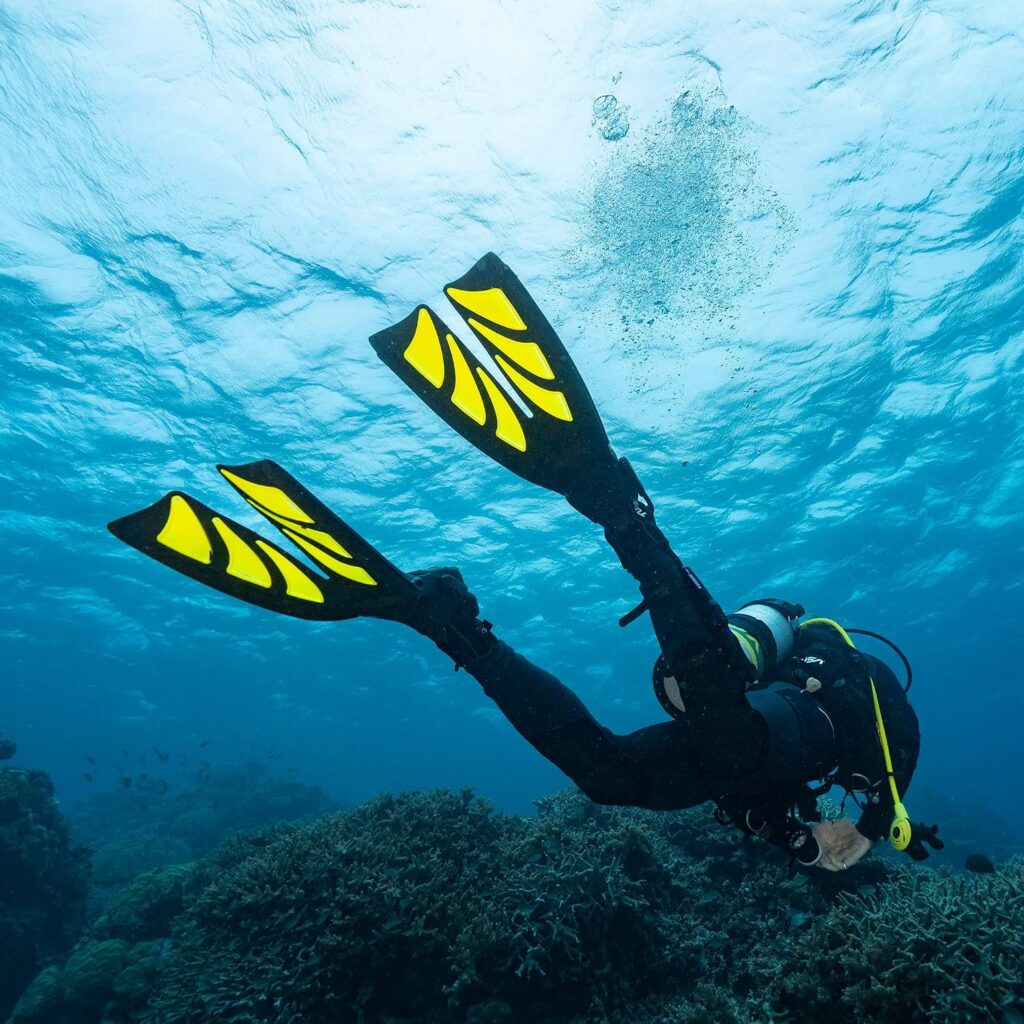
The TUSA HyFlex Zoom is my number 1 pick for best split fins — particularly for divers who want easy, efficient flutter kicking without absolutely murdering their legs.
Instead of one solid paddle, the blade is split down the middle so the two sides flex independently as you kick. The result is less resistance against your legs and a very different feeling from something stiff and chunky like the Jet Fins we just looked at.
Split fins are a bit of a weird corner of scuba gear. Some divers absolutely swear by them; others would rather attach two dinner plates to their feet.
But they do have a genuine purpose. The HyFlex Zoom is designed around quick, relatively small flutter kicks, with TUSA’s Propeller Technology allowing the two sides of the blade to flex and generate forward thrust while reducing drag.
These go a step further with six gills cut into the blade, allowing water to pass through and reducing turbulence behind it. Combined with TUSA’s flexible blade material, the whole idea is to produce useful propulsion without requiring as much effort from your legs.
That makes them particularly interesting for divers who find stiff paddle fins tiring. So if, you’re searching for the best scuba fins for bad knees, split fins like the HyFlex Zoom are worth considering because they reduce kicking resistance and require less force from your legs than stiff paddle fins.
The trade-off is control. If you’re constantly frog kicking, back kicking or making tiny technical adjustments, I’d take the RK3 or Jet Fin every time. Split fins make much more sense for recreational divers who mostly flutter kick and value efficiency over maximum precision.
That said, split fins are very much a love-them-or-hate-them design — while some divers genuinely find them easier and less tiring to kick, others notice little benefit and think they just kinda suck.
You also get an adjustable bungee strap and heel cup, with five adjustment positions, while the HyFlex system lets you separate the blade from the foot pocket — surprisingly handy when packing them for travel.
👍 Best For
- 🦵 Easy, lower-effort kicking
- 🤿 Recreational divers who mainly flutter kick
- 🦿 Divers who find stiff fins tiring
- 👌 Divers looking for less resistance against their legs
📌 Key Specs
- 🤿 Type: Open heel / split fin
- ✂️ Blade: Split design with 6 gills
- ⚙️ Technology: TUSA Propeller Technology
- 📐 Design: Angled blade
- 🪢 Strap: Adjustable bungee — 5 positions
- 🧳 HyFlex: Detachable blade & foot pocket
- 📏 Sizes: XS–L/XL
- 🎨 Colours: Several available
⭐ Bottom Line
The TUSA HyFlex Zoom is basically for divers thinking: “Could my fins please do their job without turning every dive into a leg workout?”
They’re efficient, comfortable and require less resistance-heavy kicking than a stiff paddle fin, making them one of the best split fins for recreational divers who favour a normal flutter kick.
You sacrifice some of the precise control that makes me personally love stiff paddle fins, but that’s not what these are trying to do. If easy kicking and reduced leg effort matter more to you, the HyFlex Zoom makes a lot of sense.
🚀 11) Most Innovative Design: Mares X-Stream ($$$)
⭐ Quick Verdict
The Mares X-Stream looks like someone was asked to design a scuba fin for the year 2050 — but the weirdness isn’t just cosmetic.
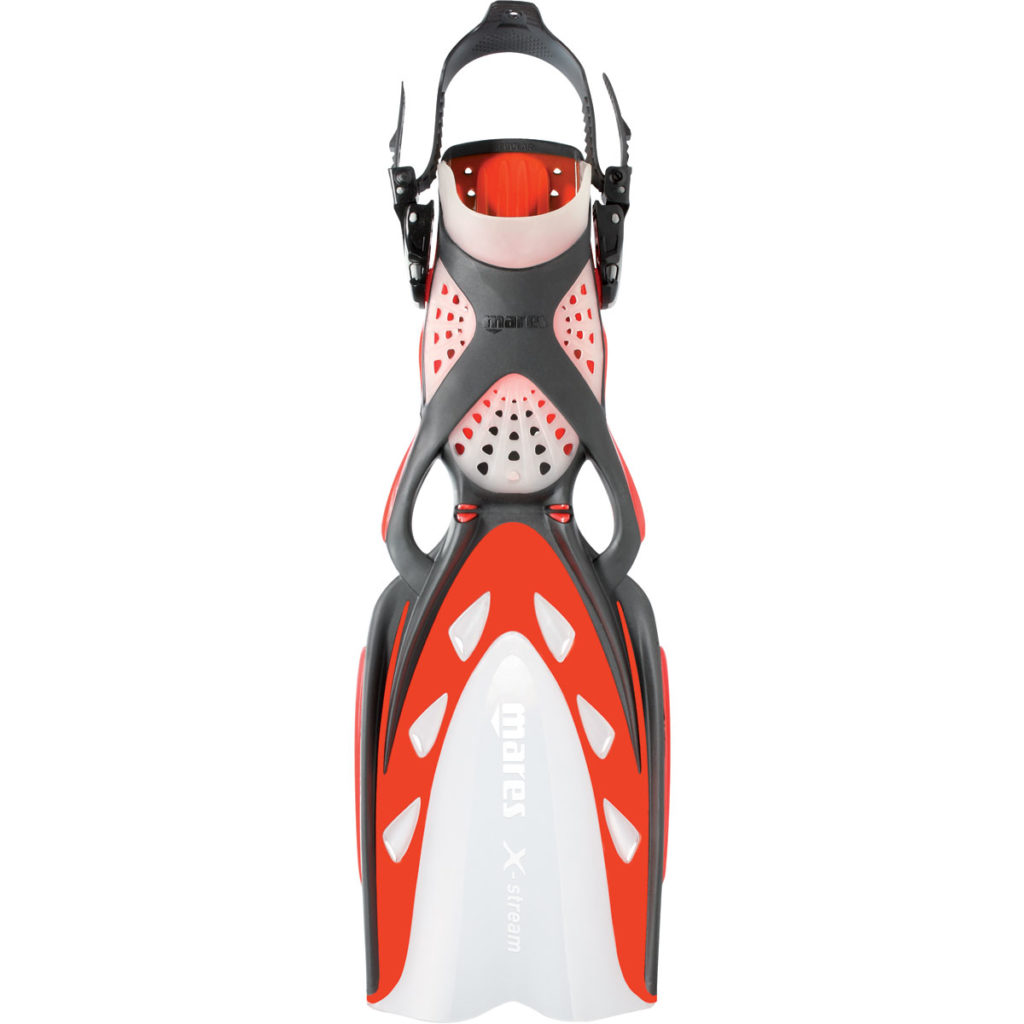
Its pivoting blade, three-material construction and heavily channelled design are all built around producing strong, efficient thrust with less wasted effort.
The big feature is Mares’ OPB (Optimized Pivoting Blade) system, which keeps the blade at an effective angle throughout your kick. Combined with Channel Thrust technology, the channels flex and direct water backwards to generate plenty of propulsion without needing an insanely stiff blade.
The construction is pretty unusual too. Mares uses three different materials, giving the fin rigidity where it needs power, flexibility where the blade needs to move and softer material around your foot. Despite looking like some enormous piece of alien machinery, they’re surprisingly lightweight.
Then there’s that distinctive foot pocket. It’s covered in large perforations designed to reduce drag, while internal ribs help distribute pressure around your foot and prevent that annoying suction effect when taking fins off.
You also get an elastic bungee strap with an ergonomic heel pad, making them quick to pull on and off over dive boots.
And obviously, we need to talk about how they look. With all those vents, channels, cut-outs and bright colour options, there really isn’t much else that looks like an X-Stream. They’re somehow completely ridiculous and extremely cool at the same time.
👍 Best For
- 🚀 Divers who love innovative gear
- ⚡ Efficient kicking
- 🦵 Divers who dislike brutally stiff fins
- 👽 Anyone bored of normal-looking fins
📌 Key Specs
- 🤿 Type: Open heel / paddle
- ⚙️ Blade: Optimized Pivoting Blade
- 🌊 Technology: Channel Thrust
- 🧱 Construction: Three materials
- 🪢 Strap: Elastic bungee
- 📏 Sizes: XS–XL
- 🎨 Colours: Several available
⭐ Bottom Line
The X-Stream is what happens when someone decides a normal piece of plastic attached to your foot isn’t complicated enough.
But underneath the bonkers appearance is some clever engineering. They’re lightweight, efficient and completely different from a traditional paddle fin.
They’re expensive, and nobody needs this much fin technology. But if you want something innovative, high-performance and genuinely unusual, they’re a brilliant choice. Plus, they look pretty awesome. 🚀
☀️ 12) Best Full-Foot Scuba Fins: Mares Volo Race ($$)
⭐ Quick Verdict
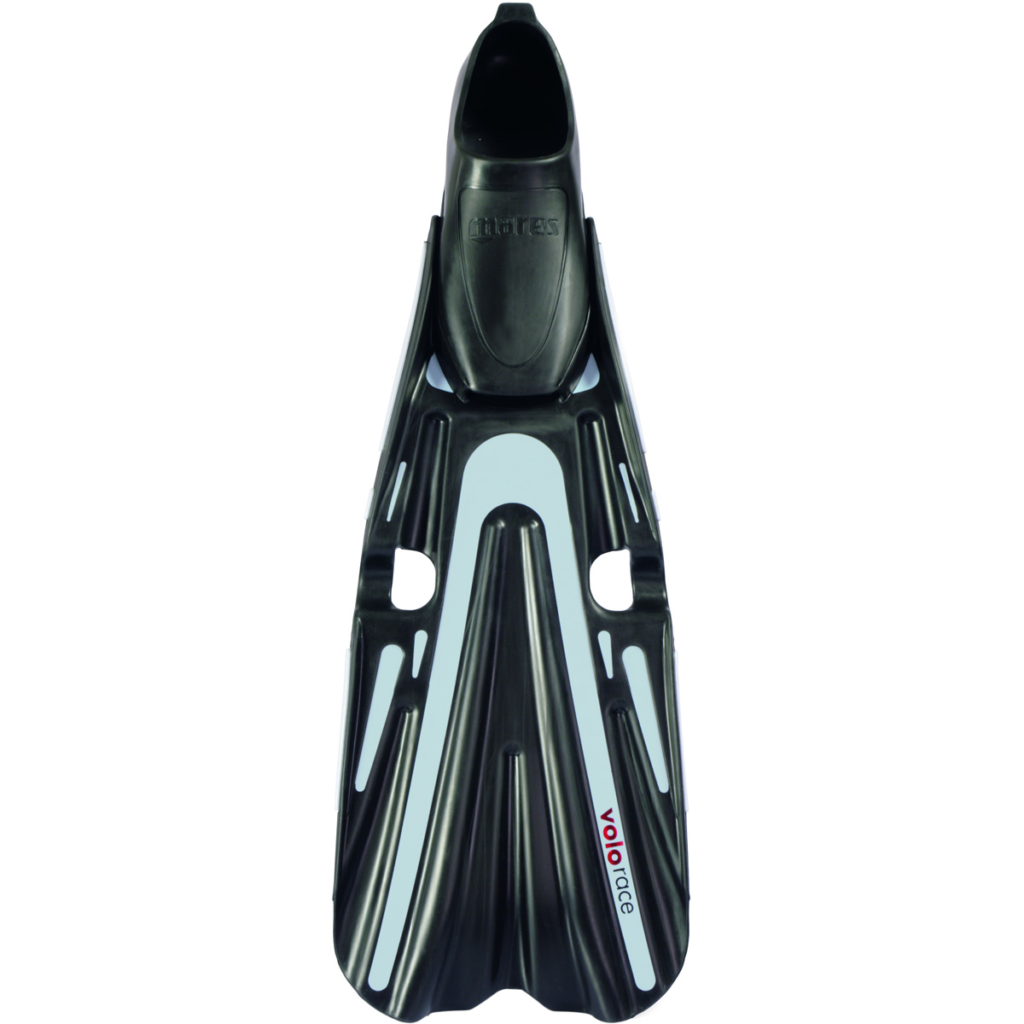
The Mares Volo Race is my pick for best full-foot scuba fins — and the odd one out in this guide.
Every other fin I’ve reviewed here is open heel. Most scuba divers prefer them because they work with dive boots and are easier to get on and off. But if you prefer diving barefoot and want something lighter and simpler, the Volo Race is one of the best-known full-foot alternatives.
Full-foot fins fit directly around your foot rather than using an adjustable heel strap. That makes sizing less forgiving and means you can’t wear normal dive boots with them, which is why I’d recommend open-heel fins to most scuba divers.
But full-foot fins have advantages. There’s no strap or buckle to mess around with, you don’t need to buy dive boots, and they can be comfortable for warm-water diving if you get the fit right.
The Volo Race also isn’t just a glorified snorkelling fin. Mares uses its Channel Thrust technology to direct water backwards for efficient propulsion, while the OPB (Optimized Pivoting Blade) system keeps the blade at an effective angle throughout your kick.
The anatomical foot pocket is designed for a comfortable, secure fit and efficient power transfer, while flexible longitudinal inserts allow controlled blade deformation as you kick.
Basically, if you’re one of the relatively small number of scuba divers who actively prefers full-foot fins, these make considerably more sense than trying to convince you otherwise.
👍 Best For
- 🦶 Divers who prefer full-foot fins
- 🩴 Diving without dive boots
- 🌴 Simple, lightweight setups
📌 Key Specs
- 🤿 Type: Full foot / paddle
- 🌊 Technology: Channel Thrust
- ⚙️ Blade: Optimized Pivoting Blade
- 🦶 Foot pocket: Anatomical full-foot design
- 🪶 Kick: Efficient, relatively low effort
- 📏 Sizes: Multiple full-foot sizes
- 🎨 Colours: Several available
⭐ Bottom Line
For most scuba divers, I’d still recommend open-heel fins and dive boots. They’re more versatile, easier to size and better suited to different diving environments.
But some divers genuinely prefer the simplicity of full-foot fins — particularly for warm-water diving — and that’s where the Volo Race comes in.
They’re comfortable, efficient and use some of the same clever blade technology found elsewhere in Mares’ range. If you already know you’re a full-foot-fin person, these are the ones I’d look at.
🤓 📊 📖 🤿 Scuba Fin Buying Guide & Terminology
Not sure how scuba fins should fit, which type of fin you need or which design works best with your kicking style?
Below I’ll cover all of that, plus the features that actually matter, scuba vs snorkelling fins and the terminology you’ll encounter when choosing a pair.
Nothing unnecessarily technical. Just the useful stuff that’ll help you figure out what the hell you actually need strapped to your feet. 👣
⚡ Jump to What You Need
📏 How to Choose the Right Scuba Fin Size
Annoyingly, scuba fin sizing is not remotely standardised. A Medium from one manufacturer can fit completely differently from a Medium elsewhere, so don’t simply think “I’m a size 9, therefore I’m a Large” and hope for the best.
Instead, start with your normal shoe size and check the manufacturer’s sizing chart for the specific fin you’re buying. Most brands give a shoe-size range for each fin size — and that’s considerably more useful than the S, M, L or XL written on the fin itself.
With the exception of full-foot fins, scuba fins are designed to be worn over dive boots. The manufacturer’s sizing chart for an open-heel scuba fin will generally account for this, so don’t automatically order a size larger just because you’ll be wearing boots.
Also check whether the chart uses US men’s, US women’s, UK or EU shoe sizes. Amazon listings aren’t always brilliantly clear about this, and those numbers are absolutely not interchangeable.
Foot shape matters too. Two people with size 10 feet can have completely different experiences with the same foot pocket thanks to width, arches and general foot chunkiness. If your feet are particularly wide or narrow, look for comments about the shape and roominess of the foot pocket rather than relying entirely on length.
If you’re between two sizes, check the manufacturer’s recommendation for that specific fin rather than automatically sizing up or down.
👣 The Simple Version
Find your normal shoe size → check the size chart for that exact fin → make sure you’re reading the correct US/UK/EU sizing → pay extra attention if you’re between sizes or have unusually wide/narrow feet.
There is no universal scuba-fin size chart, so that’s considerably safer than trusting whatever mysterious relationship apparently exists between your feet and the letter L. 👣
🐸 Choosing Scuba Fins for Your Kicking Style

The way you kick actually makes a surprisingly big difference to which fins you’ll enjoy using. Some fins are brilliant for straightforward flutter kicking but pretty crap at precise manoeuvres, while short, stiff fins generally give you much more control for frog kicks and technical-style movements.
🦵 Flutter Kick
The flutter kick is the standard up-and-down motion most divers learn first. It’s easy, intuitive and works with virtually every scuba fin.
Longer paddle fins with channels or flexible blades work particularly well because they’re designed to push plenty of water backwards with each kick. The Mares Avanti Quattro+, ScubaPro Go Travel and TUSA Solla are good examples.
If you’re mainly a recreational diver who simply wants to cruise around reefs, you really don’t need to overthink this one.
🐸 Frog Kick
My personal favourite. Most experienced divers eventually lean towards frog kicking because it’s efficient, controlled and much better for hovering motionless — you don’t have to constantly counter one kick with another.
The movement is similar to breaststroke: bring your fins outwards, then sweep them backwards together. It uses relatively little energy and avoids blasting water directly downwards, which is particularly useful around coral, sand and silty bottoms.
Shorter, stiffer fins work especially well because they give you something solid to push against the water — hence the popularity of fins like the Apeks RK3, ScubaPro Go Sport and Scubapro Jet Fin among frog kickers.
↩️ Back Kicking & Precise Manoeuvring
Once divers get more experienced, they may also learn back kicks, helicopter turns and small modified kicks for positioning themselves without swimming forwards.
This is where stiff, responsive fins really come into their own. You need the blade to react predictably to relatively small movements, which is why short technical-style fins generally outperform soft or split fins for this kind of control. Generally, fins that rock for frog kicking, are also awesome for these kinds of movements.
🤔 Which Kicking Style Should Beginners Choose For?
Most beginners start with the flutter kick. It’s the easiest and most intuitive technique to learn — essentially the same up-and-down movement you’d naturally use while swimming with fins.
As you become more experienced, it’s well worth learning the frog kick. It requires a little more technique, but gives you better control, uses less energy and makes it much easier to hover and manoeuvre without constantly kicking.
More advanced techniques like back kicking, helicopter turns and modified frog kicks can come later. They’re brilliant for precise positioning, but absolutely not something you need to worry about while you’re still figuring out which button inflates your BCD. 🤿
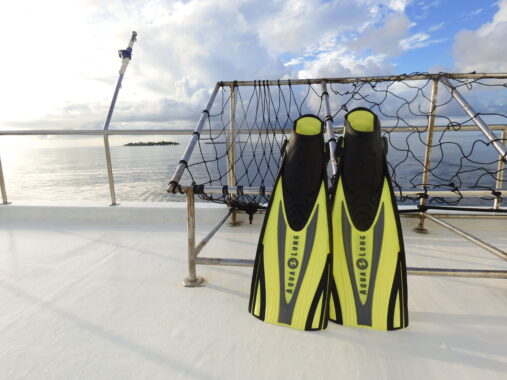
⚙️ Scuba Fin Parts & Features
Scuba fins look pretty simple — foot goes in one end, water gets kicked out the other — but quite a few design features affect how they actually perform underwater.
Here’s the terminology worth knowing:
🦶 Foot Pocket
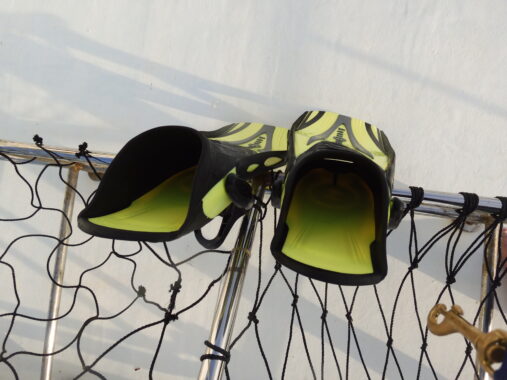
The foot pocket is where your foot sits. Revolutionary stuff.
More importantly, its shape affects both comfort and how efficiently your kicking power transfers into the blade. Some are wide and roomy, while others fit much narrower — another reason two fins labelled the same size can feel completely different.
🪢 Heel Straps & Bungees
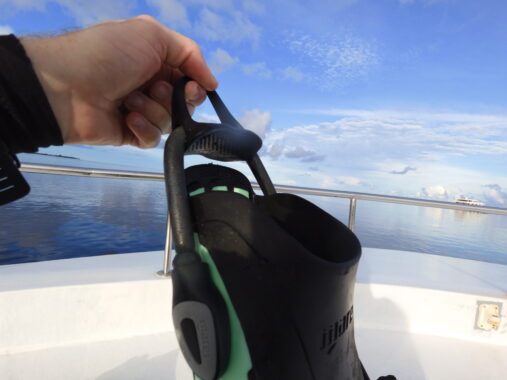
Most scuba fins are open heel, with a strap securing the fin around your dive boot.
Traditional adjustable rubber straps still exist, but many modern fins use elastic bungees or stainless-steel spring straps. These are generally quicker to pull on and off and involve considerably less pissing around with buckles on a rocking dive boat.
Replaceable straps are also handy because a broken strap shouldn’t mean a dead pair of fins.
🏄 Blade
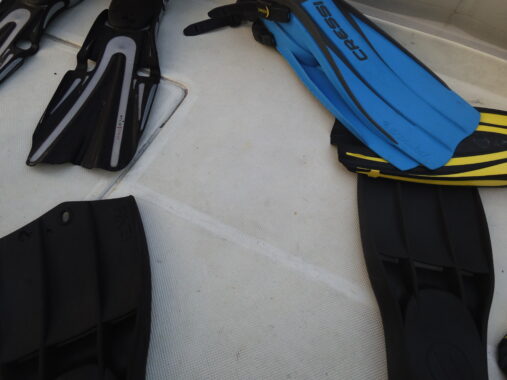
The blade is the large section that pushes against the water and generates propulsion.
Longer or more flexible blades can provide smooth, efficient propulsion, while shorter, stiffer blades generally provide greater control and responsiveness.
Stiffness matters too. Stiffer fins can generate serious thrust and provide excellent feedback, but usually require more leg strength. Softer fins are easier to kick but can feel less powerful or precise.
🌊 Channels, Rails & Stabilizers
Those grooves, ridges and rubber sections running along fin blades aren’t just there to make them look fancy.
Channels control how the blade flexes and help direct water backwards, while side rails and stabilizers can reduce unwanted twisting and help the blade maintain its shape.
Manufacturers give these features increasingly dramatic names, but they’re generally trying to do the same thing: turn more of your kicking effort into useful forward movement.
🕳️ Vents & Cut-Outs
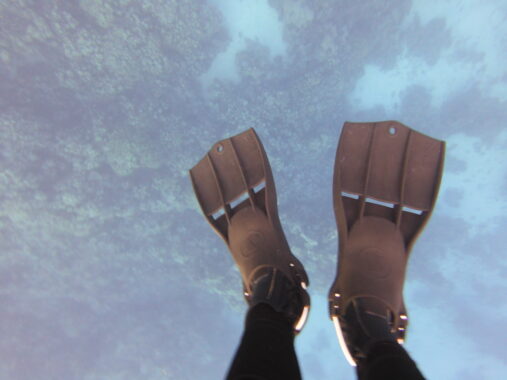
Some fins — particularly short, technical-style designs like the Apeks RK3 and Scubapro Jet Fin — have large vents near the base of the blade.
These allow water to pass through during parts of the kick cycle, reducing resistance while helping the blade maintain useful thrust.
Other fins use cut-outs and perforations to reduce drag, weight or influence how the blade flexes.
🤿 Scuba Fins vs Snorkelling Fins
First things first: every fin reviewed in this article is a scuba fin. Some can also be used for snorkelling, but they’ve all been designed and sold for scuba diving.
At first glance, scuba and snorkelling fins look pretty similar. Both are essentially large bits of plastic designed to make you considerably better at pretending to be a fish.
The main difference is that scuba fins are generally built to provide more power and control. When diving, you’re moving through the water with a tank, BCD, weights and the rest of your gear, so scuba fins tend to be more substantial than fins designed purely for snorkelling.
Most scuba fins are also open heel and worn with dive boots, whereas dedicated snorkelling fins are commonly lighter, softer and often full foot. That’s perfectly fine for cruising around the surface, but generally provides less power and control when scuba diving.
That doesn’t mean you physically can’t scuba dive in snorkelling fins. For an easy tropical dive, they’ll probably get you around. But once you’re dealing with current, bulky equipment or more precise manoeuvring, proper scuba fins make considerably more sense.
You can, however, quite happily snorkel in scuba fins — you’ll just be somewhat overqualified in the footwear department.
🤔 Can You Use the Same Fins for Scuba Diving & Snorkelling?
Absolutely. If you only want one pair, I’d buy scuba fins and use them for both.
Scuba fins will handle snorkelling perfectly well, whereas dedicated snorkelling fins aren’t necessarily going to perform as well across the much broader range of conditions you can encounter while scuba diving.
🤿 Types of Scuba Fins
Most scuba fins fall into a handful of broad categories. There’s plenty of crossover between them, but understanding the basic designs makes choosing a pair considerably easier.
🦵 Paddle Fins
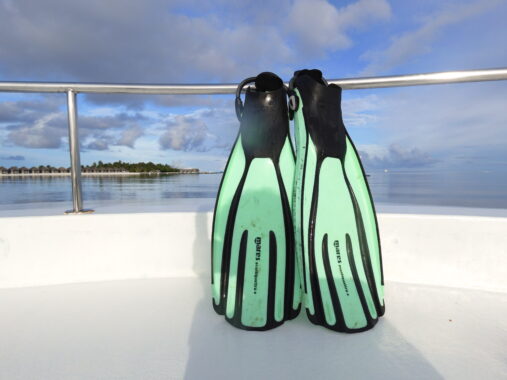
Paddle fins are the most common type of scuba fin and use a single solid blade to push water backwards as you kick.
Some are long and flexible, others short and stiff, while many use channels, rails and different materials to control how the blade flexes. They’re versatile, work with virtually every kicking style and cover everything from beginner fins to high-performance models.
The TUSA Solla and Mares Avanti Quattro+ are good examples of traditional paddle-style scuba fins.
✂️ Split Fins
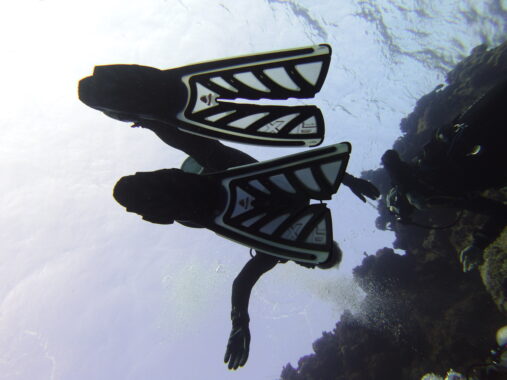
Split fins have a large opening running down the centre of the blade, allowing each side to flex somewhat independently.
They’re primarily designed for easy, repetitive flutter kicking. Some divers find the reduced resistance noticeably easier on their legs, which is why they’re often considered by people searching for the best scuba fins for bad knees.
However, split fins are very much a love-them-or-hate-them design. Other divers notice little benefit, dislike the reduced feedback and control, and think they just kinda suck.
They’re also generally less suited to frog kicks, back kicks and precise manoeuvring than a good stiff paddle fin.
⚙️ Tech / Vented Fins
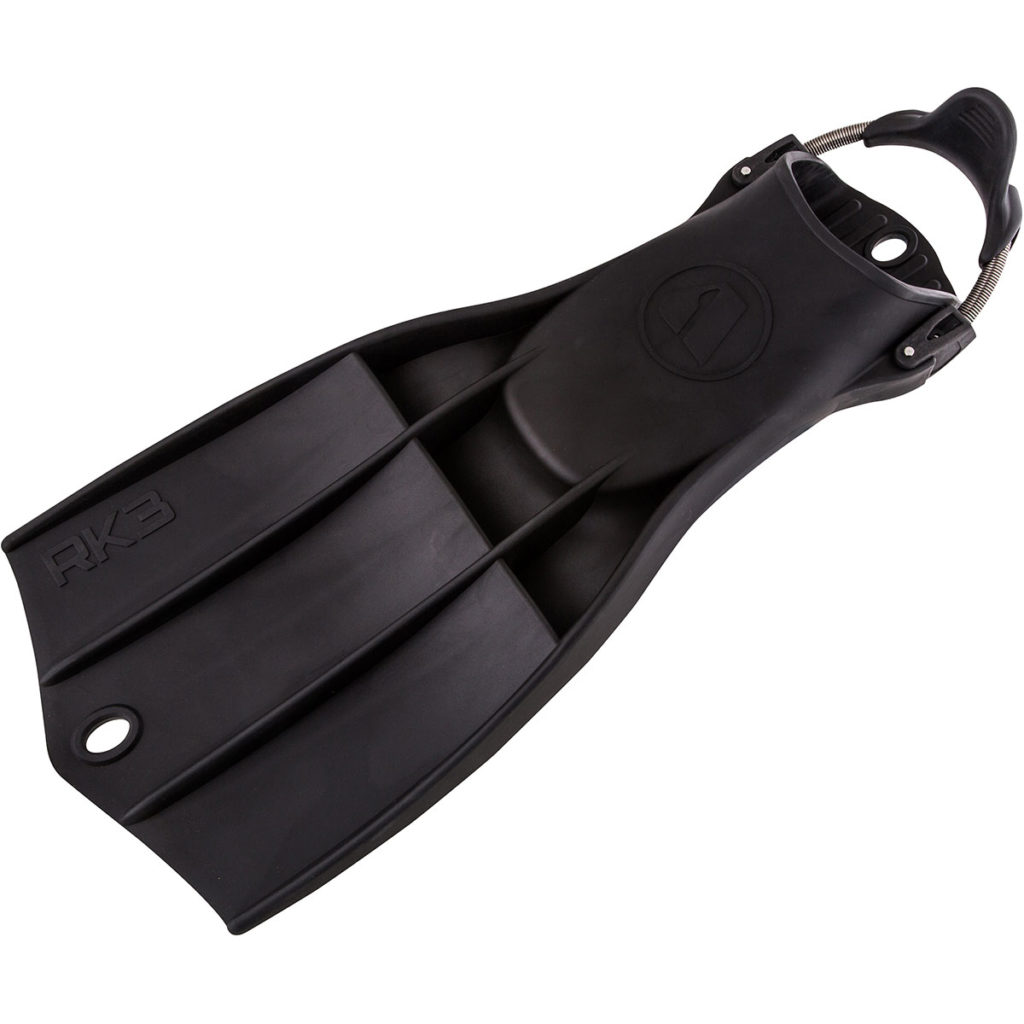
Technical-style fins are generally shorter, wider and stiffer, often with large vents near the base of the blade.
They provide excellent control and work particularly well for frog kicks, back kicks, helicopter turns and small positioning movements, which is why they’re so popular with technical, cave and wreck divers.
The Apeks RK3 and Scubapro Jet Fin are classic examples.
The trade-off is that they’re often heavier and less compact than softer recreational or travel fins. You certainly don’t need to be a technical diver to use them, though — my RK3s are my favourite fins for ordinary recreational diving too.
👽 Hybrid & Unusual Designs
And then there are fins that apparently looked at conventional paddle fins and decided absolutely none of that would do.
Designs such as the Scubapro Seawing Nova use articulated sections that allow the blade to pivot during the kick, while fins like the Mares X-Stream use unusual channels, cut-outs and pivoting blade technology.
The goal is generally to combine strong propulsion with easier, more efficient kicking.
They can work brilliantly, but don’t assume more moving parts, holes and dramatic marketing terminology automatically means a better fin. Sometimes a big slab of rubber really does work just fine.
🥾 Open Heel vs Full Foot Fins
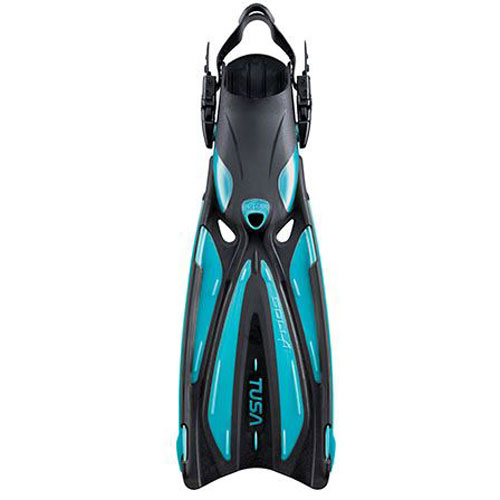
Finally, scuba fins can have either an open or full foot pocket.
Open-heel fins leave the back of your foot exposed and use a strap, bungee or spring to secure the fin around your heel. They’re worn with dive boots and are by far the most common choice for scuba diving.
Full-foot fins wrap around your entire bare foot like a shoe. They’re lighter and simpler, but can’t accommodate normal dive boots and offer much less flexibility with sizing.
Every fin in this guide except the Mares Volo Race is open heel.
For the vast majority of scuba divers, I’d recommend open-heel fins. Full-foot fins make most sense if you already know you prefer them, particularly for warm-water diving.
🤿 Final Thoughts
Scuba fins are one of those bits of gear that seem incredibly simple until you actually start comparing them. Fit, stiffness, blade design, kicking style and what kind of diving you do can all completely change which pair feels best.
For me, the Apeks RK3 remains the winner. I’ve used mine for years, they’re tough as hell, give me excellent control and suit the way I like to dive. But they’re certainly not the perfect fin for everyone.
There are lighter fins for travel, easier fins for beginners, split fins for effortless flutter kicking and considerably cheaper options if spending $200+ on things you attach to your feet sounds completely insane.
Ultimately, don’t get too obsessed with finding the mythical perfect scuba fin. Get the sizing right, choose something appropriate for how you dive and learn to use them properly.
Then go diving.
Your feet have received quite enough attention for one article. 👣🤿
Support the Squad!
We are part of the Amazon Services LLC Associate Program. If you make a purchase on amazon after clicking a link on Diving Squad, we earn a small commission fee, at no extra cost to yourself.
We are also part of several other affiliate programs so if you click on a Diving Squad affiliate link that results in you booking a liveaboard, booking accommodation, purchasing insurance or buying a product somewhere else, once more we make a small commission, without it costing you a cent extra. Thanks!