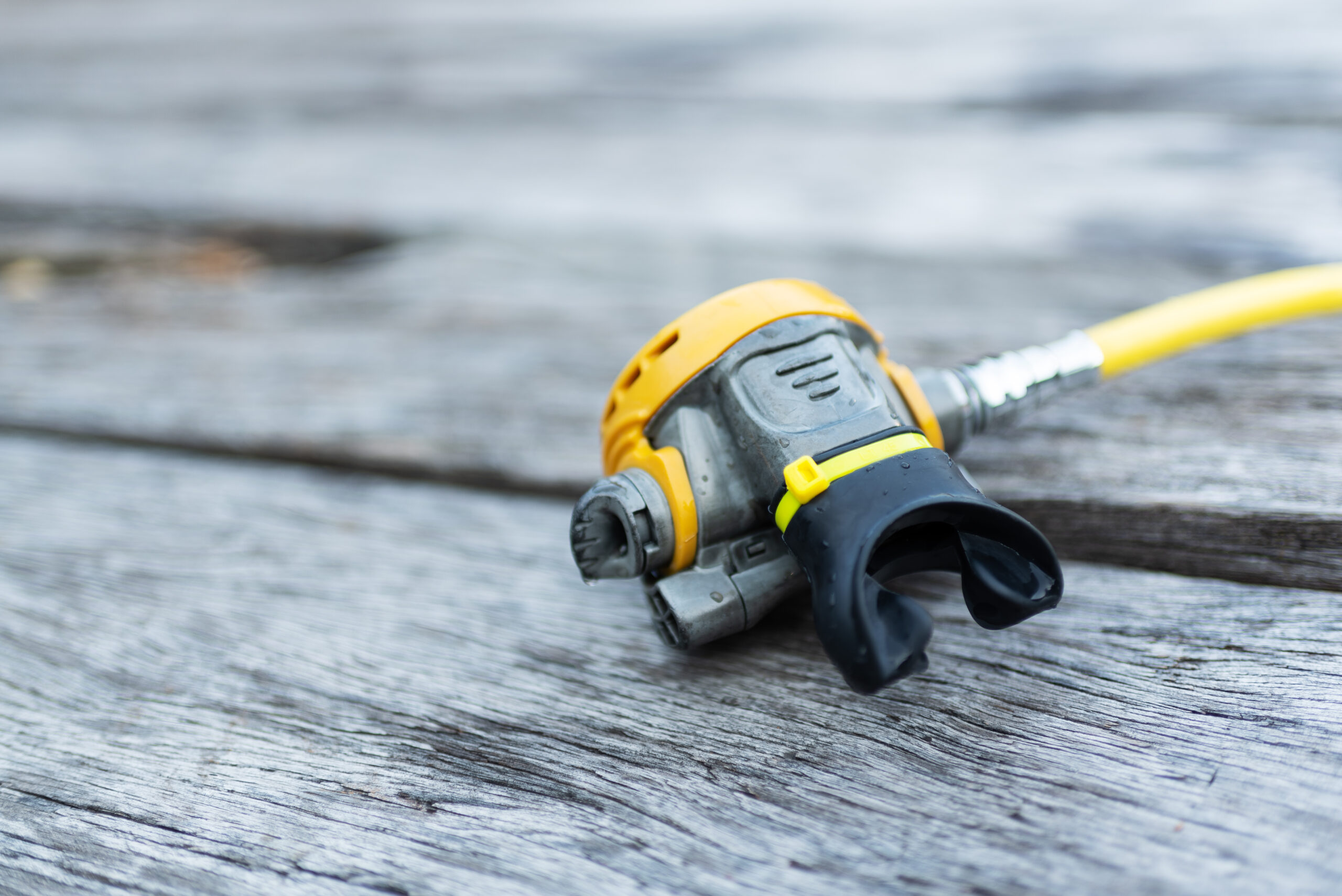
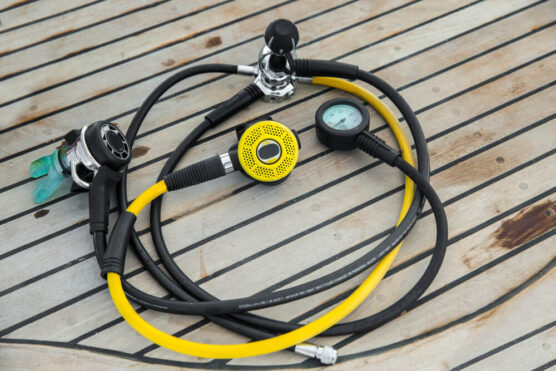
If you’re looking for the best scuba regulator in 2026, this guide focuses on the ones that deliver where it matters — smooth breathing, real comfort, and reliable performance underwater.
Hi! I’m Alex, creator of Diving Squad and a scuba instructor currently based in the Philippines. Between my own regulators, dive-shop rental gear and the setups I see other divers using, I get to experience a pretty wide range of regs underwater.
And trust me, the differences are bigger than you might think. Some regulators breathe so smoothly you barely notice they’re there; others feel heavier, more restrictive and can leave your jaw aching after a long dive. Some are also big and bulky, while others are seriously compact and lightweight — perfect if you’re travelling with your dive gear.
The good news? You absolutely don’t need to spend a fortune to get a great regulator. But there is a point where going too cheap starts costing you in comfort, breathing performance and build quality — and spending more doesn’t always mean you’ll notice a huge difference underwater either.
Below are my 10 best scuba diving regulators for 2026, picked for breathing performance, comfort, weight, build quality and reliability — with options for beginners, travellers and divers on a budget.
⚡ 🤿 Quick Picks: Best Scuba Diving Regulators
🏆 1) My Top Pick — Oceanic Delta 5
My go-to regulator after extensive real-world use — smooth breathing, adjustable and an excellent all-rounder.
👉 Read Review ↓ | 🛒 Check Price
✈️ 2) Best Travel Regulator — Oceanic Alpha 10
Lightweight, compact and straightforward — another regulator I’ve personally used extensively over the years.
👉 Read Review ↓ | 🛒 Check Price
🤑 3) Cheapest — Palantic AS101
An extremely affordable regulator setup for divers looking to spend as little as possible.
👉 Read Review ↓ | 🛒 Check Price
🛠️ 4) Simple & Reliable — Cressi MC9-SC Compact Pro
A straightforward Cressi setup I’ve seen put through regular use at the dive centre in Panglao.
👉 Read Review ↓ | 🛒 Check Price
⚙️ 5) Best All-Rounder — Scubapro MK25 EVO / S600
A high-performance balanced regulator pairing with excellent airflow and plenty of breathing adjustment.
👉 Read Review ↓ | 🛒 Check Price
💎 6) Best Premium — Atomic T3
A seriously high-end titanium regulator built around low weight, corrosion resistance and effortless breathing.
👉 Read Review ↓ | 🛒 Check Price
🤿 7) Best Mid-Range — Scubapro MK11 EVO / C370
A compact balanced-diaphragm setup offering plenty of Scubapro performance without going top-of-the-range.
👉 Read Review ↓ | 🛒 Check Price
💰 8) Budget Scubapro Option — Scubapro MK2 EVO / R105
One of the more affordable ways into Scubapro, with a simple, proven regulator design.
👉 Read Review ↓ | 🛒 Check Price
🎛️ 9) Unique Breathing Control — Aqualung Leg3nd MBS
A premium regulator with an unusual MBS control that adjusts inhalation resistance and Venturi assistance together.
👉 Read Review ↓ | 🛒 Check Price
❄️ 10) Best Cold Water Regulator — Scubapro MK19 EVO / G260
A sealed, cold-water-focused setup designed for demanding dives and low temperatures.
👉 Read Review ↓ | 🛒 Check Price
🤓 ⚙️ 📊 📈 Not sure what all these Regulator Specs mean!?
Dive down to the Scuba Regulator Info, Terminology & Buying Guide ↓ for nerdy explanations of DIN vs Yoke, first and second stages, balanced vs unbalanced, piston vs diaphragm, breathing controls, cold-water regulators and more.

Ahoy! I’m Alex — a PADI Scuba Diving Instructor and the creator of Diving Squad. I started this blog back in early 2019, during a five-year odyssey spent drifting through Southeast Asia, Central America and beyond. In 2023, I landed in Panglao, Philippines — and liked it so much I never really left. I’ve been based here ever since, diving, teaching and continuing to build Diving Squad. When I’m not underwater, I’m usually editing dive footage, plotting the next questionable adventure or cruising around on my bike — but never for long before the reefs pull me back.
🌊🤘📚 Reviews of the Best Scuba Regulators
🏆 🤿 1) My Top Pick: Oceanic Delta 5
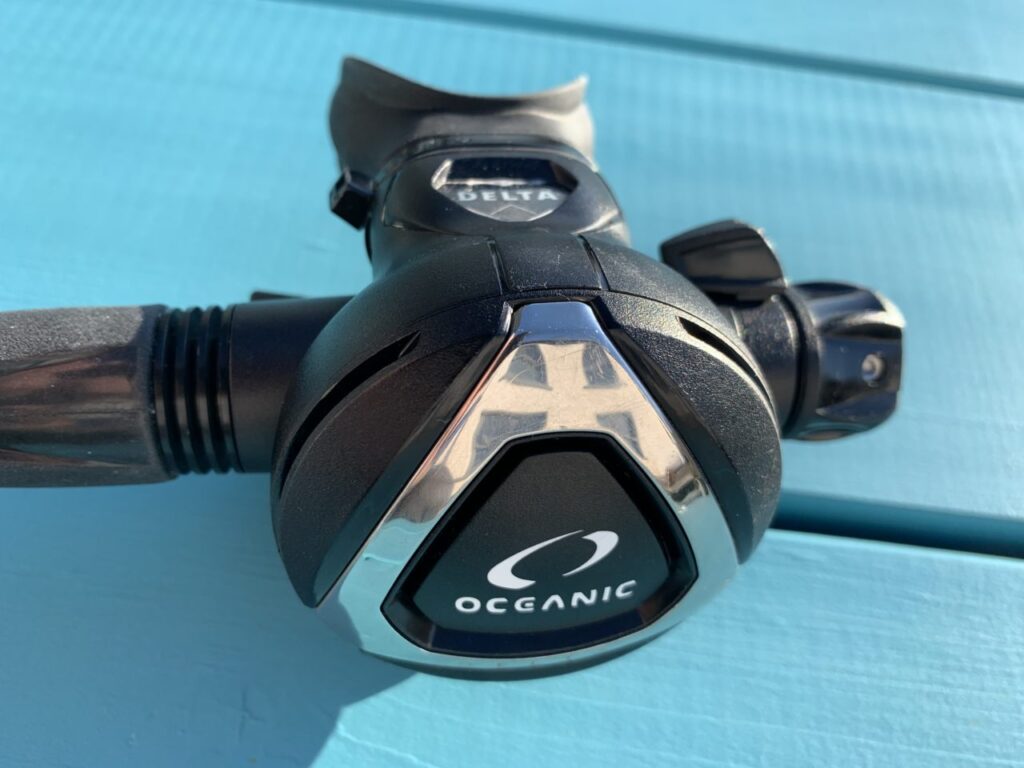
⭐ Quick Verdict
The Oceanic Delta 5 is my Top Pick and my personal favourite scuba regulator — it’s the one I reach for on most dives. It breathes incredibly smoothly, feels comfortable even after multiple dives and delivers near-premium performance without the premium price tag.
I’ve used the Oceanic Delta 5 extensively while teaching, filming content and just diving for fun, and it’s still my favourite regulator I’ve owned.
The biggest thing I notice is simply how effortless it feels to breathe from. Air delivery is smooth and predictable, without that slightly restricted feeling you sometimes notice with cheaper rental regulators. When I’m teaching, that reliability means I can basically forget about my own gear and concentrate on my students.
It’s also seriously comfortable. The Delta 5 uses a dual-material orthodontic mouthpiece, and on long dives or multiple-dive days I notice considerably less jaw fatigue than I’ve experienced with some other regulators.
There’s an adjustable airflow control if you want to fine-tune the breathing resistance, although most of the time I barely touch it. Once I’m underwater, the Delta 5 just fades into the background — which is exactly what I want from a regulator.
The first stage is built from forged, chrome-plated marine brass, giving it that chunky exposed-metal look that I think looks pretty badass (!) while also providing excellent durability and corrosion resistance.
I’ve used mine extensively in warm tropical water as well as cooler conditions, and it has always felt consistent and dependable. For me, it hits that sweet spot where performance, comfort and price all come together — which is ultimately why it’s the regulator I reach for more than any other.
👍 Best For
- 🏆 Divers wanting an excellent all-round regulator
- 😌 Long dives and multiple-dive days where comfort matter
- 🤿 Regular recreational divers
- 💰 Divers wanting near-premium performance without spending a fortune
📌 Key Specs
- 💨 Smooth, consistent air delivery
- 🎛️ Adjustable airflow control
- 😁 Dual-material orthodontic mouthpiece
- 🔩 Forged chrome-plated marine-brass first stage
- 🌡️ Suitable for warm and cooler-water diving
- 😎 Forged chrome-plated marine-brass first stage — looks totally badass!
- 🔗 Connection: Available in DIN or Yoke versions
⭐ Bottom Line
The Oceanic Delta 5 is the regulator I keep coming back to. It’s smooth, comfortable, tough and dependable, without costing anywhere near as much as some premium regulators.
If you want one high-quality regulator that can handle the vast majority of recreational diving and last you for years, this is my Top Pick.
✈️ 🤿 2) Best Travel Regulator: Oceanic Alpha 10
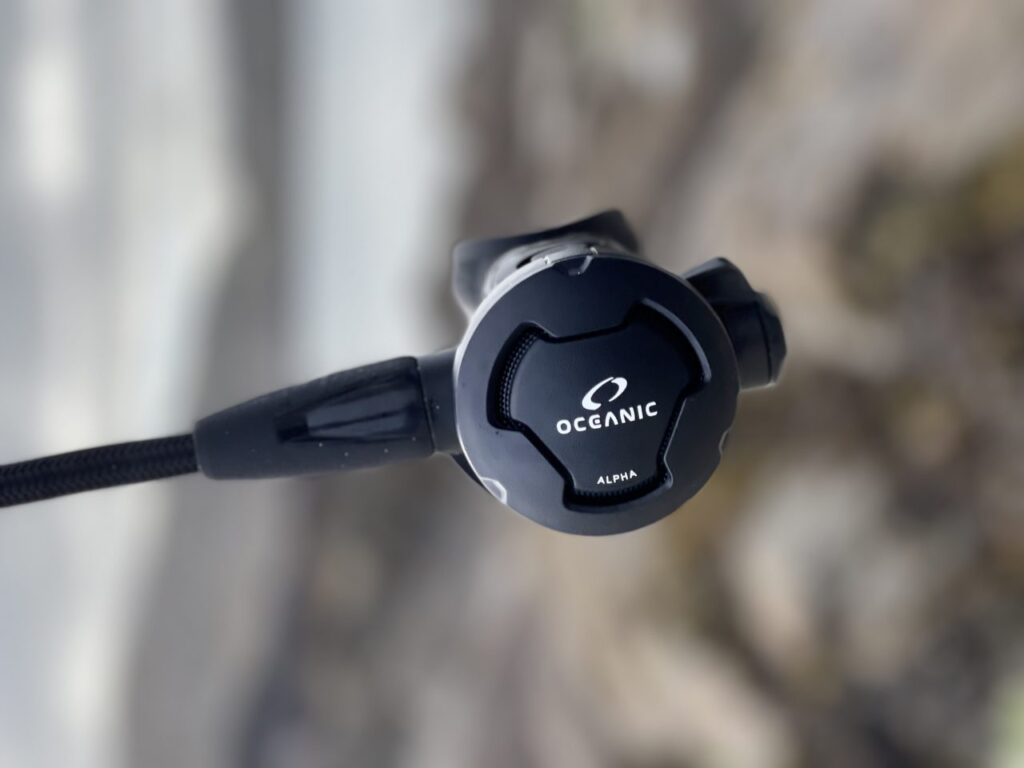
⭐ Quick Verdict
The Oceanic Alpha 10 is my Best Travel Regulator — it’s compact, lightweight, affordable and, most importantly, I’ve personally been diving with an Alpha 10 for years. If you want a dependable regulator that won’t take up half your luggage allowance, this is an excellent choice.
🛒 Prefer DIN? Check Oceanic Alpha 10 DIN on Amazon
I’ve used an Oceanic Alpha 10 as my alternate regulator for years, so this is another model I know extremely well underwater.
What immediately stands out is how small and unobtrusive it feels. It adds very little bulk to my setup and, after travelling around with dive gear enough times, I’ve come to appreciate anything that keeps the overall size and weight down.
Despite being relatively affordable, it doesn’t feel like a bargain-bin regulator either. The second stage feels solid and dependable, and breathing from it is smooth and predictable — exactly what I want from something I may need to rely on underwater.
It’s also refreshingly simple. You don’t get the extensive adjustment controls and premium features found on regulators like the Delta 5, but for travelling that’s arguably part of the appeal: it’s compact, straightforward and doesn’t have loads of unnecessary bulk.
My own Alpha 10 is used as an alternate rather than my primary regulator, but after years of diving with it, I’d have no hesitation choosing the Alpha 10 system as a lightweight travel setup.
👍 Best For
- ✈️ Travelling divers wanting a compact, lightweight regulator
- 🎒 Divers trying to minimise the size and weight of their dive luggage
- 💰 Anyone wanting a dependable regulator without premium-regulator prices
- 🤿 Recreational divers who value simplicity over loads of adjustments
📌 Key Specs
- 🎒 Design: Compact, lightweight and travel-friendly
- 💨 Breathing: Balanced-diaphragm CDX first stage
- 🔩 Build: Chrome-plated marine-brass first stage
- 🌊 Protection: Environmentally sealed first stage
- 🎛️ Controls: Simple second-stage adjustment
- 🔗 Connection: Available in DIN or Yoke versions
⭐ Bottom Line
The Alpha 10 is compact, lightweight and refreshingly straightforward, which is exactly what I want from a regulator designed with travel in mind. There’s no unnecessary bulk or complicated controls — just a simple setup that’s easy to throw in your dive bag and take anywhere.
I’ve personally dived with the Alpha 10 for years, and that’s why I’m comfortable recommending it. If you want a dependable regulator for travelling and recreational diving without paying for features you don’t really need, it’s an excellent choice.
🛒 Prefer DIN? Check Oceanic Alpha 10 DIN on Amazon
💰 ⭐ 🤑 3) Cheapest Scuba Regulator: Palantic AS101 ($)
⭐ Quick Verdict
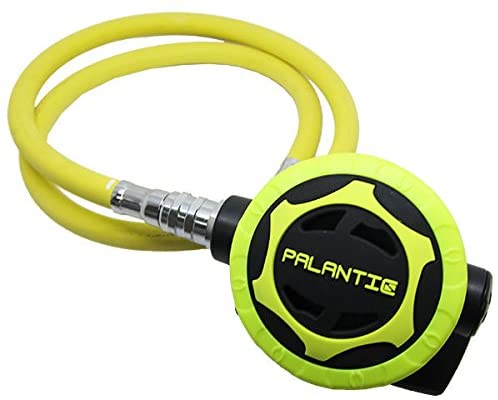
The Palantic AS101 is the cheapest scuba regulator on this list — and by quite a margin. It’s basic, no-frills and nowhere near as refined as the regulators above, but if your priority is simply getting a functional regulator setup for as little money as possible, it’s hard to beat.
The biggest reason to consider the Palantic AS101 is obvious: it’s ridiculously cheap for what you get.
Unlike many regulators sold at this price, the package I’ve linked to includes a primary and alternate second stage, so you’re already getting more of your regulator setup in one purchase rather than immediately having to buy a separate octopus.
I also see Palantic regulators surprisingly often in dive shops and rental setups. They’re certainly not glamorous, but that’s kind of the point — they’re simple regulators designed to get used rather than admired.
Construction is similarly straightforward, with a chrome-plated brass first stage and relatively basic second stages. You don’t get the breathing adjustments, swivels or more sophisticated features found on expensive regulators.
And yes, you can tell the difference underwater. Breathing isn’t as effortless or refined as something like my Oceanic Delta 5, and if I were diving regularly, I’d personally spend more.
But that’s not really what the AS101 is competing for. It’s about getting a usable regulator setup at an exceptionally low price, and on that front it makes a strong case for itself.
👍 Best For
- 💰 Divers on the tightest possible budget
- 👶 Beginners buying their first regulator setup cheaply
- 🤿 Occasional recreational divers who don’t need premium features
- 🏝️ Anyone wanting a basic, no-frills regulator
📌 Key Specs
- 🔩 Construction: Chrome-plated brass first stage
- 🧊 Design: Environmentally sealed first stage*
💨 Breathing: Simple, no-frills design
- 💵 Price: One of the least expensive regulator packages in this guide
- 🔗 Connection: Available in DIN or Yoke versions
⭐ Bottom Line
The Palantic AS101 isn’t going to breathe like a premium regulator — but it isn’t trying to. It’s a remarkably inexpensive way to get your own regulator, and the inclusion of an alternate second stage makes the package particularly appealing for divers trying to keep costs down.
If price matters more than refinement, this is the one I’d look at.
🛠️ 🤿 4) Simple & Reliable: Cressi MC9-SC Compact Pro
⭐ Quick Verdict
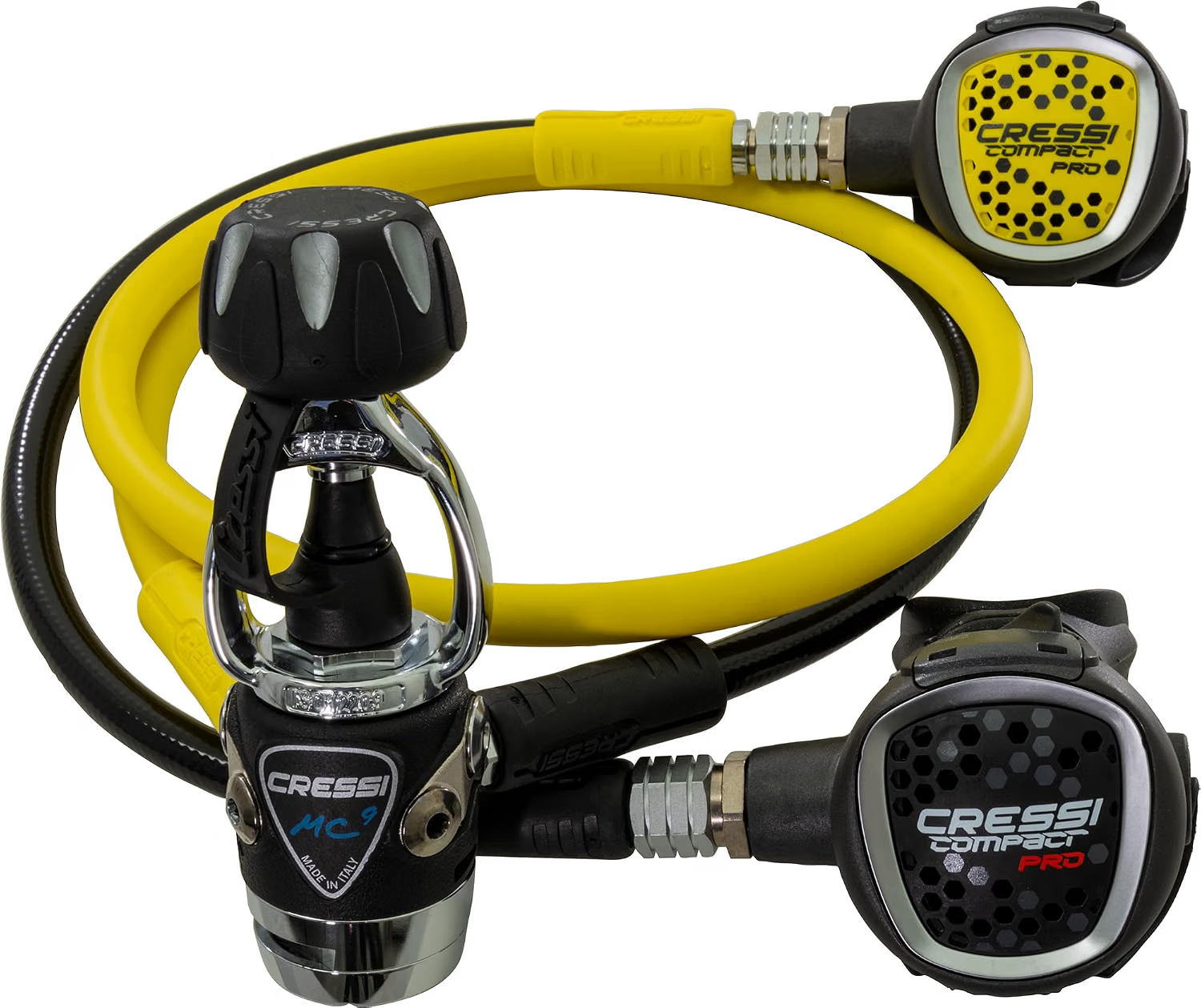
The Cressi MC9-SC Compact Pro is my Simple & Reliable pick — and it’s a regulator we use at Charming Blue, my dive shop in Panglao. It’s compact, lightweight and tough enough to withstand constant use, while the sealed first stage and cold-water capability make it considerably more versatile than its small size suggests.
We use the Cressi MC9-SC Compact Pro at Charming Blue in Panglao, so I’ve seen these regulators subjected to considerably more use than the average personally owned regulator will ever experience.
Rental equipment gets dived again and again, used by divers with wildly different experience levels and generally treated like rental equipment gets treated. And these just keep doing their job.
What I particularly like about this setup is that it manages to be small and lightweight without feeling like an ultra-basic regulator. The Compact Pro second stage is tiny, which makes it comfortable in your mouth and also means the whole setup takes up surprisingly little space in a dive bag.
The MC9-SC first stage is more sophisticated than Cressi’s cheaper AC2. It uses a balanced diaphragm design with an environmentally sealed chamber, helping protect the internal components while also allowing the regulator to perform in cold water.
Breathing is smooth and predictable, while the second stage has an adjustable Venturi control for switching between pre-dive and dive modes. It doesn’t give you the extensive fine-tuning of some premium regulators, but for most recreational diving there’s very little here that feels unnecessarily complicated.
That’s really the appeal for me: it’s compact, dependable and versatile without trying to reinvent the regulator.
👍 Best For
- 🛠️ Divers wanting a dependable, straightforward regulator
- 🎒 Travellers who appreciate compact, lightweight equipment
- ❄️ Divers wanting something capable of both warm and cold-water diving
- 🤿 Recreational divers who don’t need loads of complicated adjustments
📌 Key Specs
- ⚙️ First Stage: Balanced-diaphragm MC9-SC
- 🛡️ Sealed Chamber: Environmentally sealed first stage
- 🪶 Second Stage: Ultra-light Compact Pro — just 140 g without hose
- 🎛️ Controls: Adjustable Venturi / dive-pre-dive control
- 🔩 Ports: 2 high-pressure + 4 low-pressure ports
- 🔗 Connection: Available in DIN or Yoke versions
⭐ Bottom Line
The Cressi MC9-SC Compact Pro hits a really useful middle ground. It’s small enough for travelling, capable enough for cold-water diving and, from my experience with it at the dive shop, tough enough to withstand repeated use.
If you want a regulator that’s compact, versatile and refreshingly straightforward, this is one of my favourite value-oriented choices.
⚙️ 🤿 5) Best All-Rounder: Scubapro MK25 EVO/S600
⭐ Quick Verdict
The Scubapro MK25 EVO/S600 is my Best All-Rounder — a seriously capable regulator that combines excellent breathing performance, plenty of adjustment and the ability to handle a huge range of diving conditions. It ain’t cheap, but it’s built for divers who want one high-performance regulator they can use for years.
🛒 Prefer DIN? Check Scubapro MK25 on Amazon
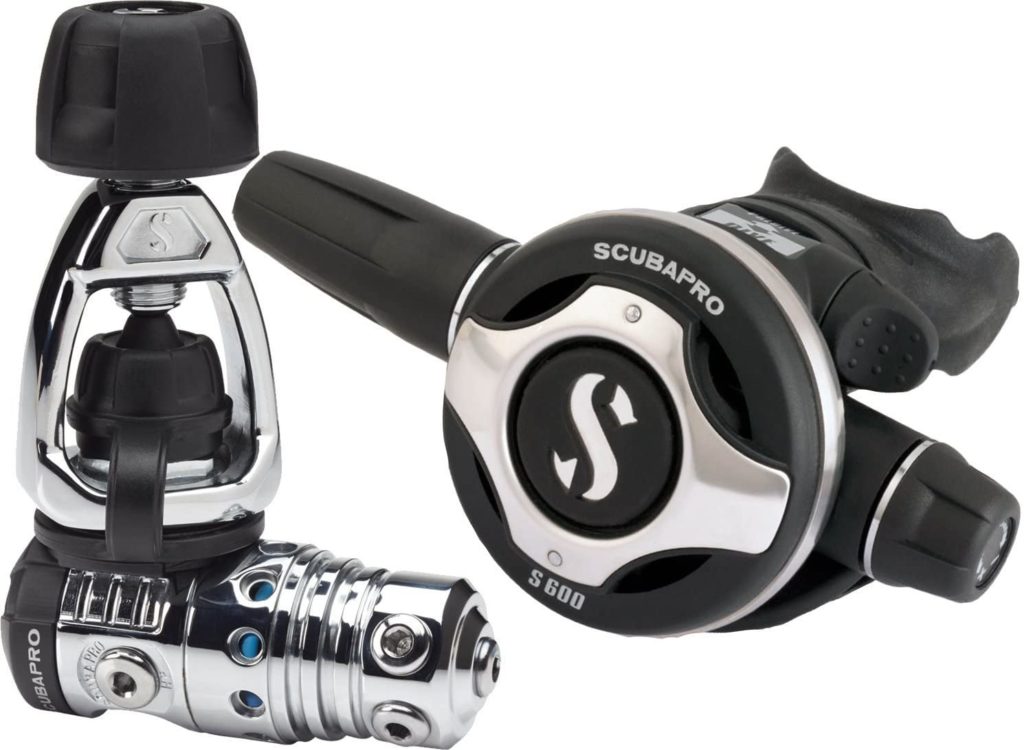
The MK25 is one of those regulator first stages you see everywhere among experienced divers, and Scubapro pairs it with several different second stages. For this guide, I’ve gone with the S600, which I think makes the most sense as the all-rounder.
At its heart is Scubapro’s balanced-piston MK25 EVO first stage, designed to maintain strong airflow even when you’re deeper, breathing harder or tank pressure begins to drop.
The S600 second stage complements it nicely. Rather than the heavy all-metal construction of the A700, it uses a lighter technopolymer casing with metal components, while still delivering the adjustable, high-performance breathing you’d expect from one of Scubapro’s flagship setups.
You can adjust both inhalation resistance and the Venturi effect, allowing you to fine-tune how the regulator breathes rather than simply accepting one factory setting.
Another big advantage is versatility. The MK25 EVO incorporates Scubapro’s cold-water-focused XTIS system, while its swivelling first-stage turret and multiple low-pressure ports give you plenty of flexibility when routing your hoses.
This isn’t the cheapest, smallest or lightest regulator here — it’s the one I’d look at if versatility and outright performance matter more than specialising in one particular area.
👍 Best For
- ⚙️ Divers wanting one high-performance regulator for varied conditions
- 🤿 Frequent recreational divers
- 🌡️ Divers looking for a more premium experience
- 🎛️ Anyone who likes being able to fine-tune how their regulator breathes
📌 Key Specs
- ⚙️ First Stage: Air-balanced flow-through piston
- 💨 Second Stage: Air-balanced S600
- 🎛️ Controls: Adjustable inhalation resistance + Venturi control
- 🔄 Hose Routing: Swivelling turret with five low-pressure ports
- ❄️ Cold Water: MK25 EVO with Scubapro XTIS thermal protection
- 🔗 Connection: Available in DIN or Yoke versions
⭐ Bottom Line
The MK25 EVO/S600 doesn’t win by being the cheapest or most compact regulator — it wins by being extremely capable at almost everything.
If you dive regularly, encounter different conditions and want a high-performance setup you won’t quickly outgrow, the Scubapro MK25 EVO/S600 is my Best All-Rounder.
🛒 Prefer DIN? Check Scubapro MK25 DIN on Amazon
💎 🤿 6) Best Premium Regulator: Atomic T3
⭐ Quick Verdict
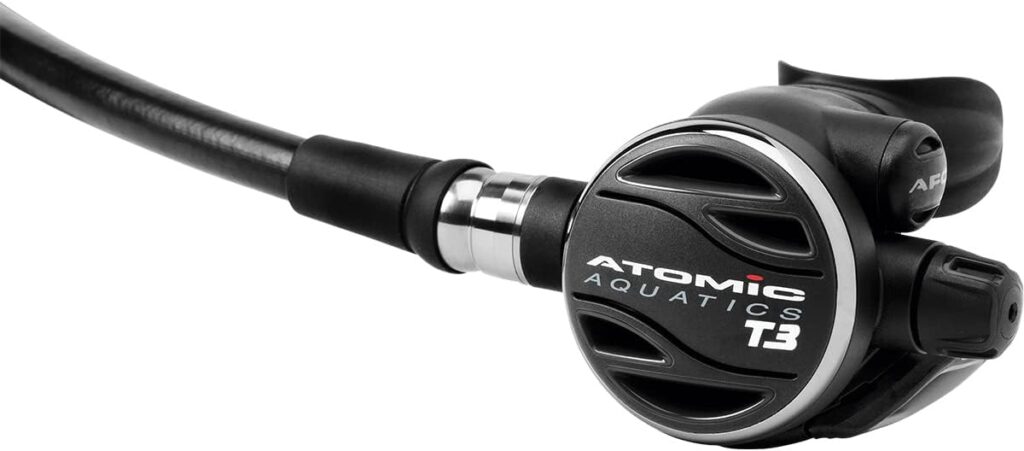
The Atomic T3 is an absolute beast of a regulator — being exceptionally lightweight, titanium-heavy flagship designed around effortless breathing, comfort and corrosion resistance. It’s undeniably expensive and absolutely more regulator than most recreational divers need, but if price isn’t a major concern, the T3 is about as premium as scuba regulators get.
Prefer YOKE? Check Atomic T3 on Amazon >
The first thing that makes the Atomic T3 unusual is its extensive use of titanium. Atomic uses titanium throughout both stages, producing a regulator that’s remarkably lightweight while also being extremely resistant to corrosion.
And we’re talking seriously light. The complete regulator weighs around 734 g in DIN configuration, making it particularly impressive considering this is a flagship regulator rather than a stripped-down travel model.
Comfort is another major focus. Atomic’s Comfort Swivel allows the second-stage hose to move through a 30° range, reducing the pulling and tugging you can otherwise feel when turning your head underwater.
Then there’s the breathing performance. The T3 uses a balanced first stage and pneumatically balanced second stage, while Atomic’s Automatic Flow Control automatically adjusts the Venturi effect as you dive. You can still fine-tune inhalation effort yourself, but much of the work is handled automatically.
Atomic also gives the T3 an unusually long recommended service interval of three years or 300 dives, whichever comes first.
So what’s the catch? The price. At over 2K, this is an extraordinarily expensive regulator (!), and I’m not going to pretend the average recreational diver needs to spend this much. Something like my Delta 5 will already give most divers excellent breathing performance for considerably less money.
The T3 is for the diver who knows that — and wants the premium option anyway.
👍 Best For
- 💎 Divers who want a genuinely premium regulator
- 🏆 Superior quality and comfort
- 🌊 Frequent divers who value titanium’s excellent corrosion resistance
- 💰 Experienced divers willing to pay considerably more for premium gear
📌 Key Specs
- 🪶 Weight: Approx. 734 g complete in DIN configuration
- 🔩 Construction: Extensive titanium construction
- 💨 Breathing: Balanced first stage + pneumatically balanced second stage
- 🔄 Comfort: 30° second-stage Comfort Swivel
- 🎛️ Controls: Adjustable inhalation effort + Automatic Flow Control
- 🛠️ Service Interval: 3 years or 300 dives, whichever comes first
- 🔗 Connection: Available in DIN or Yoke versions
⭐ Bottom Line
The Atomic T3 is expensive and unnecessary for most divers — but that’s kind of the point. It’s an ultra-light, corrosion-resistant flagship built for divers who want premium materials, excellent breathing performance and aren’t particularly concerned about price.
If you want the luxury option on this list, this is it.
🤿 Prefer Yoke? View Atomic T3 Yoke on Amazon
🤿⚙️💰 7) Best Mid-Range: Scubapro MK11 EVO / C370
⭐ Quick Verdict
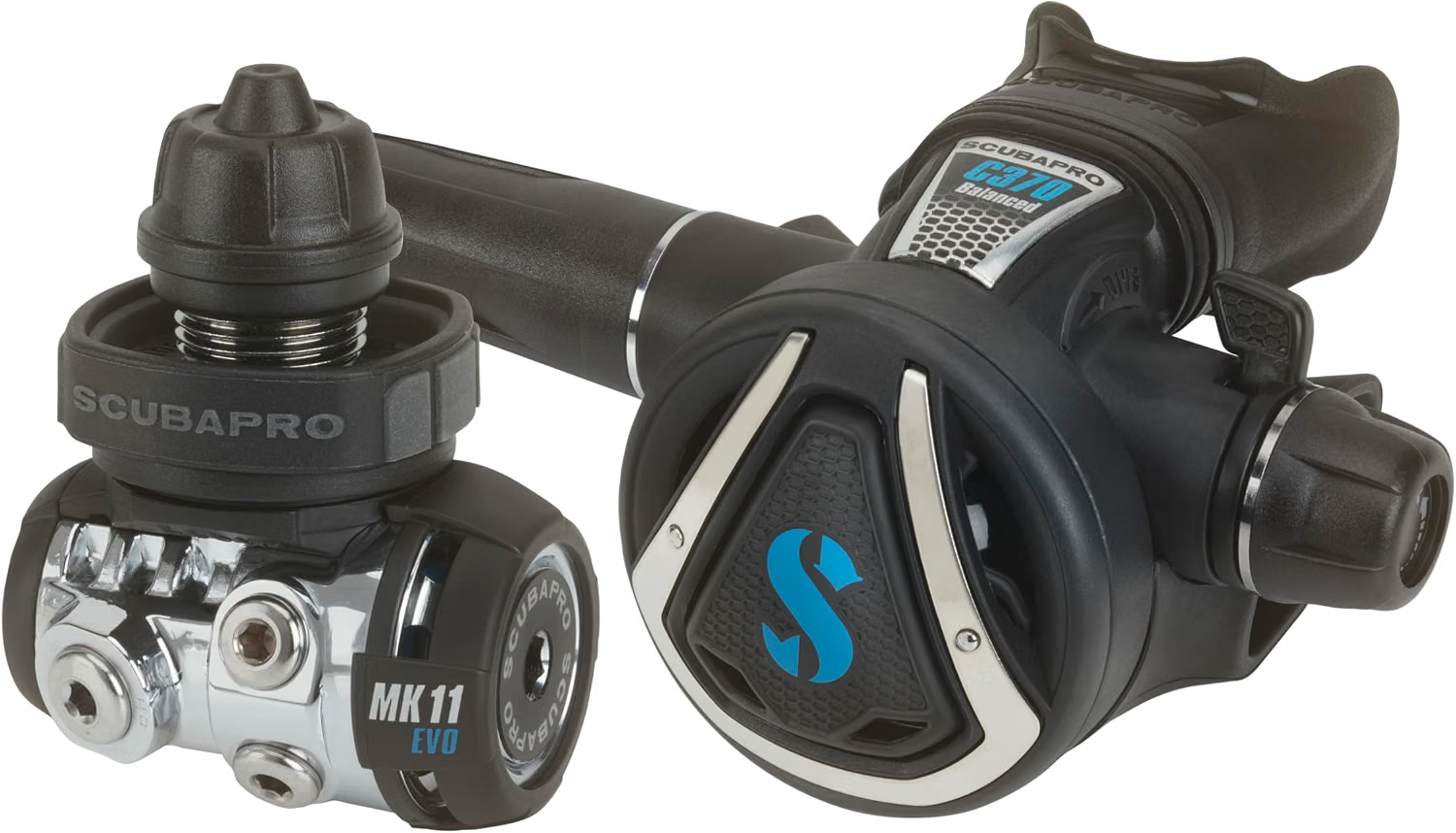
The Scubapro MK11 EVO / C370 hits a brilliant middle ground between cheap entry-level regulators and seriously expensive premium setups. It’s compact, well-built and delivers smooth, dependable breathing without loading you up with features you probably don’t need.
The MK11 EVO / C370 sits in a really useful middle ground. It gives you much of what actually matters in a good regulator — smooth breathing, a balanced first stage and solid build quality — without going overboard on expensive materials or features.
The MK11 EVO uses a balanced-diaphragm first stage, which helps maintain consistent performance as your depth and cylinder pressure change. It’s also environmentally sealed, helping isolate its internal components from the surrounding water.
Paired with it is Scubapro’s compact C370 second stage. It’s considerably smaller and lighter than some of Scubapro’s more substantial second stages, making this a particularly manageable setup if you don’t want a big lump of regulator hanging from your mouth.
You still get some useful control over its breathing characteristics, including adjustable inhalation resistance and a dive/pre-dive switch, but without turning the regulator into something unnecessarily complicated.
And that’s really where the MK11 EVO/C370 makes sense. It’s not trying to beat the MK25 EVO/S600 on outright performance or the Atomic T3 on exotic materials. Instead, it gives recreational divers a well-rounded Scubapro setup at a more approachable price.
👍 Best For
- 🤿 Divers upgrading from an entry-level regulator
- 💰 Anyone wanting Scubapro quality without flagship pricing
- 🎒 Divers who appreciate a relatively compact, lightweight setup
- ⚙️ Recreational divers wanting useful adjustments without unnecessary complexity
📌 Key Specs
- ⚙️ First Stage: Balanced-diaphragm MK11 EVO
- 🛡️ Protection: Environmentally sealed first stage
- 🪶 Second Stage: Compact, lightweight C370
- 🎛️ Controls: Adjustable inhalation resistance + dive/pre-dive switch
- 🔩 Construction: Chrome-plated brass first stage
- 🔗 Connection: Available in DIN or Yoke versions
⭐ Bottom Line
The MK11 EVO / C370 is the sensible middle ground in this guide. You get a more sophisticated regulator than the budget options without paying for the extreme materials and performance of the most expensive models.
If you’re ready to move beyond entry-level gear but don’t need a flagship regulator, the MK11 EVO / C370 makes a lot of sense.
💰 🤿 ⚙️ 8) Budget Scubapro Option: Scubapro MK2 EVO / R105
⭐ Quick Verdict
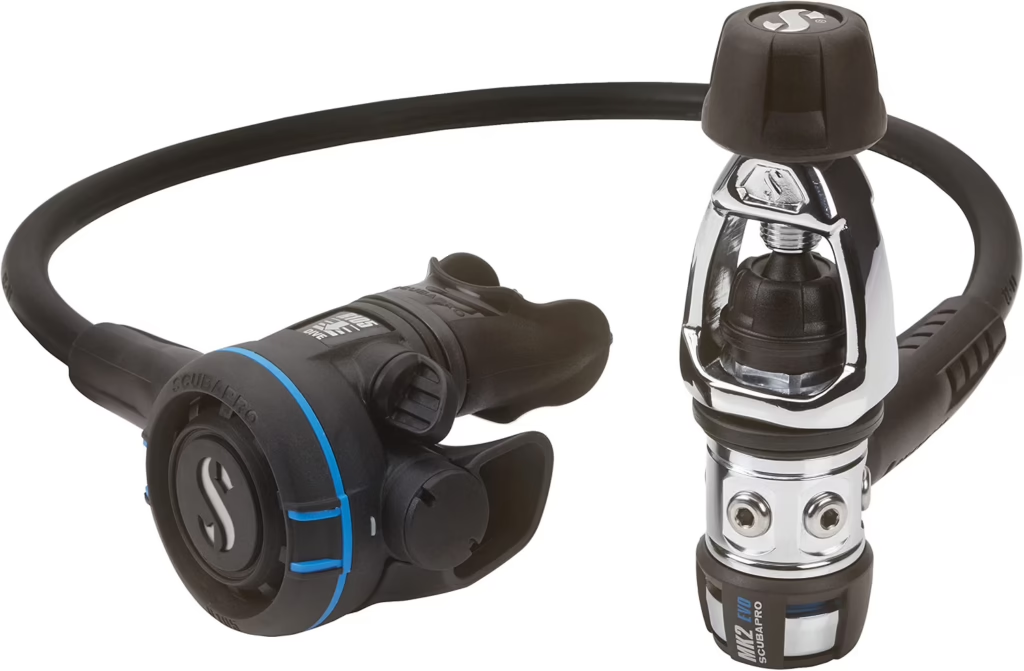
Scubapro makes some seriously good regulators — but they’re not exactly known for being cheap. The MK2 EVO / R105 is one of the more affordable ways into the Scubapro range, giving you a straightforward, well-built Scubapro setup without the price of the more sophisticated models further up the range.
It’s important to put “budget” in context here. This isn’t the cheapest regulator in this guide — we’ve already looked at considerably cheaper options. Instead, think of it as the budget Scubapro option.
The MK2 EVO is a relatively simple downstream piston first stage, rather than the balanced diaphragm design of the MK11 EVO or the high-performance balanced piston design of the MK25 EVO.
That simplicity helps keep the price down, while you’re still getting a chrome-plated brass first stage from one of the biggest names in scuba regulators.
The R105 second stage follows a similar philosophy. It’s based around a classic downstream valve design, with a metal valve housing and a dive/pre-dive switch to help prevent free-flow when you’re on the surface.
There’s even some useful flexibility built in: the hose attachment can be reversed to either side of the second stage, which gives you more options when configuring your setup.
The big thing to understand is where this sits compared with the other Scubapros in this guide. The MK11 EVO/C370 gives you a more sophisticated mid-range setup, while the MK25 EVO/S600 takes another step up in performance and adjustability.
Unlike the other regulators we’ve looked at so far, this particular setup is available in Yoke only. Yoke is the slightly simpler, more familiar connection for many recreational divers, and I’ll explain exactly how Yoke vs DIN works — and which one you should choose — in the info section further below.
The MK2 EVO/R105 is for someone looking at those prices and thinking: I like Scubapro — I just don’t need all of that.
👍 Best For
- 💰 Divers wanting a more affordable Scubapro setup
- 🤿 Recreational divers who don’t need loads of adjustments
- ⚙️ Anyone comparing the different Scubapro regulator combinations
- 👍 Divers who would rather spend less than jump straight to an MK11 or MK25 setup
📌 Key Specs
- 🔗 Connection: Available in Yoke only
- ⚙️ First Stage: Classic downstream piston MK2 EVO
- 🔩 Construction: Chrome-plated brass first stage
- 💨 Second Stage: Classic downstream R105
- 🎛️ Control: Dive/pre-dive VIVA switch
- 🔄 Hose: Reversible left or right hose attachment
⭐ Bottom Line
The MK2 EVO / R105 makes Scubapro ownership considerably more accessible. It isn’t trying to compete feature-for-feature with the MK11 or MK25 systems — and that’s exactly why it costs less.
If you’ve got your eye on Scubapro but don’t want to pay for one of its more expensive regulator combinations, this is the one I’d look at first.
🎛️ 💨 🤿 9) Unique Breathing Control: Aqualung Leg3nd MBS
⭐ Quick Verdict
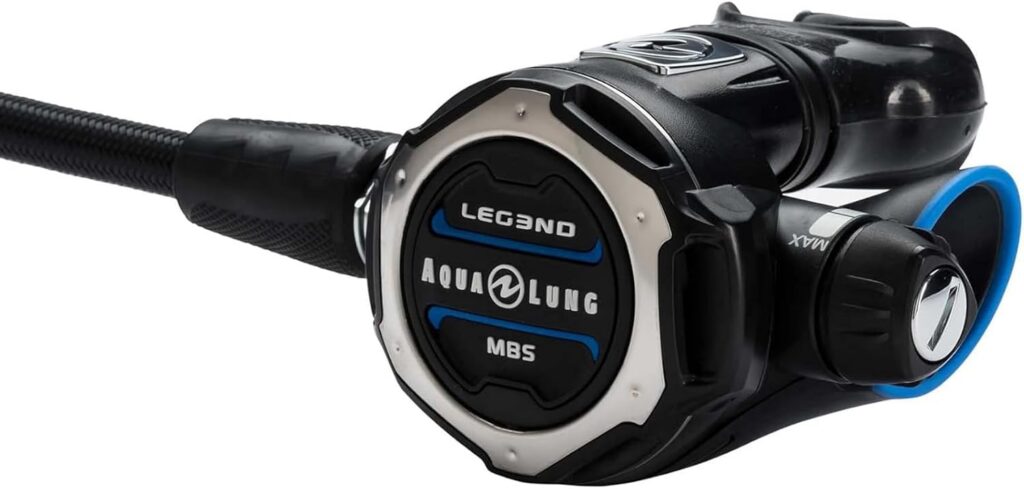
The Aqualung LEG3ND MBS has one of the more unusual breathing-control systems in this guide. Instead of giving you separate controls for inhalation resistance and the Venturi effect, its Master Breathing System links both together — letting you adjust both with a single knob.
The MBS — or Master Breathing System — is really what makes this version of the LEG3ND interesting.
On many adjustable regulators, inhalation resistance and the Venturi effect are controlled separately. That gives you plenty of control, but it also means two different adjustments to understand and fiddle with.
Aqualung takes a different approach here. Turn the single MBS control and it simultaneously adjusts both inhalation effort and the Venturi assistance, essentially simplifying two breathing controls into one.
That doesn’t necessarily mean the LEG3ND MBS breathes better than every other regulator in this guide — but it is a clever way of giving you meaningful control without covering the second stage in separate adjustment knobs.
The regulator underneath that system is pretty sophisticated too. The LEG3ND uses an overbalanced diaphragm first stage, designed to maintain strong breathing performance as depth increases, paired with a pneumatically balanced second stage.
It also features Aqualung’s Auto Closure Device (ACD), which automatically seals the first-stage inlet when the regulator is disconnected from the cylinder. This helps prevent water and debris getting inside during rinsing, storage and transport.
This is definitely towards the more expensive end of the regulators in this guide, so it’s not something I’d recommend purely because it has an interesting knob. But if you want a high-end regulator and like the idea of being able to fine-tune its breathing characteristics without separately managing multiple controls, the MBS system gives the LEG3ND a genuinely distinctive feature.
👍 Best For
- 🎛️ Divers who like adjusting how their regulator breathes
- 💨 Anyone who likes the idea of combining two breathing adjustments into one control
- 🤿 Experienced recreational divers looking for a more sophisticated setup
- 💎 Divers prepared to spend more for a high-end regulator
📌 Key Specs
- ⚙️ First Stage: Overbalanced diaphragm design
- 💨 Second Stage: Pneumatically balanced
- 🎛️ MBS Control: Simultaneously adjusts inhalation resistance and Venturi assistance
- 🔒 ACD: Automatically closes the first-stage inlet when disconnected
- 🛡️ Protection: Environmentally sealed first stage
- 🔌 Ports: 2 high-pressure + 4 medium-pressure ports
- 😬 Comfort: Comfo-Bite mouthpiece
- 🔗 Connection: Available in DIN or Yoke versions
⭐ Bottom Line
The Leg3nd MBS stands out because it approaches regulator adjustment differently. Rather than giving you separate controls to manage, Aqualung’s MBS system links inhalation resistance and Venturi assistance together through one knob.
It’s certainly not cheap, and plenty of recreational divers will be perfectly happy with a simpler regulator. But if you want a premium setup with an unusually intuitive way of controlling how it breathes, the Leg3nd MBS is one of the more interesting regulators in this guide.
❄️ 🧊 🤿 10) Best Cold Water Regulator: Scubapro MK19 EVO / G260
⭐ Quick Verdict
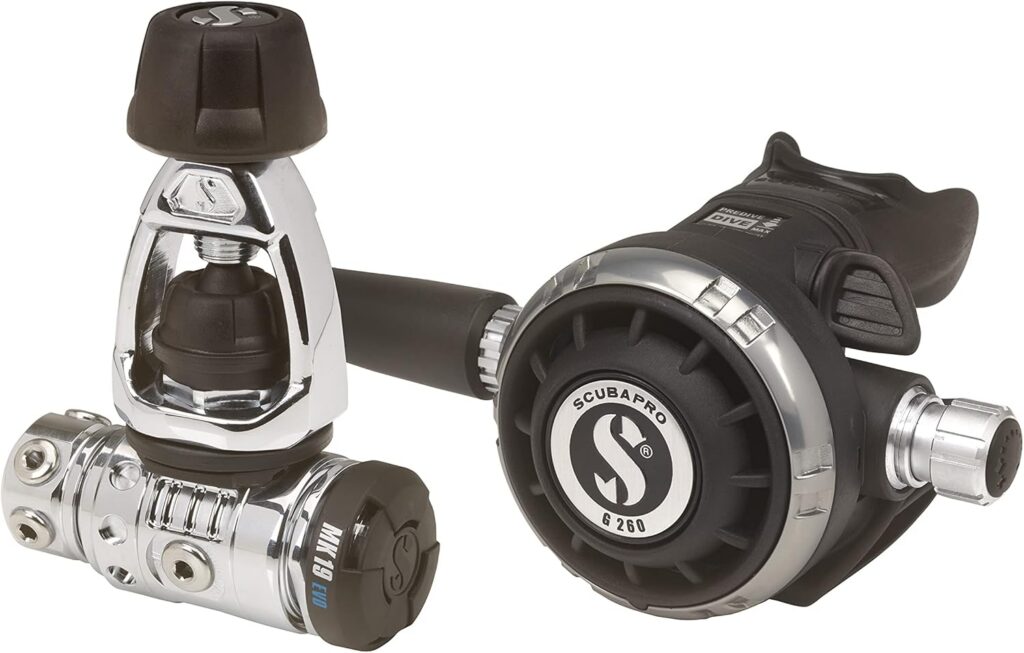
The Scubapro MK19 EVO / G260 is designed specifically for cold-water diving, where very low temperatures can cause ordinary regulators to freeze and free-flow. Its sealed MK19 EVO first stage and cold-water-focused G260 make it a strong choice for divers regularly heading into genuinely chilly conditions.
So what exactly is cold-water diving, and why would you need a different regulator for it?
In regulator standards, water below 10°C / 50°F is generally treated as cold water. As high-pressure air expands through your regulator, its temperature drops dramatically — potentially making parts of the regulator even colder than the surrounding water. In extreme cases, moisture can freeze inside and cause a free-flow, where the regulator continuously dumps air.
That’s why cold-water regulators are specifically engineered to resist freezing.
The MK19 EVO uses an environmentally sealed, air-balanced diaphragm first stage, keeping its internal mechanism isolated from the surrounding water. Scubapro’s XTIS thermal protection further improves its resistance to freezing.
It’s paired with the G260 second stage, which uses a metal valve housing to improve heat exchange and is specifically designed for strong performance in cold and demanding conditions.
And despite the similar name, don’t confuse the MK19 EVO with the MK11 EVO we reviewed earlier. The MK11/C370 is our more general mid-range Scubapro setup; this combination is much more specifically focused on cold-water diving.
👍 Best For
- ❄️ Divers regularly diving below 10°C / 50°F
- 🧊 Divers who specifically need strong freeze resistance
- 🤿 Anyone planning substantial cold-water diving rather than mainly tropical trips
📌 Key Specs
- 🔗 Connection: Available in Yoke
- ⚙️ First Stage: Air-balanced diaphragm MK19 EVO
- 🛡️ Protection: Environmentally sealed dry chamber
- 🧊 Cold Water: XTIS thermal protection
- 💨 Second Stage: Air-balanced G260
- 🔩 G260: Metal valve housing for improved heat exchange
- 🎛️ Controls: Adjustable inhalation resistance + dive/pre-dive Venturi
- 🔄 Hose Routing: Swivelling first-stage turret
⭐ Bottom Line
If most of your diving is in warm tropical water, you don’t need to specifically seek out a regulator like this. But once you’re regularly diving in genuinely cold water, freeze resistance becomes an important safety consideration — and that’s exactly what the MK19 EVO / G260 is engineered around.
🤿 🤓 📚 📊 Scuba Regulator Buying Guide & Info

Buying a scuba regulator can get confusing fast. DIN or Yoke? Balanced or unbalanced? First stage, second stage, octopus, SPG — and why do some regulator names seem to contain two completely different models?
Don’t worry. Below I’ll explain what all of this actually means, what you really need to buy for a complete regulator setup, and which features are worth paying attention to.
⚡ Jump to What You Need
⚙️ 🤿 What the Hell are the First & Second Stages of a Scuba Regulator anyway?
A scuba regulator isn’t just the part you put in your mouth. At its simplest, it has two main components: a first stage and a second stage (which are connected to eachother via the hose!).
Scuba Tank → First Stage → Hose → Second Stage → You
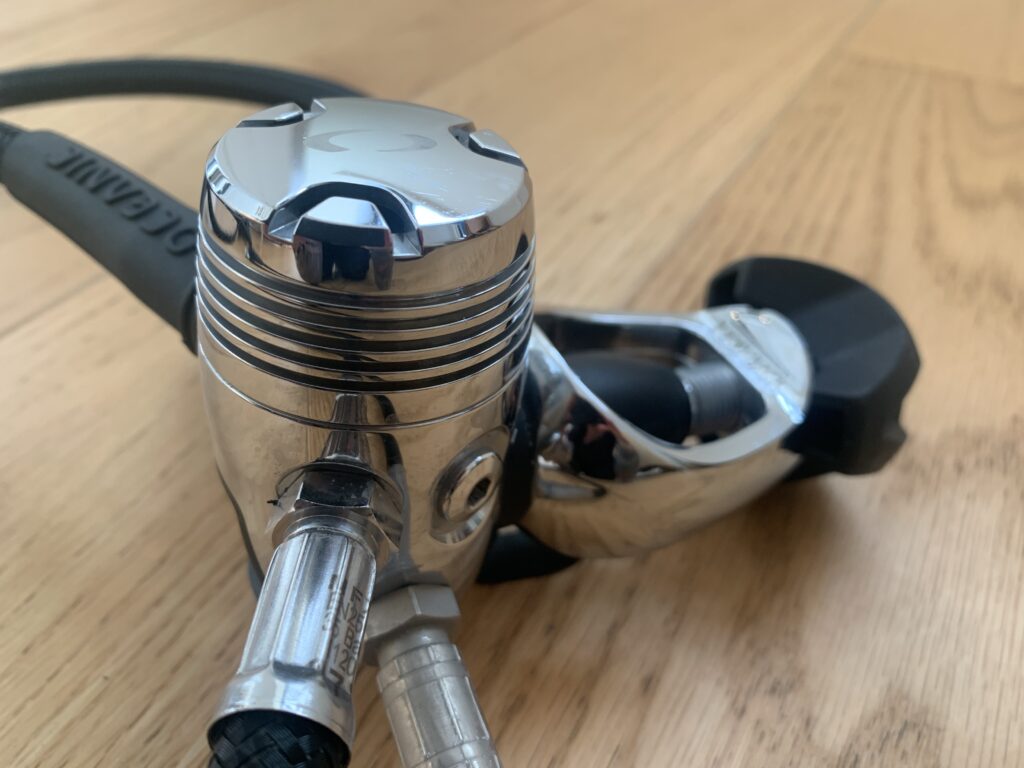
⚙️ First Stage:
The first stage is the metal part of your regulator that attaches directly to your scuba tank.
Air inside the cylinder is stored at extremely high pressure. The first stage reduces this to a much lower intermediate pressure before sending it through the regulator hose.
This is also where DIN and Yoke come in — they’re two different ways the first stage can connect to the tank (we’ll cover these in the next section).
🤿😮💨 Second Stage:
The second stage is the part that goes in your mouth.
It takes the air supplied by the first stage, reduces it again to the surrounding pressure and delivers air whenever you inhale.
This is where you’ll find things like purge buttons, Venturi switches and breathing-resistance controls.
🤔 Why Do Some Regulators Have Two Model Names?
You’ll often see regulators with names like Scubapro MK25 EVO / S600 because you’re actually buying two named components: the MK25 EVO first stage + S600 second stage.
Manufacturers often offer the same first stage paired with several different second stages. Generally, you’ll see more significant variation between first stages, while compatible second stages tend to be more similar to one another.
The first stage determines things like the main pressure-reduction design, environmental sealing and hose routing, while different second stages can still change breathing adjustment, comfort, weight and breathing feel.
For example:
- MK25 EVO / S600 = MK25 EVO first stage + S600 second stage
- MK11 EVO / C370 = MK11 EVO first stage + C370 second stage
So when those names look confusing, just read them as First Stage / Second Stage.
📎 ⚔️ 🤿 DIN vs Yoke Regulators: What’s the Difference?
DIN and Yoke are the two main ways your regulator’s first stage connects to a scuba tank. You’ll often find exactly the same regulator available in either version.
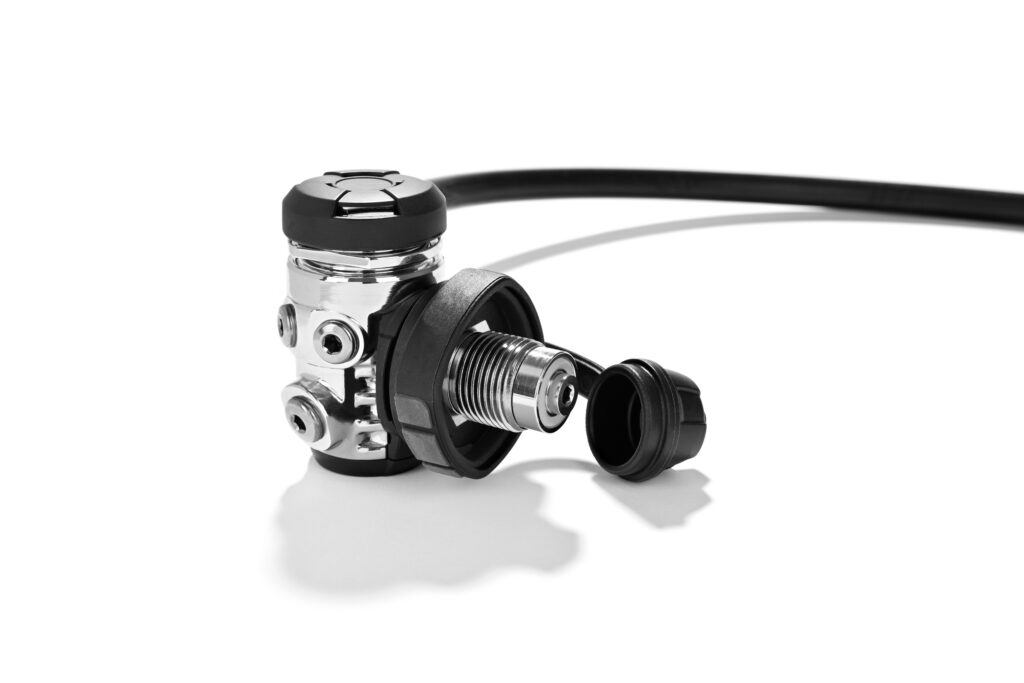
DIN First Stage
A DIN regulator screws directly into the tank valve. Its O-ring is built into the regulator connection and sits protected inside the valve when attached. This creates a compact and extremely secure connection.
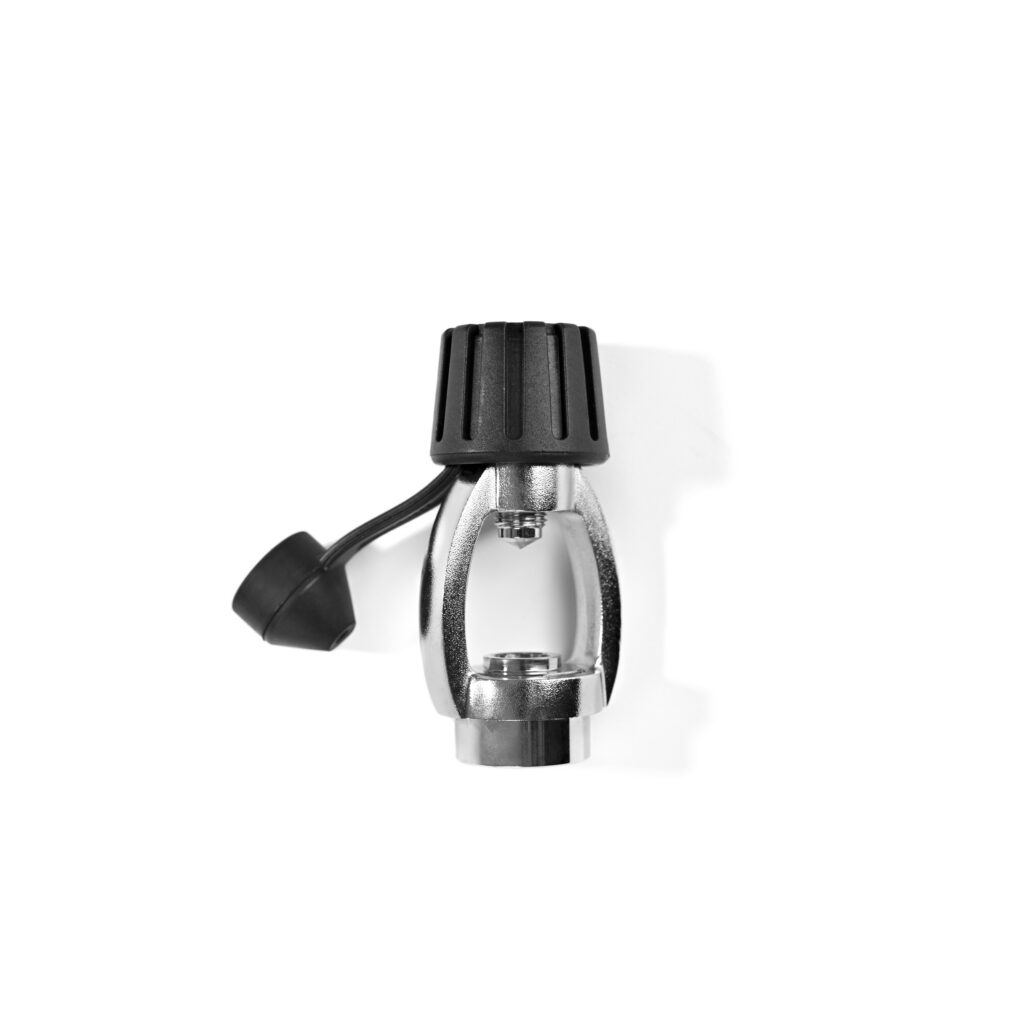
YOKE First Stage
A Yoke regulator (also called A-clamp) fits over the tank valve and is tightened into place using the large screw at the back. With Yoke, the O-ring sits in the face of the tank valve instead.
Both DIN and Yolk ultimately do exactly the same job — connecting your first stage securely to the tank — but the two designs have some practical differences. So before deciding which is right for you, here are the main pros and cons of DIN vs Yoke:
🔩 DIN: Pros & Cons
In practice, DIN is the more compact and secure of the two systems. There’s less hardware sticking out behind your head and the O-ring is better protected. These advantages become particularly useful for technical diving, overhead environments and higher-pressure cylinders.
👍 DIN Pros:
- 🔒 Very secure connection — screws directly into the tank valve.
- 🛡️ Protected O-ring — enclosed inside the connection.
- 📏 Smaller and more streamlined behind your head.
- 🪨 Less likely to bump or snag on wrecks, caves or other overhead environments.
- 💪 Available for higher-pressure cylinder systems.
- 🤿 Generally preferred for technical diving and by many experienced divers.
👎 DIN Cons:
- 🔄 Takes slightly longer to screw on and remove.
- 🌴 May be slightly less common than Yoke at some recreational dive centres.
- 🔧 You may occasionally need an adapter when using rental tanks.
🔧 Yoke: Pros & Cons
Yoke’s main strengths are simplicity and convenience. It takes seconds to clamp onto a tank and remains extremely familiar throughout recreational diving. It’s probably still slightly more common at recreational dive centres, although this varies considerably around the world.
👍 Yoke Pros:
- ⚡ Very quick and easy to attach and remove.
- 🌍 Probably slightly more common at recreational dive centres.
- 🏝️ Extremely familiar across recreational and rental diving.
- 🤿 Straightforward for new divers to use.
👎 Yoke Cons:
- 📦 Bulkier connection sticking out behind your head.
- ⚠️ The O-ring is more exposed because it sits in the tank valve.
- 🪨 Slightly more likely to bump or snag in tight or overhead environments.
- 💪 Less suitable for the higher-pressure systems used in some technical diving.
🔄 BUT Don’t Get Too Hung Up on Compatibility
Here’s the good news: DIN vs Yoke isn’t as restrictive as it initially sounds.
Many modern scuba tanks have convertible valves. An insert can be screwed into the valve for use with a Yoke regulator; remove that insert and the same tank valve can accept a DIN regulator.
There are also DIN-to-Yoke adapters, allowing a DIN regulator to be used with a Yoke tank valve. Dive centres regularly deal with both systems, so this usually isn’t a major problem when travelling.
🤔 So Which Should You Choose?
For normal recreational diving, either is absolutely fine.
Yoke is slightly simpler and may still be a little more common at recreational dive centres, while DIN is smaller, more secure and generally preferred as diving becomes more advanced or technical.
Choose whichever best suits where and how you normally dive — DIN vs Yoke is nowhere near as important a decision as choosing the regulator itself.
🐙 🤿 ⚙️ What Do You Need for a Complete Scuba Regulator Setup?
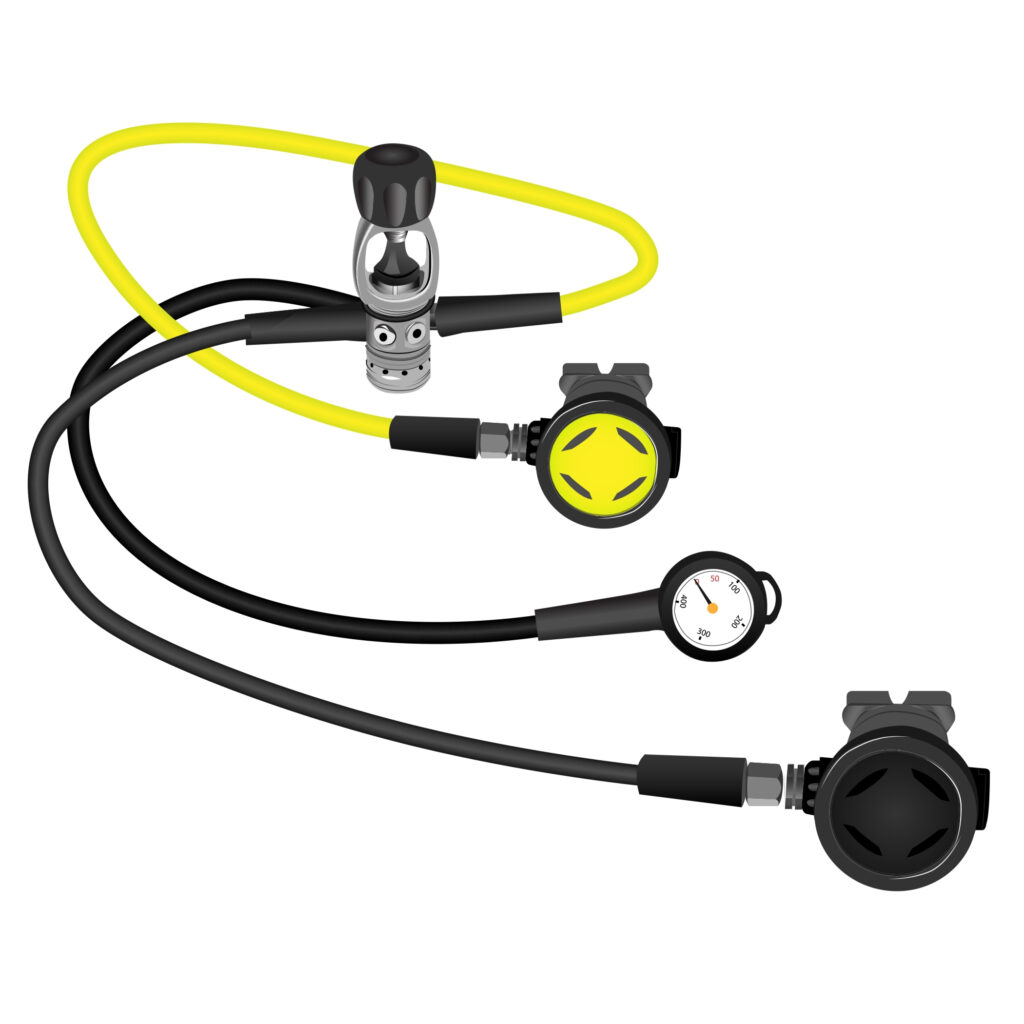
Here’s something that’s surprisingly easy to miss when buying your first regulator: a first stage and primary second stage aren’t normally your entire setup.
A complete recreational regulator configuration — sometimes sold or described as a scuba octopus setup or regulator set — will typically include:
- ⚙️ First Stage — attaches directly to your scuba tank and reduces the extremely high cylinder pressure. This is the part that comes in either DIN or Yoke, as explained above.
- 🫁 Primary Second Stage — the regulator that goes in your mouth and delivers air whenever you inhale.
- 🟡 Alternate Second Stage — a second regulator used primarily for sharing air with another diver in an emergency. It’s usually bright yellow and attached to a longer hose so it’s easy to identify and deploy.
- 📏 SPG (Submersible Pressure Gauge) — shows the pressure remaining in your scuba tank, letting you keep track of your air throughout the dive. Tank pressure is commonly displayed in bar, although some SPGs — particularly in the US — use PSI instead. Some display both.
- 🎈 BCD Inflator Hose — a low-pressure hose running from your first stage to your BCD. This supplies the air used to inflate your BCD underwater.
Together, these parts form the complete scuba regulator setup you’ll actually take diving.
When shopping online, pay attention to exactly what’s included. Many regulator listings include only the first stage and primary second stage, while others are sold as complete setups with the alternate second stage, SPG and sometimes BCD inflator hose included.
🛒 ⚠️ Important When Buying a Regulator Online
One thing that can be confusing when buying a regulator online is that many regulator packages only include the first stage and primary second stage.
That means you may still need to buy:
- 🟡 An alternate second stage — your backup regulator for sharing air with another diver in an emergency. 👉 Check out some recommended alternate second stages here.
- 🧭 An SPG (pressure gauge) — shows how much air remains in your tank. Depending on where you dive, pressure may be displayed in bar or PSI, and some gauges display both. 👉 Check out some recommended SPGs here.
Your BCD will normally come with its own low-pressure inflator hose, which connects to an LP port on the regulator’s first stage.
So when comparing regulator prices, always check exactly what’s included. A regulator that looks considerably cheaper may simply contain fewer components.
⚖️ 🫁 🤿 What Does Balanced vs Unbalanced Mean?
You’ll often see scuba regulators described as balanced or unbalanced. In simple terms, this describes how well the regulator compensates for changes in tank pressure and surrounding water pressure as you dive.
⚖️ Balanced Regulators
A balanced regulator is designed so that its breathing performance remains much more consistent as your tank pressure drops and conditions change. This means the regulator can continue delivering air with very little change in breathing effort throughout the dive.
👍 Pros:
- 🫁 More consistent breathing as tank pressure changes.
- 🌊 Better suited to demanding diving conditions.
- 💨 Excellent airflow and breathing performance.
- 🏆 Very common among modern mid-range and premium regulators.
👎 Cons:
- 💰 Generally more expensive.
- ⚙️ More complicated internal design.
🔧 Unbalanced Regulators
An unbalanced regulator uses a simpler mechanism that doesn’t compensate for pressure changes in the same way. As the tank empties, breathing resistance can increase, meaning you may notice slightly more effort required to breathe towards the end of the tank.
👍 Pros:
- 💰 Usually cheaper.
- 🔧 Simple, proven design.
- 🤿 Still perfectly capable for normal recreational diving.
👎 Cons:
- 🫁 Breathing effort can increase as tank pressure falls.
- 🌊 Less consistent performance under demanding conditions.
🤔 Which Should You Choose?
These days, balanced regulators are extremely common, particularly once you move beyond the cheapest entry-level models. In fact, most of the regulators recommended in this guide use balanced designs, including many of our mid-range and premium picks.
An unbalanced regulator can still be a perfectly good choice for normal recreational diving, particularly if you want something simple and inexpensive. The Scubapro MK2 EVO/R105 is a good example of this.
But if your budget allows, I’d generally choose a balanced regulator for its more consistent breathing performance as tank pressure and diving conditions change.
⚙️ 🆚 🤿 Piston vs Diaphragm Scuba Regulators
Another term you’ll see when comparing regulators is piston vs diaphragm. This refers to the internal mechanism the first stage uses to control airflow and reduce the tank’s high pressure.
Both designs can make excellent regulators, and both can be balanced or unbalanced. So this is separate from the balanced vs unbalanced question we just covered.
⚙️ Piston Regulators
Piston first stages use a moving piston inside the regulator to control airflow. They’re known for having relatively simple internal designs and, in high-performance balanced versions, can deliver extremely high airflow.
👍 Pros:
- 🔧 Relatively simple internal design.
- 💨 Excellent potential airflow and breathing performance.
- 🏆 Used in some extremely high-performance regulators.
- 🤿 Proven design that’s been around for decades.
👎 Cons:
- 💧 Parts of the mechanism can be exposed to the surrounding water.
- 🧊 This can make environmental protection more important for very cold or contaminated water.
The Scubapro MK25 EVO and Atomic T3 are examples of high-performance balanced piston regulators.
🛡️ Diaphragm Regulators
Diaphragm first stages use a flexible diaphragm to transmit changes in water pressure to the internal mechanism. The main internal components can therefore be isolated from the surrounding water.
👍 Pros:
- 🛡️ Internal mechanism can be better isolated from water, salt and contaminants.
- 🧊 Particularly well suited to environmentally sealed and cold-water designs.
- 🌊 Excellent performance across recreational and technical diving.
- 🏆 Very common among modern premium regulators.
👎 Cons:
- ⚙️ Generally a somewhat more complex internal design.
- 💨 Theoretical airflow differences exist between designs, but they’re unlikely to matter to an ordinary recreational diver.
The Scubapro MK11 EVO, MK19 EVO and Aqualung Leg3nd from our recommendations are examples of diaphragm first stages.
🤔 Which Should You Choose?
🤔 Which Should You Choose?
Don’t choose a regulator purely because it’s piston or diaphragm. Both can provide excellent breathing performance.
If you’re regularly diving in very cold or dirty/silty water, a sealed diaphragm design can be particularly attractive. For ordinary recreational diving, however, the overall quality and features of the regulator matter far more than simply whether there’s a piston or diaphragm inside it.
🎛️ 💨 🤿 Venturi & Inhalation Controls: What Do They Do?
Some second stages have controls that let you adjust how the regulator breathes. The two you’ll encounter most often are Venturi controls and inhalation-resistance controls.
💨 Venturi Control
A Venturi switch usually has settings such as Dive / Pre-Dive or +/−.
Once you’re breathing from the regulator, the Dive/+ position uses airflow inside the second stage to help maintain the flow of air, making breathing feel easier.
The Pre-Dive/− setting reduces this effect, helping prevent the regulator from free-flowing when it’s out of your mouth — for example, while entering the water.
In simple terms: Pre-Dive before you start breathing from it → Dive while you’re actually diving.
🎚️ Inhalation-Resistance Control
Some regulators also have an adjustment knob that changes how much effort it takes to initially trigger airflow when you inhale.
Turn it one way and the regulator becomes easier to breathe from; turn it the other and more inhalation effort is required before air begins flowing.
You don’t need either control for normal recreational diving, but they give you more control over how your regulator behaves and feels.
🫁 🌊 🤿 What Makes One Scuba Regulator Breathe Better Than Another?

You’ve probably noticed that expensive regulators often promise smoother or easier breathing. But what does that actually mean?
A good regulator should deliver air quickly and consistently without making you feel like you have to suck hard to get each breath. This becomes more challenging as depth increases and the surrounding pressure rises.
Several things affect how a regulator breathes:
- ⚖️ Balanced design — helps maintain consistent breathing performance as tank pressure and conditions change.
- 💨 Airflow performance — higher-performance first stages can deliver large amounts of air efficiently when demand increases.
- 🎛️ Venturi & inhalation controls — let you fine-tune how easily the second stage begins and continues delivering air.
- 🌊 Depth & conditions — regulators have to work harder as surrounding pressure increases, making good performance particularly valuable on deeper or more demanding dives.
- 😮💨 Second-stage design — valve design, exhaust system and breathing adjustments can all affect how natural and comfortable each breath feels.
For normal recreational diving, you don’t need the world’s most expensive regulator to breathe comfortably. Modern regulators from reputable manufacturers generally perform very well within their intended limits.
Where premium regulators tend to distinguish themselves is in how effortlessly and consistently they breathe across a wider range of depths, tank pressures and demanding conditions.
✈️ 🪶 🤿 Regulator Weight, Size & Travel
You’ll often see regulators advertised as “travel regulators,” but this isn’t a specific type of regulator or a special piece of technology.
It simply means the regulator has characteristics that make it convenient for travelling — typically a smaller first stage, lightweight second stage, flexible hoses and lower overall weight.
In other words, there’s no feature that suddenly makes one regulator a “travel regulator.” It’s mostly about being compact, light and easy to pack.
If you travel frequently for scuba diving, these things are worth considering — especially when every kilogram of checked luggage counts.
👍 Advantages of a lightweight regulator:
- ✈️ Less weight in your luggage.
- 🪶 Less weight hanging from your mouth while diving.
- 🎒 Smaller and easier to pack.
- 🌴 Particularly convenient for frequent dive trips.
There can be trade-offs. Larger or heavier regulators may use more metal components, which can offer advantages such as durability and heat transfer. So lightweight doesn’t automatically mean better.
🤔 How Important Is Weight?
For frequent travellers, it’s useful — but I wouldn’t prioritise it over breathing performance, reliability or the features you actually need.
If two regulators otherwise suit you equally, though, I’d happily take the lighter one on a flight.
The Oceanic Alpha 10 reviewed above is a good example of what manufacturers and divers mean when they talk about a travel-friendly regulator.
❄️ 🧊 🤿 What Makes a Regulator Good for Cold Water?

In regulator standards, water below 10°C / 50°F is generally considered cold water. That’s important because regulators can become much colder than the surrounding water as high-pressure air expands through them.
If parts of the regulator become cold enough, moisture can freeze and potentially cause a free-flow, where air continuously rushes from the second stage.
Cold-water regulators combat this using features such as:
- 🛡️ Environmental sealing — isolates important first-stage components from the surrounding water.
- 🔥 Heat-exchange features — help transfer heat into the regulator and reduce ice formation.
- ❄️ Freeze-resistant components and designs — engineered and tested specifically for low-temperature use.
- 💨 Good airflow performance — important because high airflow can increase cooling inside the regulator.
🤔 Do You Need a Cold Water Regulator?
If you mainly dive somewhere like Thailand, the Philippines or the Caribbean, it’s not something I’d worry much about.
But if you’re regularly diving below 10°C / 50°F — particularly somewhere like the UK — cold-water suitability becomes an important consideration.
Look specifically for a regulator rated by its manufacturer for cold-water use, rather than simply assuming an expensive regulator will be suitable.
The Scubapro MK19 EVO / G260 is a good example of a setup specifically designed with demanding cold-water diving in mind.
🔧 🧼 🤿 Scuba Regulator Servicing & Maintenance
A good scuba regulator can last for many years if it’s properly maintained — but remember, this is life-support equipment, so regular inspection and servicing matters. After diving:
- 🚿 Rinse thoroughly with fresh water, particularly after saltwater dives.
- 🛡️ Make sure the first-stage dust cap is securely fitted before rinsing.
- 💧 Avoid allowing water to enter the first stage.
- 🔘 Don’t press the second-stage purge button while rinsing an unpressurised regulator, as this can allow water inside.
- 🌬️ Allow it to dry naturally before storing somewhere cool and dry.
- 👀 Regularly inspect hoses, mouthpieces and connections for cracking, damage or excessive wear.
🔧 How Often Should You Service a Scuba Regulator?
You’ll sometimes hear “once a year” given as a blanket rule, but modern manufacturer recommendations actually vary considerably.
Depending on the regulator, a full service might be specified after a certain number of dives or roughly every 1–2 years, while some models allow even longer intervals. Heavy professional or frequent use may require more regular inspection and servicing.
For example, Scubapro currently specifies 24 months or 100 dives for its regulators, while Atomic specifies 2 years or 300 dives for many of its models.
So the best rule is simple: follow the service schedule specified by the manufacturer for your exact regulator, and get it checked sooner if it starts leaking, free-flowing, breathing unusually or showing signs of damage.
And unless you’re properly trained, internal regulator servicing is a job for an authorised/qualified regulator technician.
💰 🤔 🤿 How Much Should You Spend on a Scuba Regulator?
You don’t need to buy the most expensive regulator to get something safe, reliable and enjoyable to dive with. As you spend more, you’re generally paying for things like:
- ⚖️ Balanced designs for more consistent breathing performance.
- ❄️ Cold-water and environmental protection for more demanding conditions.
- 🎛️ Breathing adjustments such as Venturi and inhalation-resistance controls.
- 🪶 Lighter or more premium materials — particularly on high-end and travel-focused regulators.
- 💨 Higher airflow and breathing performance under demanding conditions.
- 🔧 More sophisticated first-stage designs, hose routing and additional ports.
For straightforward warm-water recreational diving, you can get an excellent regulator without spending anywhere near premium prices.
Move into cold water, deeper or more demanding diving, very frequent diving or technical diving, and spending more for additional performance and features starts to make considerably more sense.
At the extreme end, regulators such as the Atomic T3 use expensive materials like titanium and command a huge premium. They’re fantastic pieces of equipment, but most recreational divers absolutely don’t need to spend that much.
💡 Don’t Forget the Rest of the Setup
When comparing prices, remember what we covered earlier: a first stage and primary second stage may not be your complete regulator setup.
If the package doesn’t include them, you’ll still need an alternate second stage and SPG, so factor those into your overall budget too.
My advice: decide where and how you’re actually going to dive, then pay for the features you’ll genuinely use — rather than simply assuming the most expensive regulator must be the best choice for you.
🏆 🤿 Which Scuba Regulator Should You Buy?
There’s no single regulator that’s perfect for every diver — the right choice depends on where you dive, how often you dive and how much you want to spend.
For most recreational divers, I’d focus on a regulator that’s comfortable to breathe from, made by a reputable manufacturer and appropriate for the conditions you’ll actually encounter.
If you travel constantly, weight and size become more important. If you’re regularly diving in cold water, freeze resistance matters. If you’re on a tight budget, there are perfectly capable simpler regulators. And if you want exceptional materials, adjustment and performance, there’s no shortage of premium options either.
That’s exactly why I’ve split my recommendations above into different categories rather than pretending there’s one regulator everyone should buy.
Still not sure? Head back to the Quick Picks at the top of this guide and choose the option that best matches the kind of diving you actually do.
🤿 🌊 Final Thoughts
I’ve used a lot of regulators over the years — teaching students, guiding dives, filming underwater and diving purely for fun — and honestly, you don’t need to make choosing one more complicated than it needs to be.
A good regulator should breathe comfortably, suit the conditions you dive in and be something you can rely on dive after dive.
You don’t need the most expensive model either. Pick the regulator that makes sense for your diving and your budget, look after it properly, and it should accompany you on adventures for years to come.
See you underwater! 🤿
Support the Squad!
We are part of the Amazon Services LLC Associate Program. If you make a purchase on amazon after clicking a link on Diving Squad, we earn a small commission fee, at no extra cost to yourself.
We are also part of several other affiliate programs so if you click on a Diving Squad affiliate link that results in you booking a liveaboard, booking accommodation, purchasing insurance or buying a product somewhere else, once more we make a small commission, without it costing you a cent extra. Thanks!